
 Creative Commons License

Tablet Recording a Business Letter
(Ancient Near East )
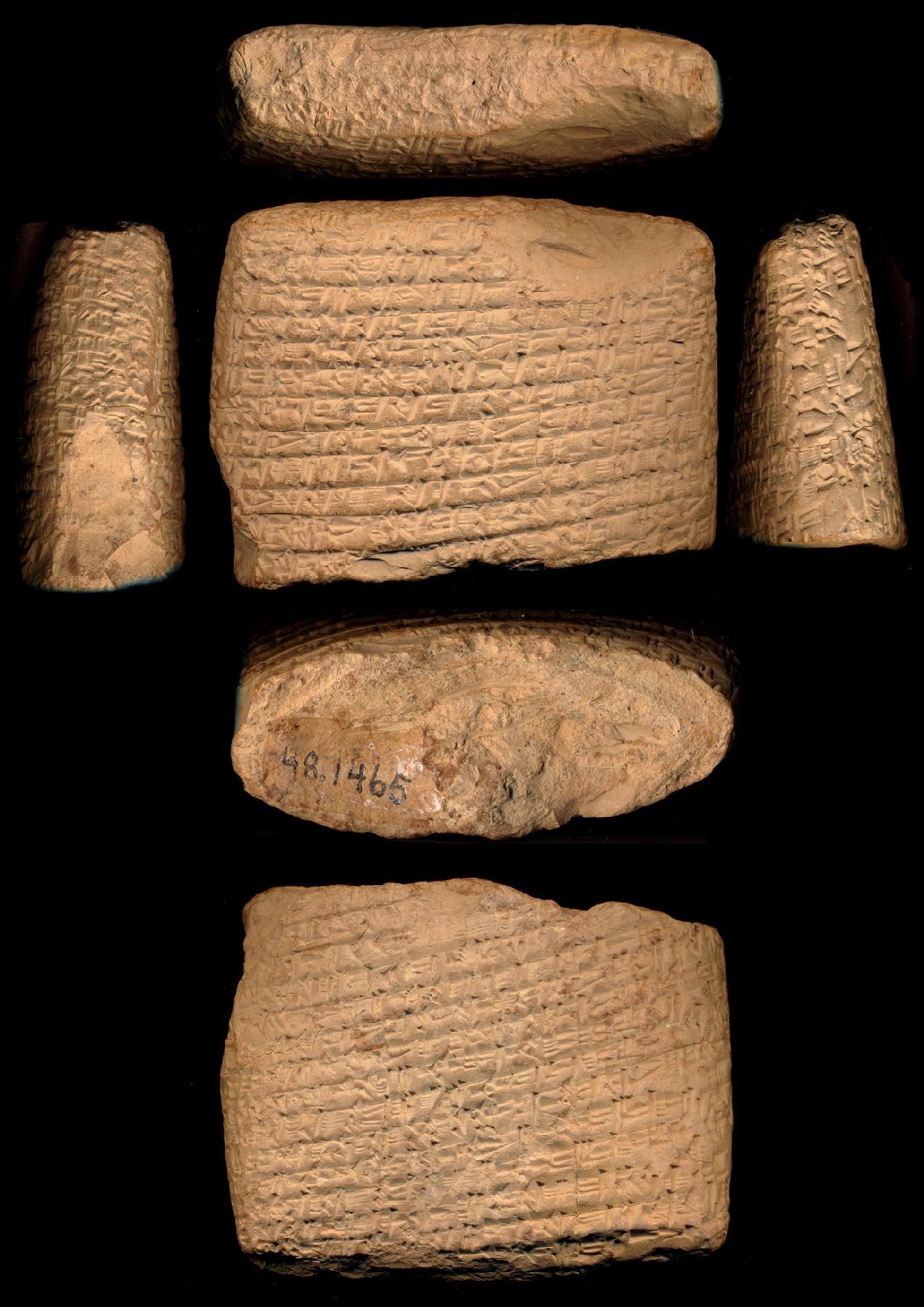
This thick rectangular clay tablet is broken at the bottom and damaged on its face, but is otherwise covered in cuneiform text. This complex text is a letter from Buzutaja in Kanesh to Puzur-šadue, Aššur-[...and], Pušuken in Assyria regarding the imprisonment of another man whom Buzutaja quotes in the letter. The author stresses that it was the decision of the plenary assembly of the colony to imprison the individual for cheating the colony in a sale of precious metals.
Around 20,000 clay tablets dating to the 2nd millennium BCE have been discovered at Kültepe (ancient Kanesh), Turkey, which was near Kayseri (ancient Caesarea) where this tablet is said to have been found. During this period, Kanesh had a large commercial quarter and was part of a network of Assyrian trade colonies. Many tablets found at Kanesh are letters recording business transactions between Kanesh and Assyria in northern Mesopotamia. They were enclosed in clay envelopes and impressed with stamp or cylinder seals. These letters provide a glimpse into everyday life in the ancient Near East during the beginning of the 2nd millennium BCE, illustrating complex economic and social interactions between Assyria and its colonies.
Inscription
Provenance
Provenance (from the French provenir, 'to come from/forth') is the chronology of the ownership, custody, or location of a historical object. Learn more about provenance at the Walters.
Dikran Kelekian, Paris and New York [date and mode of acquisition unknown] [said to be from Caesarea]; Henry Walters, Baltimore, 1913, by purchase; Walters Art Museum, 1931, by bequest.
Geographies
Turkey, Kayseri, Kültepe (Kanesh)
(Place of Origin)
Turkey, Kültepe (Place of Discovery)
Measurements
H: 1 15/16 × W: 2 5/8 × D: 1 1/16 in. (4.9 × 6.7 × 2.7 cm)
Credit Line
Acquired by Henry Walters, 1913
Location in Museum
Not on view
Accession Number
In libraries, galleries, museums, and archives, an accession number is a unique identifier assigned to each object in the collection.
In libraries, galleries, museums, and archives, an accession number is a unique identifier assigned to each object in the collection.
48.1465