
 Creative Commons License

Vase with Tiger and Dragon
(China )
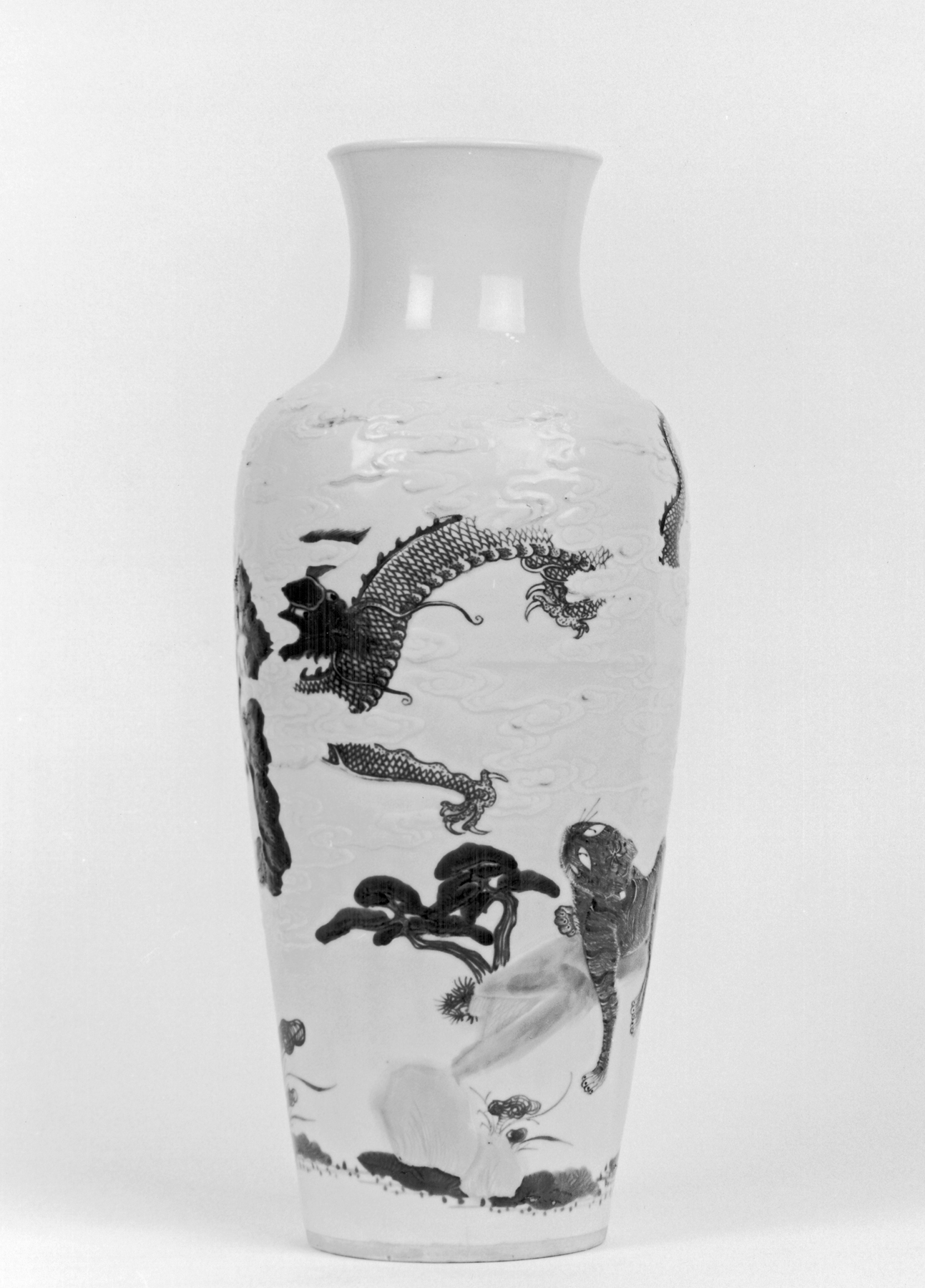
Confrontations between tigers and dragons appear on a variety of blue and white porcelain types to represent complimentary opposites. This tall baluster vase is carved and painted with a dragon flying overhead in the scrolling clouds looking back at a tiger on the ground. The tiger and dragon act as Taoist symbols for Yin and Yang, the tiger ruler of the arid land and the dragon lord of the skies, seas, and bringer of rain. On the opposite side, a powerful pine tree painted in brown is rooted to a celadon painted rock with maroon fungi. Blades of grass jut out, painted in blue. A low relief carving forms the clouds that hide the flying four clawed dragon.
Inscription
Provenance
Provenance (from the French provenir, 'to come from/forth') is the chronology of the ownership, custody, or location of a historical object. Learn more about provenance at the Walters.
William T. Walters, Baltimore [date and mode of acquisition unknown]; inherited by Henry Walters, Baltimore, 1894; by bequest to Walters Art Museum, 1931.
Geographies
China (Place of Origin)
Measurements
H: 16 11/16 in. (42.4 cm)
Credit Line
Acquired by William T. Walters
Location in Museum
Not on view
Accession Number
In libraries, galleries, museums, and archives, an accession number is a unique identifier assigned to each object in the collection.
In libraries, galleries, museums, and archives, an accession number is a unique identifier assigned to each object in the collection.
49.1649