
 Creative Commons License

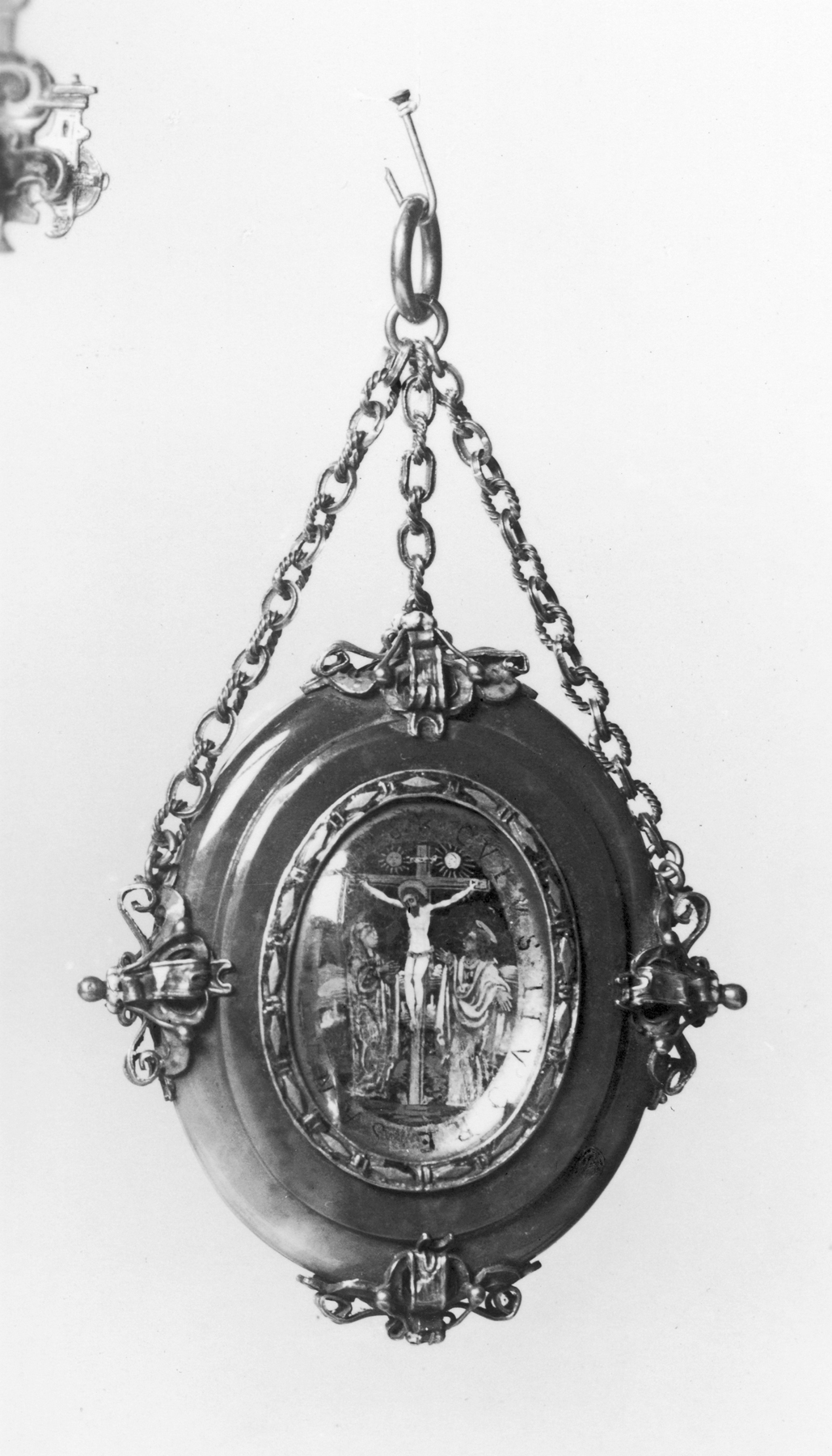
Locket with Scenes of the Crucifixion and the Virgin with the Christ Child
(Renaissance Europe )
On one side of this double-sided locket is the Crucifixion, with Christ on the cross flanked by the Virgin Mary and Saint John the Evangelist. The image is encircled by a Latin inscription from the book of Isaiah (53:8): “By whose wounds we are healed.” This prophetic message was interpreted as referring to Christ’s death on the cross as the event that precipitated the possibility of human salvation. The other side of the locket depicts the Virgin and Child, alluding to the role of Mary—as a symbol of the Christian Church—in human redemption.
The first step of the amalierung technique used to decorate this pendant involved the application of a layer of gold leaf onto the rock crystal. Next, the negative space of the composition would be scratched away with a stylus to create the golden details of the cross and the figures’ haloes. Then, the artist would paint the image with translucent, colored resins. This technique required the reversal of a painter’s usual practice, as highlights in the foreground needed to be added before figures and the background, requiring the artist to keep the finished image in their mind while applying each layer. Finally, a sheet of reflective silver foil was added to the back of the composition. Light is refracted through the rock crystal, passes through the translucent resins, and reflects off the backing, giving the image a luminous quality.
Inscription
Provenance
Provenance (from the French provenir, 'to come from/forth') is the chronology of the ownership, custody, or location of a historical object. Learn more about provenance at the Walters.
Henry Walters, Baltimore [date and mode of acquisition unknown]; Walters Art Museum, 1931, by bequest.
Exhibitions
| 1979-1980 | Jewelry - Ancient to Modern. The Walters Art Gallery, Baltimore. |
Conservation
| Date | Description | Narrative |
|---|---|---|
| 3/22/1961 | Treatment | cleaned |
| 1/27/1988 | Treatment | cleaned; examined for condition |
| 5/9/1991 | Examination | examined for condition |
Geographies
Italy, Lombardy (?)
(Place of Origin)
((not assigned))
Measurements
H: 3 1/4 × W: 2 × D: 9/16 in. (8.3 × 5.1 × 1.4 cm)
Credit Line
Acquired by Henry Walters
Location in Museum
Accession Number
In libraries, galleries, museums, and archives, an accession number is a unique identifier assigned to each object in the collection.
In libraries, galleries, museums, and archives, an accession number is a unique identifier assigned to each object in the collection.
46.13