
 Creative Commons License
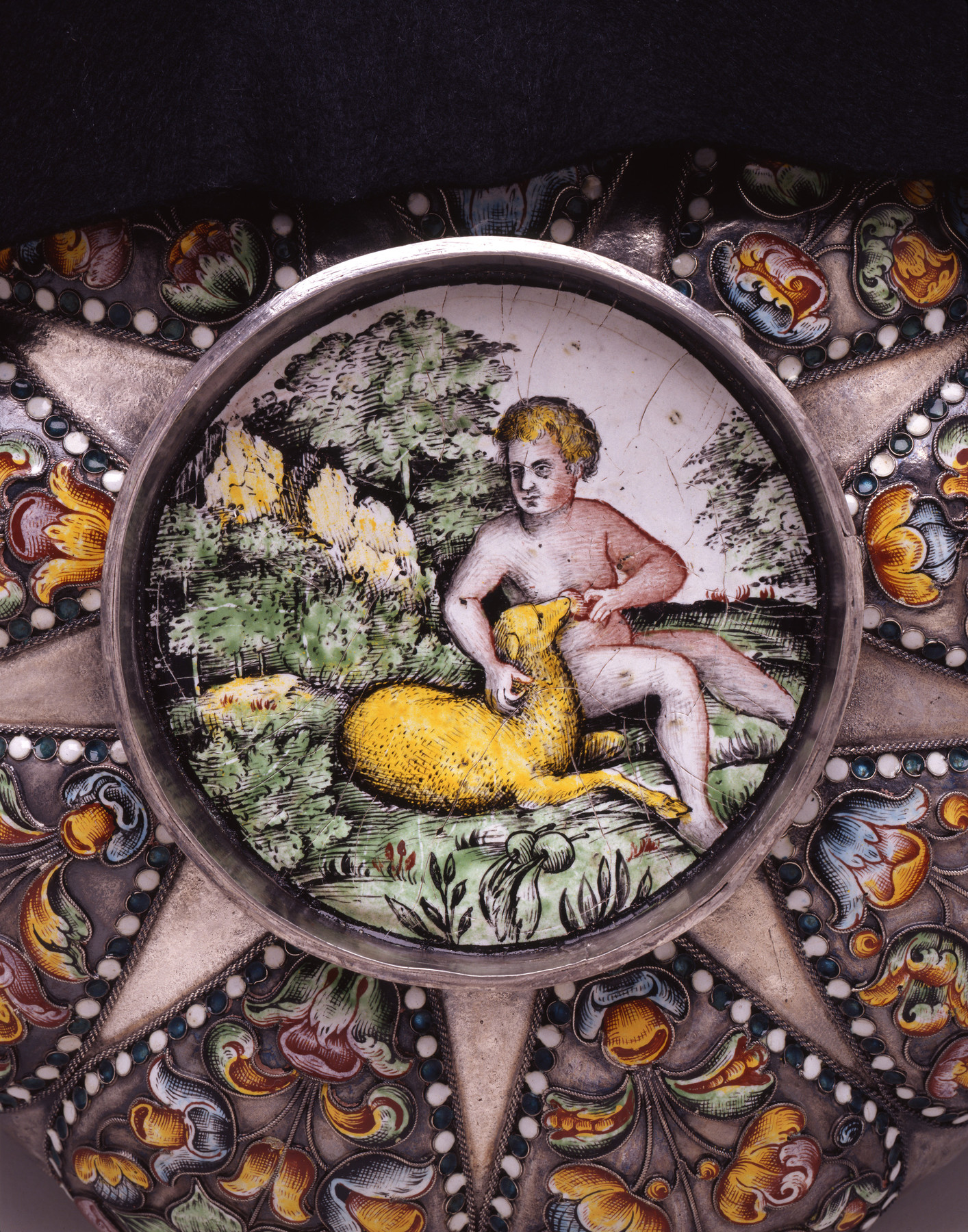


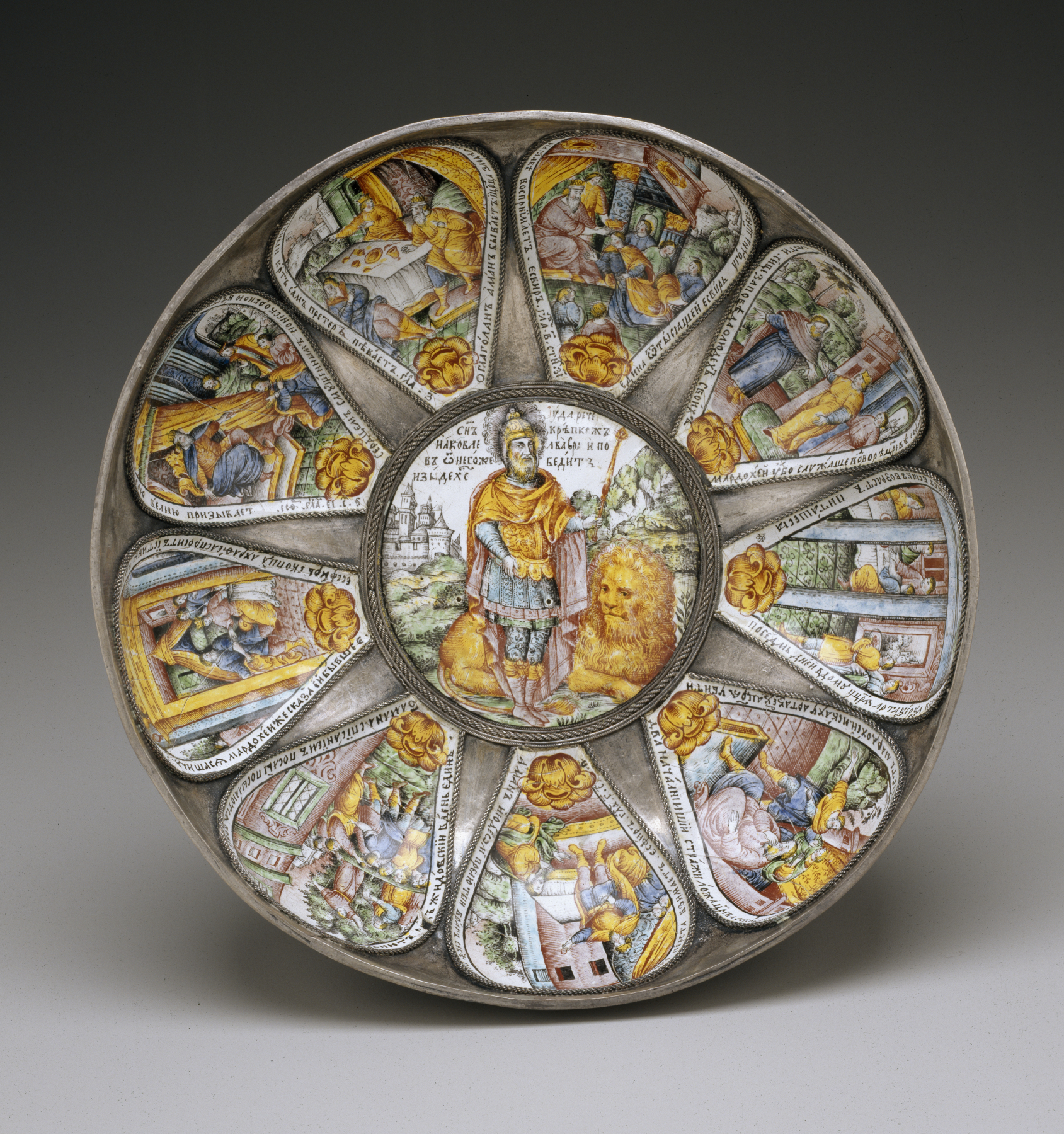
Bowl with Judah and Lion Surrounded by Scenes from the Book of Esther
(Baroque Europe )
The source for the scenes on this bowl and on a similar one in the Moscow Kremlin Armory (inv. MP-1079) is the illustrated Bible of Nicholaus Johannes Piscator (1586-1652), a Dutch publisher and engraver. This Bible was translated into Russian in the 1670s and became a source for images on objects and church frescoes. The paintings, like the inscriptions, are freely adapted: there are more scenes on the bowl than are illustrated in the Piscator Bible, and sometimes a single scene has been painted in two parts to accommodate the lobes of the bowl. The image in the central medallion seems to allude to the young Russian Czar Peter I (r. 1682-1725), while the surrounding scenes from the Book of Esther may refer to his mother, the Czarina Natalia Kirillovna Naryshkina. Formerly attributed to a Solvychegodsk workshop, the bowl is more likely to have been made in Moscow.
Inscription
Provenance
Provenance (from the French provenir, 'to come from/forth') is the chronology of the ownership, custody, or location of a historical object. Learn more about provenance at the Walters.
Alexandre Polovtsoff (Aleksandr Aleksandrovich Polovtsov), Saint Petersburg and Paris, by purchase; Henry Walters, Baltimore [date of acquisition unknown], by purchase; Walters Art Museum, 1931, by bequest.
Exhibitions
| 1996-1997 | Russian Enamels. The Walters Art Gallery, Baltimore. |
| 1988-1989 | A Millennium of Christianity: Russian Art from The Walters Art Gallery. The Walters Art Gallery, Baltimore. |
| 1965 | Works of Faith. |
| 1964 | Festival of the Bible in the Arts. |
| 1963 | The Hebrew Bible in Christian, Jewish & Muslim Art. The Jewish Museum, New York. |
| 1959-1960 | Russian Art: Icons and Decorative Arts from the Origin to the Twentieth Century. The Walters Art Gallery, Baltimore. |
Conservation
| Date | Description | Narrative |
|---|---|---|
| 10/15/1959 | Treatment | cleaned |
| 12/5/1988 | Treatment | cleaned |
Geographies
Russia, Moscow (Place of Origin)
Measurements
Diam: 10 1/8 in. (25.72 cm)
Credit Line
Acquired by Henry Walters
Location in Museum
Not on view
Accession Number
In libraries, galleries, museums, and archives, an accession number is a unique identifier assigned to each object in the collection.
In libraries, galleries, museums, and archives, an accession number is a unique identifier assigned to each object in the collection.
44.46