
 Creative Commons License
 Creative Commons License
 Creative Commons License
 Creative Commons License


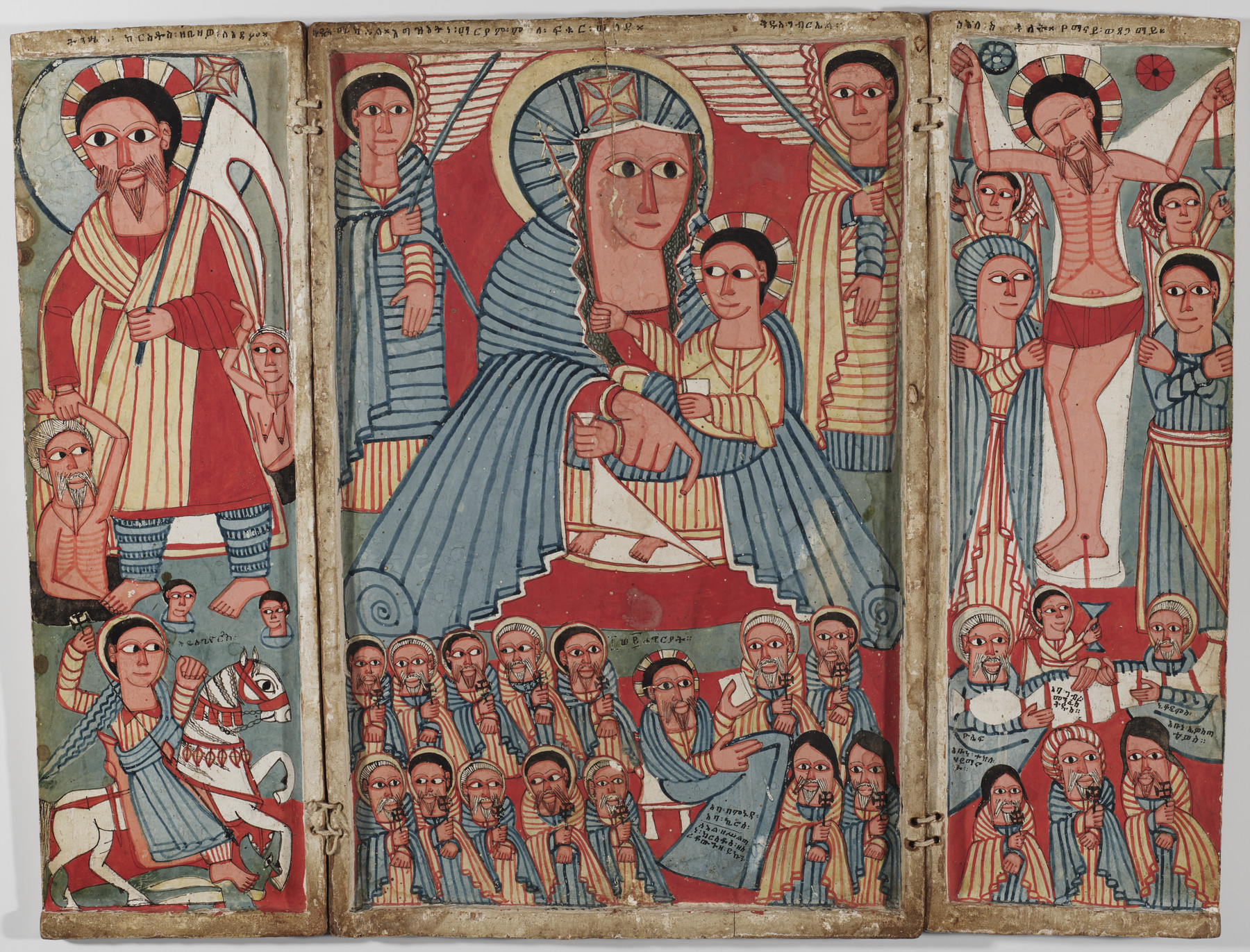
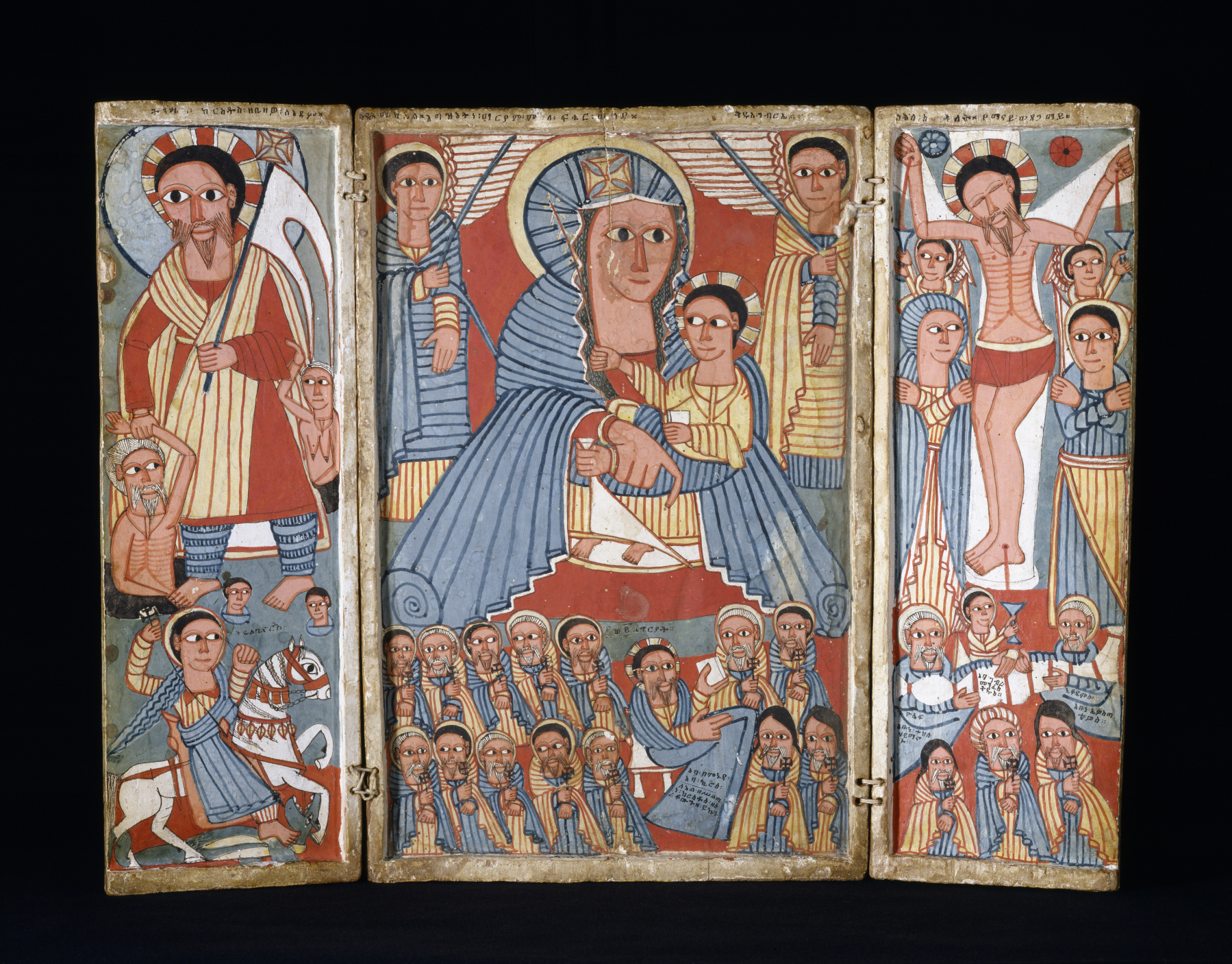
The Virgin and Child with Archangels, Scenes from the Life of Christ, and Saints
(Ethiopia)
The central panel of this triptych features a version of Mary and the infant Christ based on a famous icon from the Roman basilica of Santa Maria Maggiore that was believed to have been painted by St. Luke the Evangelist. Prints of this painting entered Ethiopia around the year 1600 with Jesuit missionaries. The widespread circulation of these prints led to the adoption of the Santa Maria Maggiore icon as a prototype for pictures of Mary and Christ and transformed Ethiopia's traditional Marian imagery. In paintings based on this icon, the Christ Child typically sits on the Virgin's left arm while holding a book in his left hand. Mary, crossing her arms in front of Christ, holds a cloth in her left hand and extends the elongated fingers of her right hand toward the ground. As with the original Roman painting, the hood of Mary's cloak often bears a cross. This triptych is a fine example of the work of a group of Ethiopian painters that apparently specialized in producing icons based on the Roman prototype. Yet in their panels, as can be seen here, the western model assumes a new form, with Mary's cloak stretching out in either direction to embrace the scene of Christ Teaching the Apostles below. Umbrella-like, Mary appears as both the protector and personification of the church. The paintings of this school typically combine large figures across the top of all three panels with smaller figures below. These painters also made extensive use of blue grounds and added fine linear details in black ink.
Provenance
Provenance (from the French provenir, 'to come from/forth') is the chronology of the ownership, custody, or location of a historical object.
Knopfelmacher Collection, New York [date and mode of acquisition unknown] [Knopfelmacher 12]; William Wright Gallery, New York [date and mode of acquisition unknown]; Walters Art Museum, 1996, by purchase.
Exhibitions
| 2011-2012 | Lost and Found: The Secrets of Archimedes. The Walters Art Museum, Baltimore. |
| 2006-2007 | Angels of Light: Ethiopian Art from the Walters Art Museum. Birmingham Museum of Art, Birmingham; Smith College Museum of Art, Northampton; Museum of Biblical Art, New York. |
| 2002-2005 | Realms of Faith: Medieval and Byzantine Art from the Walters Art Museum. Frist Center for the Visual Arts, Nashville. |
| 2001-2002 | Realms of Faith: Medieval and Byzantine Art from the Walters Art Museum. Frist Center for the Visual Arts, Nashville. |
| 1996 | Ethiopian Art at The Walters. The Walters Art Gallery, Baltimore. |
Geographies
Ethiopia, Tigray Kifle Håger (Place of Origin)
Measurements
H: 16 3/4 x W: 22 5/16 in. (42.54 x 56.66 cm); Center panel H: 16 5/8 x W: 11 1/4 in. (42.23 x 28.6 cm); Left panel H: 16 5/8 x W: 5 7/16 in. (42.2 x 13.8 cm); Right panel H: 16 3/4 x W: 5 5/8 in. (42.5 x 14.3 cm)
Credit Line
Museum purchase with funds provided by the W. Alton Jones Foundation Acquisition Fund, 1996
Location in Museum
Not on view
Accession Number
In libraries, galleries, museums, and archives, an accession number is a unique identifier assigned to each object in the collection.
In libraries, galleries, museums, and archives, an accession number is a unique identifier assigned to each object in the collection.
36.4