
 Creative Commons License
 Creative Commons License
 Creative Commons License
 Creative Commons License


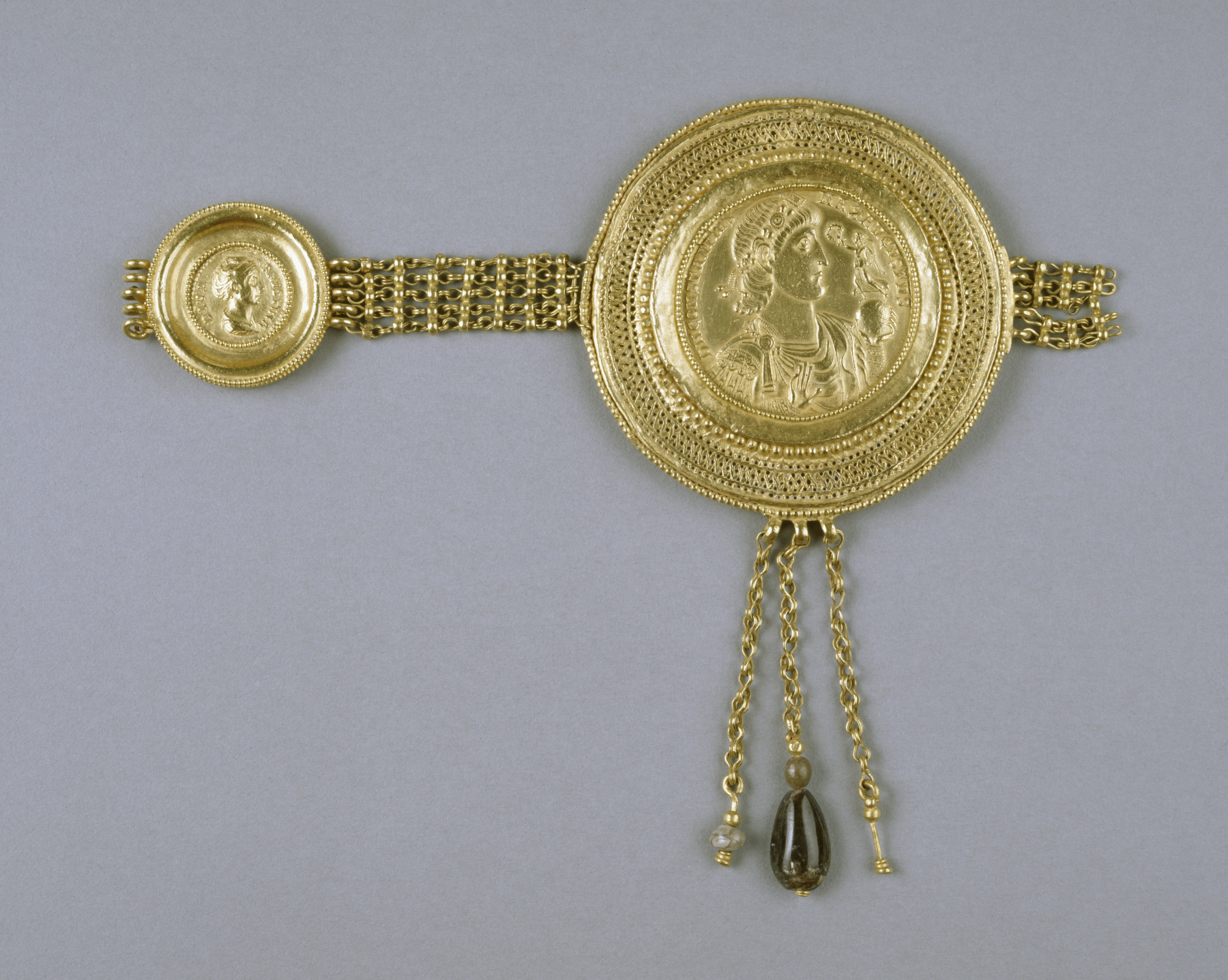
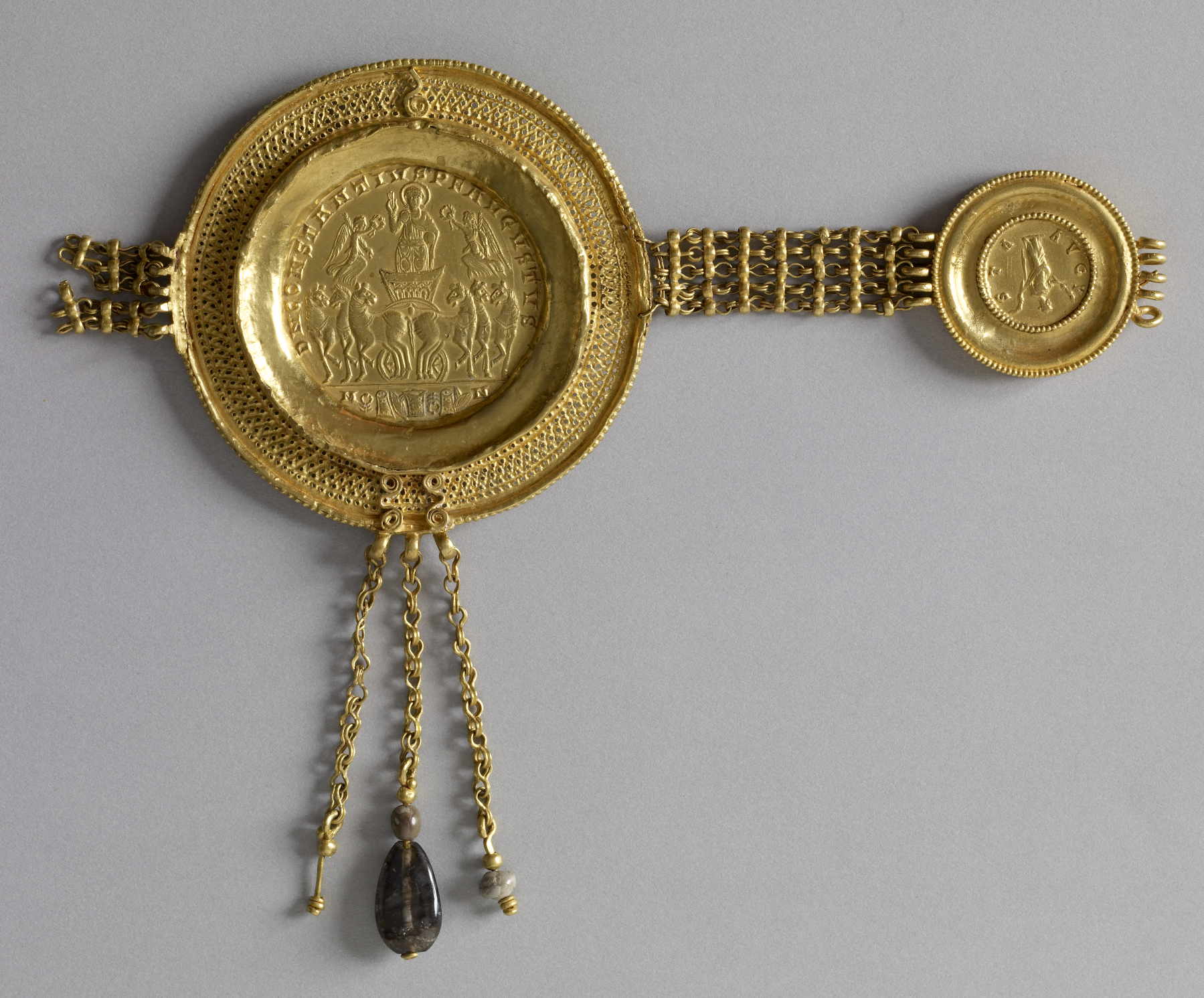
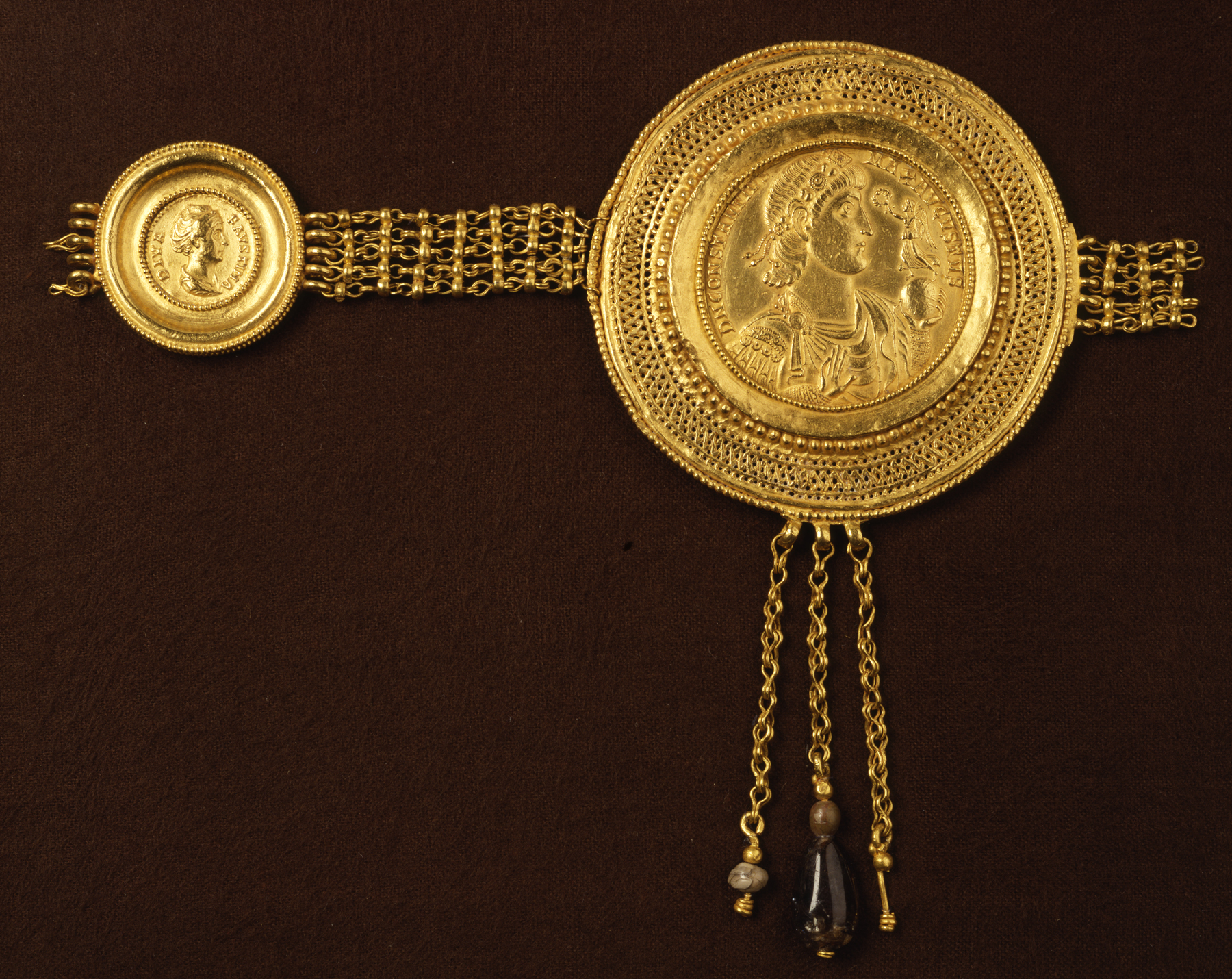
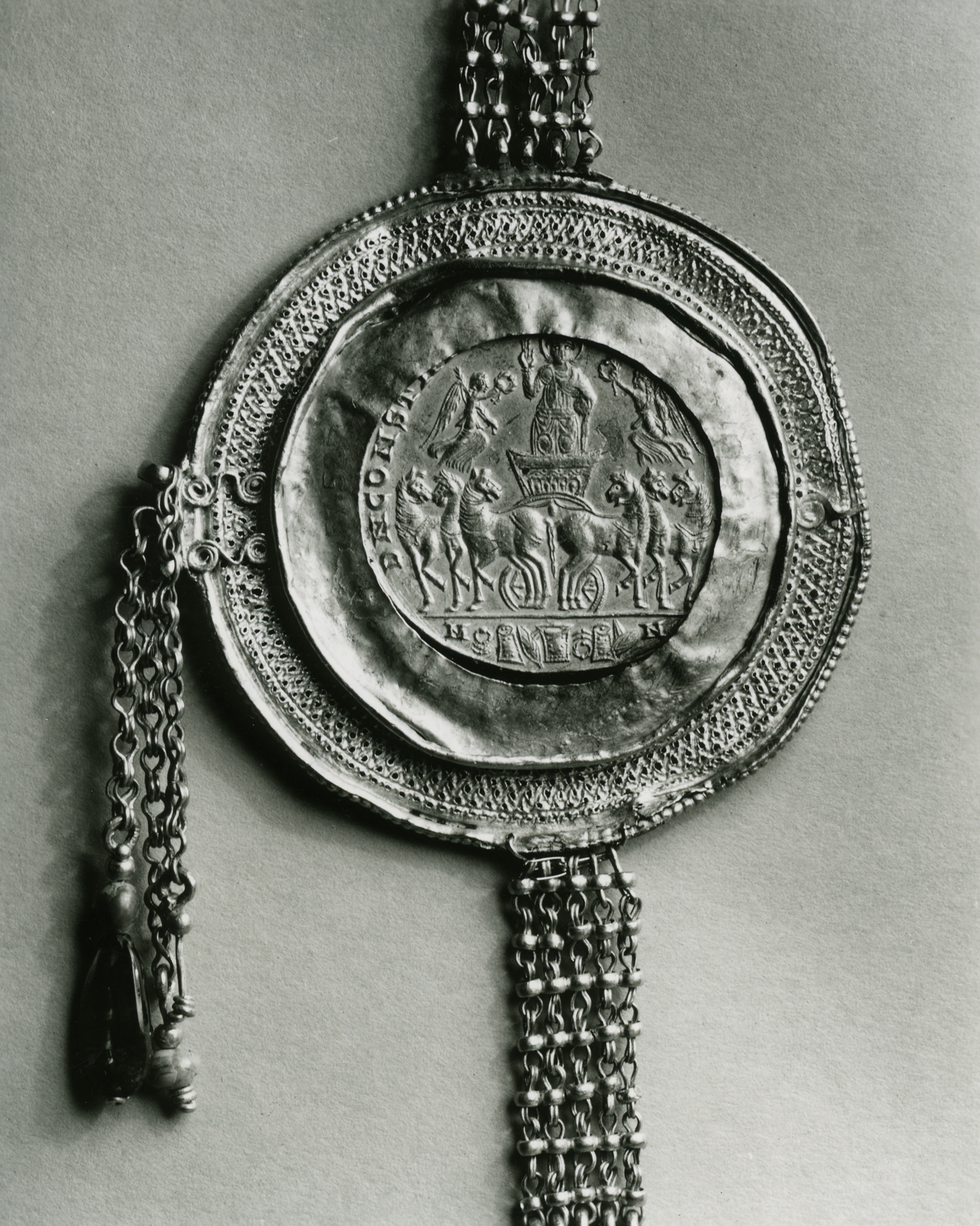
Belt Section with Medallions of Constantius II and Faustina
Imperial medallions, such as this one of Constantius II (reigned 350-361), were often mounted by their recipients to boast of their highly favored status in society. This stunning example, minted in Nicomedia (Asia Minor), represents on the reverse the triumphant emperor in his chariot. Smaller coins were also mounted as jewelry, like the smaller aureus honoring Faustina the Elder (died 140/141), wife of Antoninus Pius. Other mounted coins, separated by lengths of chain, would have completed this section of either a belt or a necklace.
Inscription
Provenance
Provenance (from the French provenir, 'to come from/forth') is the chronology of the ownership, custody, or location of a historical object. Learn more about provenance at the Walters.
Henry Walters, Baltimore [date of acquisition unknown], by purchase; Walters Art Museum, 1931, by bequest.
Exhibitions
| 2019-2021 | Excursions through the Collection: Portraiture, Adornment, and the Natural World. |
| 2016 | Waste Not: The Art of Medieval Recycling. |
| 2010 | Bedazzled: 5,000 Years of Jewelry. El Paso Museum of Art, El Paso. |
| 2006-2009 | Bedazzled: 5,000 Years of Jewelry from the Walters Art Museum. Frist Center for the Visual Arts, Nashville; The John and Mable Ringling Museum of Art, Sarasota; The Walters Art Museum, Baltimore. |
| 1993-1994 | Coins and Costume in Late Antiquity. Dumbarton Oaks, Washington. |
| 1983-1984 | Late Antiquity and Early Christianity. Staedtische Galerie Liebieghaus, Frankfurt am Main. |
| 1979-1980 | Jewelry - Ancient to Modern. The Walters Art Gallery, Baltimore. |
| 1947 | Early Christian and Byzantine Art. Baltimore Museum of Art, Baltimore. |
Conservation
| Date | Description | Narrative |
|---|---|---|
| 6/22/1979 | Examination | examined for condition |
| 9/19/1979 | Examination | examined for condition |
| 10/28/1983 | Treatment | cleaned; examined for loan |
| 4/11/1984 | Treatment | cleaned |
Geographies
Turkey (Nicomedia) (Place of Origin)
Measurements
Overall H: 6 x W: 7 5/8 in. (15.2 x 19.4 cm); Constantine Medallion Diam: 3 3/16 x D: 5/16 in. (8.1 x 0.8 cm); Faustina Medallion H: 1 3/8 x D: 1/4 in. (3.5 x 0.7 cm)
Credit Line
Acquired by Henry Walters, 1931
Location in Museum
Accession Number
In libraries, galleries, museums, and archives, an accession number is a unique identifier assigned to each object in the collection.
In libraries, galleries, museums, and archives, an accession number is a unique identifier assigned to each object in the collection.
57.527