
 Creative Commons License
 Creative Commons License


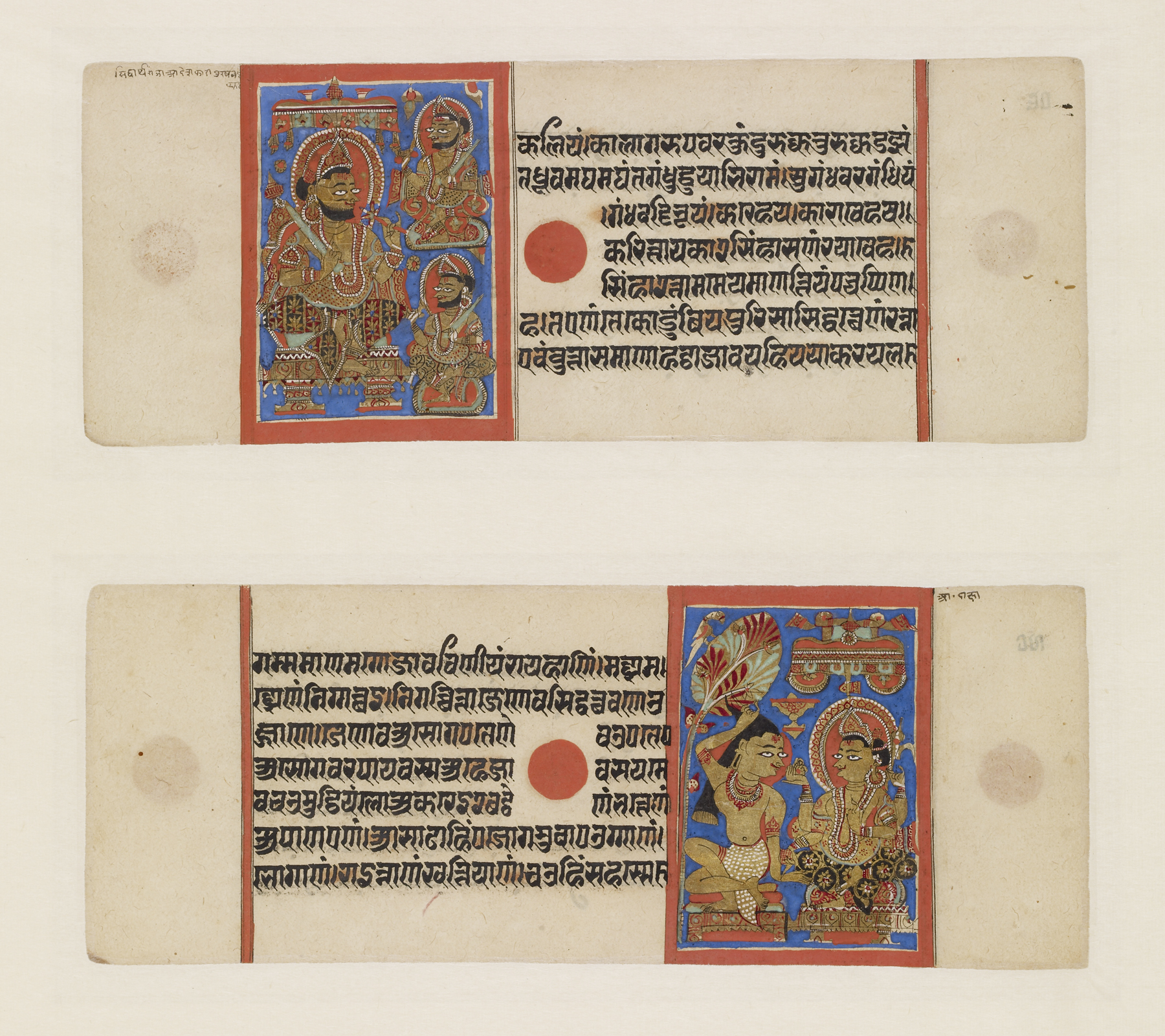
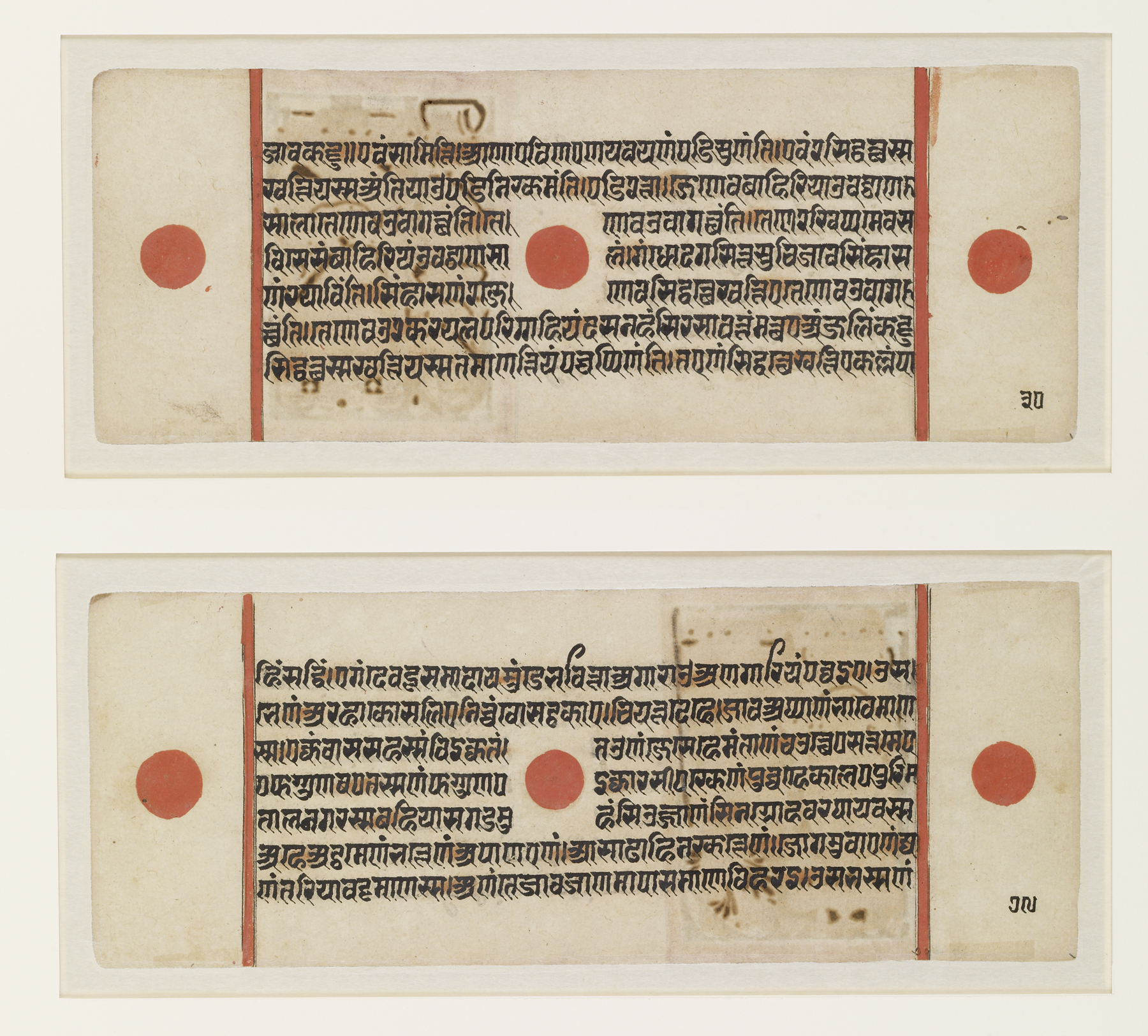
Two folios from the "Kalpasutra" illustrating King Siddhartha at Court and the Renunciation of Mahavira
(India, Nepal, and Tibet)
These two illustrated folios are from a manuscript of the "Kalpasutra," one of the most important canonical texts of the Shvetambara Jain tradition. Part of the text relates the life stories of the twenty-four Jinas, the omniscient, spiritually liberated teachers revered by Jains. These folios depict moments in the life of Mahavira, the twenty-fourth Jina. In the first, Mahavira’s father, King Siddhartha, converses with two courtiers, most likely about the dreams of Queen Trishala that preceded Mahavira’s birth. The second folio depicts Mahavira’s renunciation of his life as a prince. Before giving up his jewels and fine clothing, he plucks out his own hair, enduring the pain it causes as an exercise in overcoming attachment to material comforts. The god Shakra (Indra) sits before him, receiving the hair with outstretched hands.
Both illustrations make lavish use of blue pigments and gold, expensive materials that would have cost the manuscript’s donor a great sum of money. By donating such manuscripts to monastic libraries, members of the Jain laity provided a service to the religion and gained merit. In addition to playing a role in the sacred education of both monastic and lay Jains, manuscript copies of the Kalpasutra are objects of worship, especially during the annual festival of Paryushan, when Shvetambara Jains recite, listen to, and honor the holy manuscripts with ritual processions.
Provenance
Provenance (from the French provenir, 'to come from/forth') is the chronology of the ownership, custody, or location of a historical object. Learn more about provenance at the Walters.
John and Berthe Ford, Baltimore; given to Walters Art Museum, 2002.
Exhibitions
| 2015-2016 | Pearls on a String: Artists, Patrons, and Poets at the Great Islamic Courts. The Walters Art Museum, Baltimore; Asian Art Museum, San Francisco. |
Conservation
| Date | Description | Narrative |
|---|---|---|
| 9/1/2015 | Treatment | examined for exhibition; media consolidation; splits mended |
Geographies
India, Gujarat (Place of Origin)
Measurements
H of page: 4 1/2 × W: 11 5/8 in. (11.4 × 29.5 cm)
Credit Line
Gift of John and Berthe Ford, 2002
Location in Museum
Not on view
Accession Number
In libraries, galleries, museums, and archives, an accession number is a unique identifier assigned to each object in the collection.
In libraries, galleries, museums, and archives, an accession number is a unique identifier assigned to each object in the collection.
W.910