
 Creative Commons License
 Creative Commons License
 Creative Commons License
 Creative Commons License
 Creative Commons License


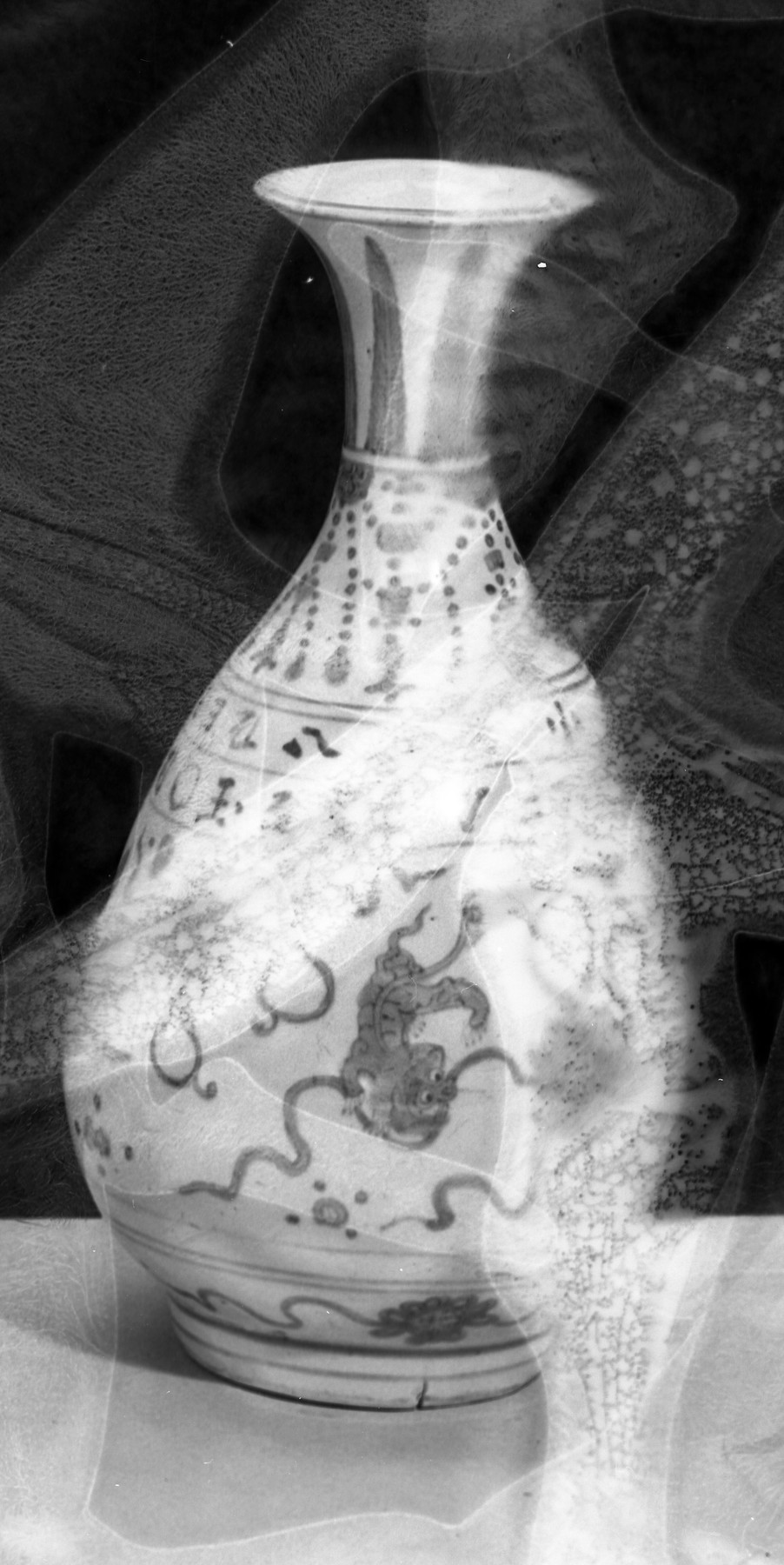
Bottle Vase Made for a Portuguese Trader
(China )
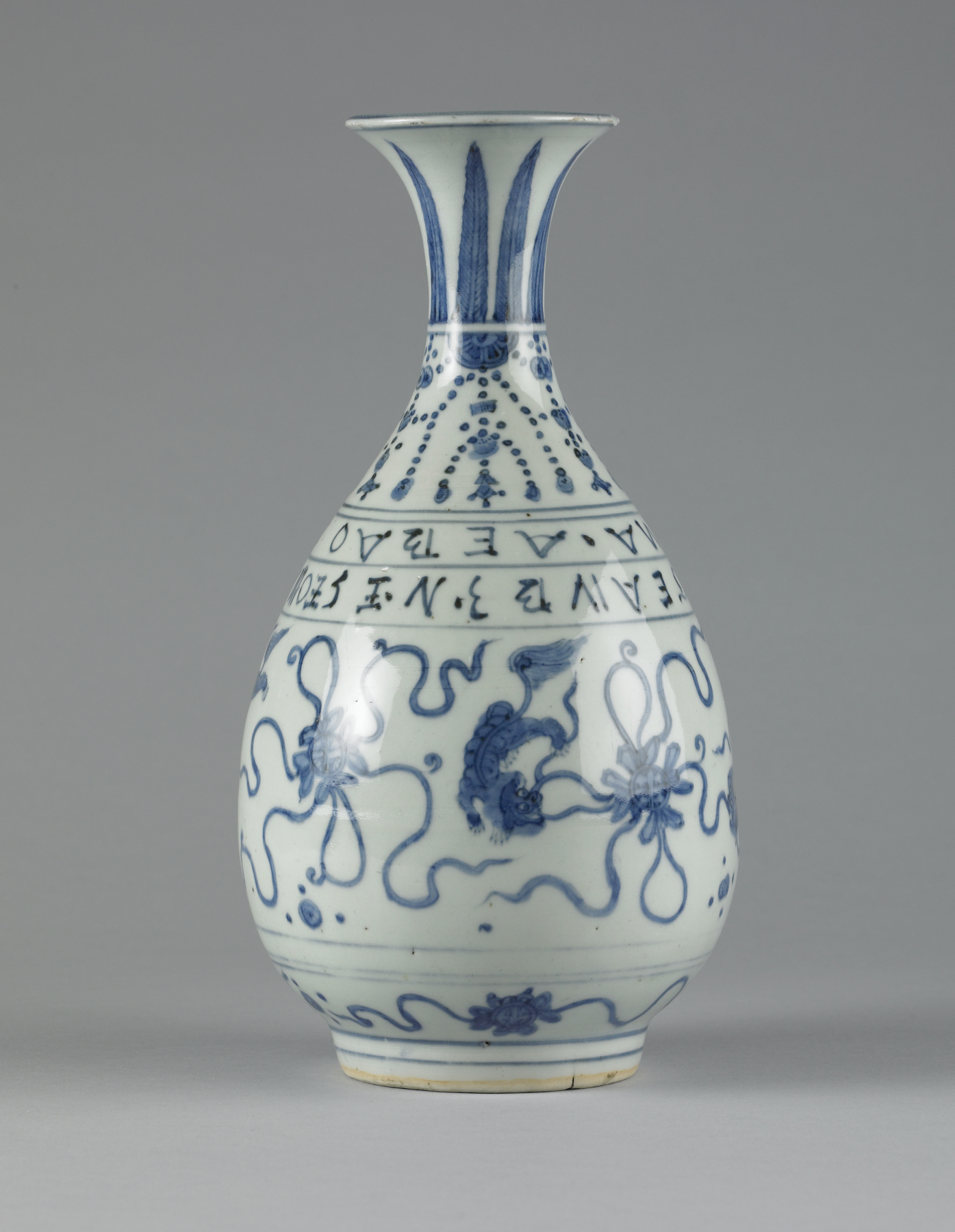
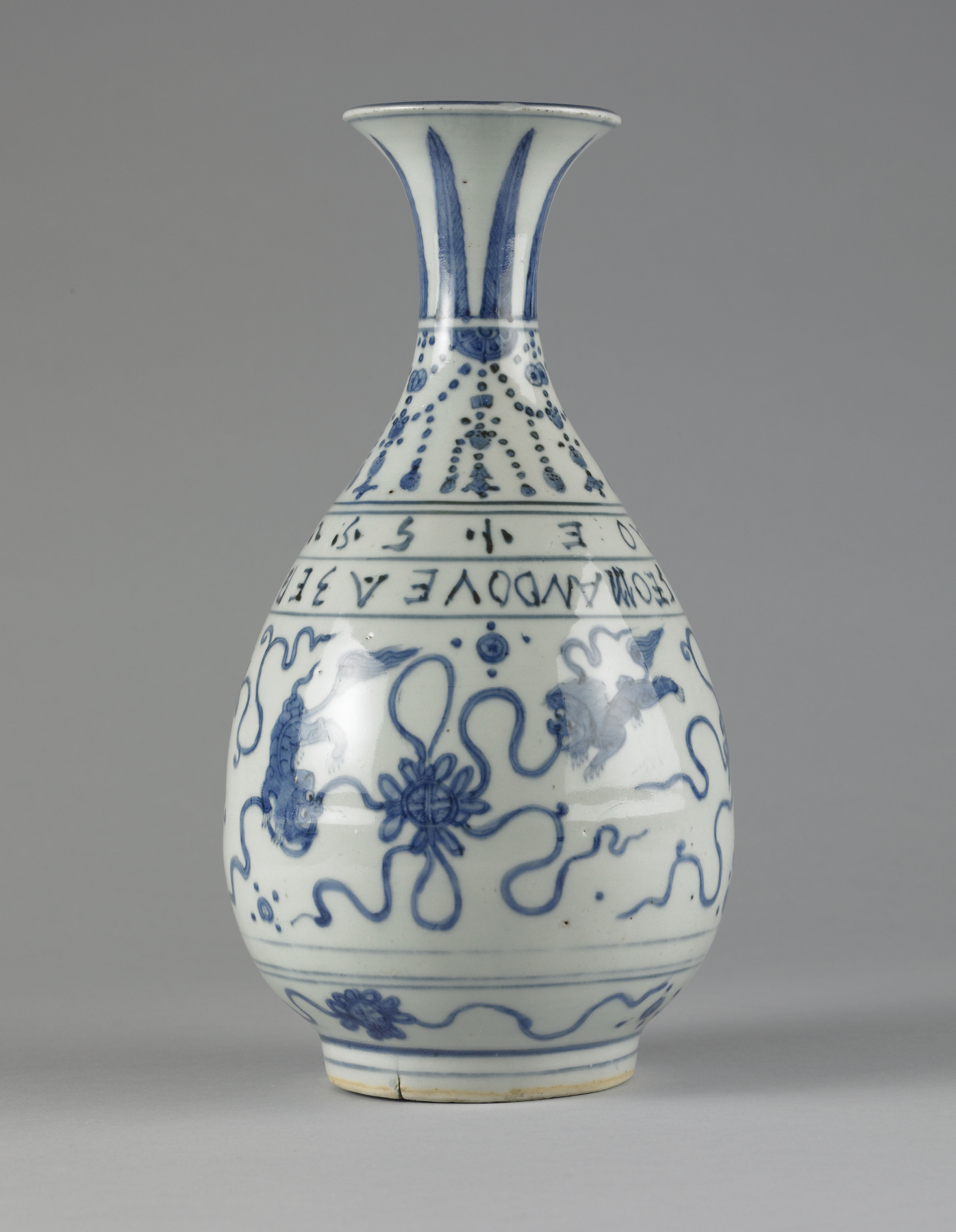
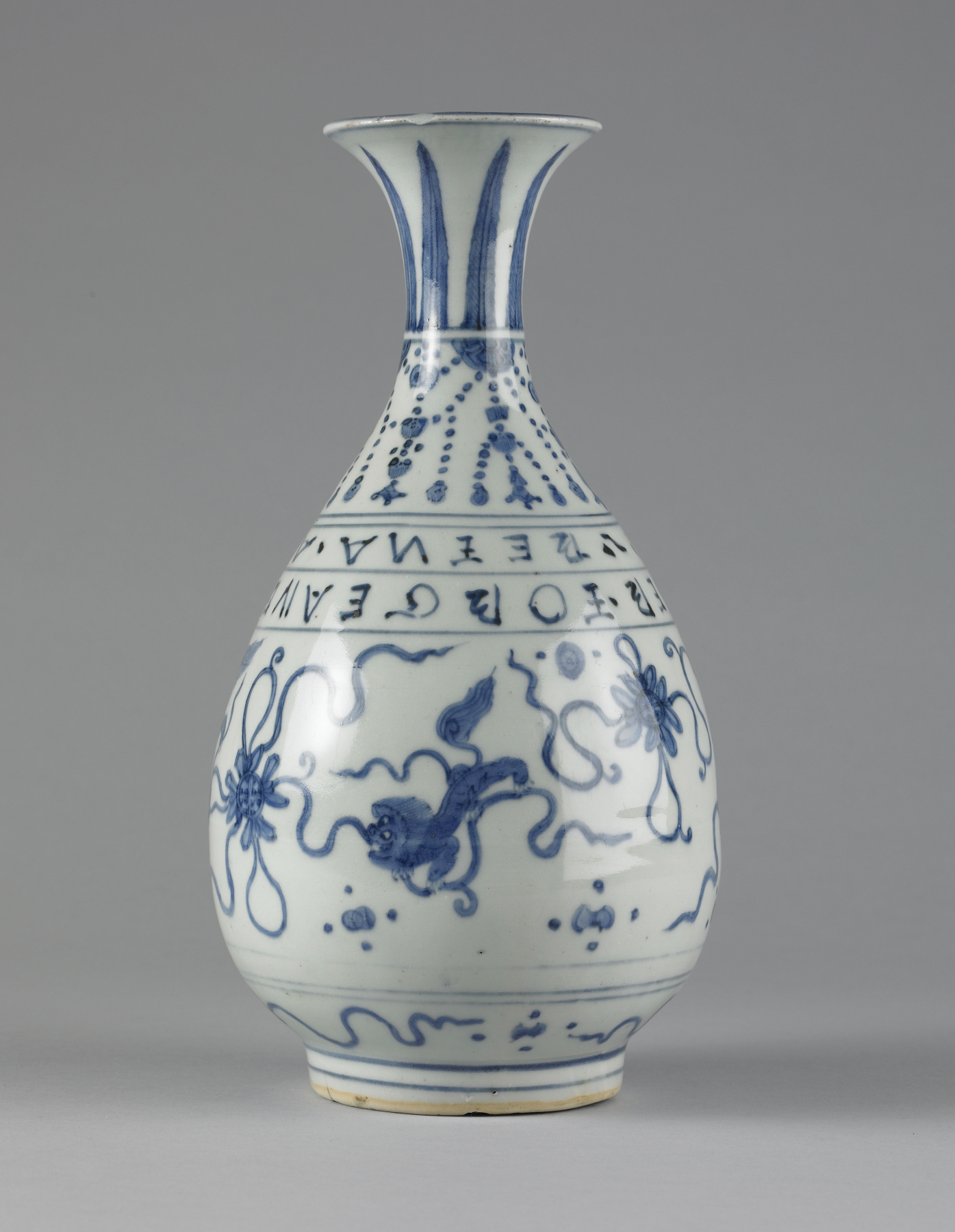
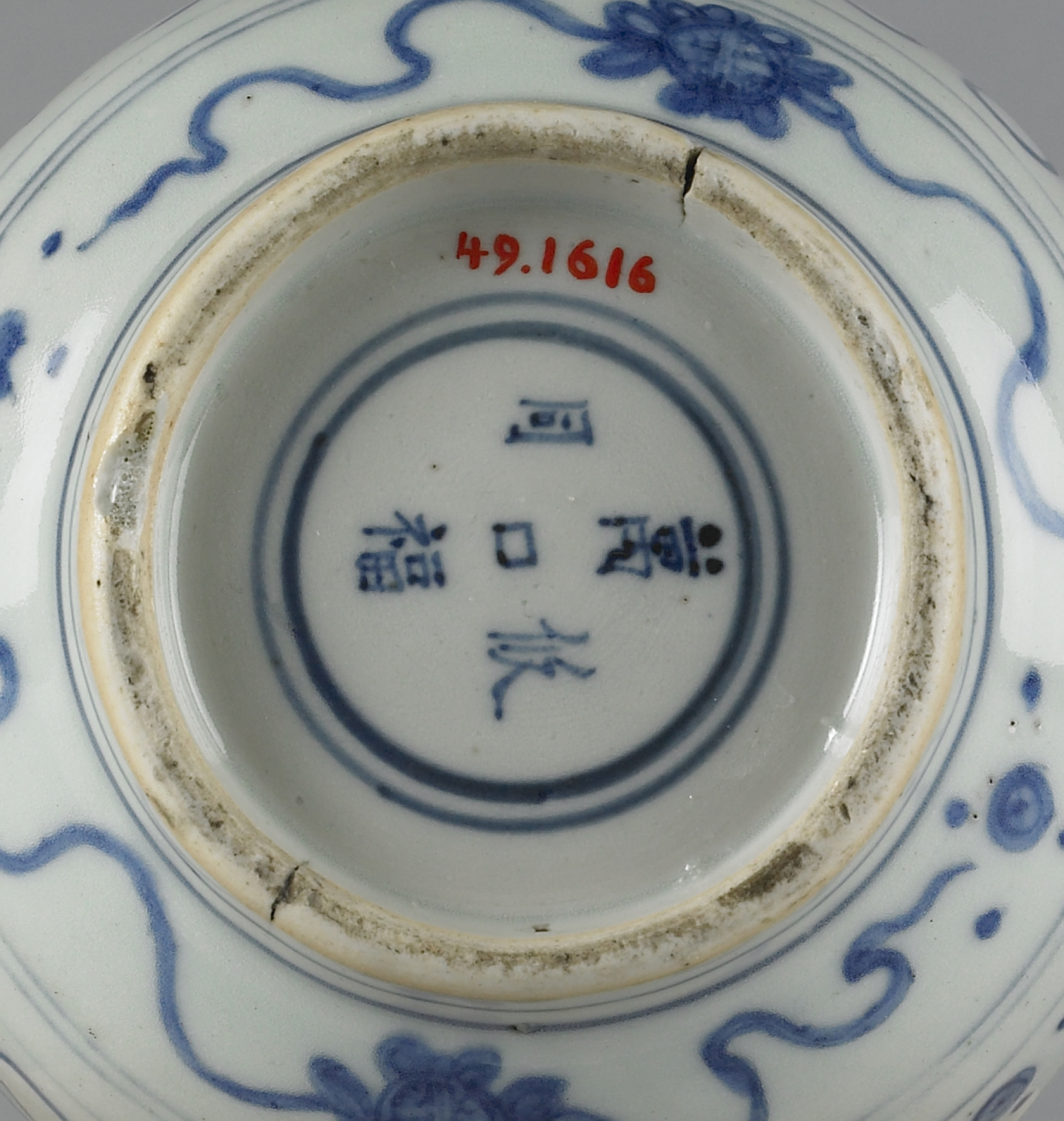
Trading and exchange between China and the Portuguese began after Manuel I established an embassy at Beijing in 1517. The Portuguese exported and traded blue and white porcelain throughout Europe. This bottle is one of six known "Jorge Álvares bottles," named for the Portuguese naval captain and merchant that purchased them. Álvares was also known to be a friend to St. Frances Xavier, a Jesuit missionary in China and throughout the Asian continent. The inscription around the shoulder of the bottle, written upside-down in imitation of a Portuguese model, is translated as "Jorge Alvrz (Álvares) had this made at the time of 1552 [reign of King John III]." The base reads "wan fu you tong" translated roughly as "may infinite happiness come to this place."
The cobalt blue painting in the outline and wash technique depicts the 16th-century Buddhist motif of lions playing with brocaded balls. Beneath, along the curved base, are more balls with waving tassels. Ornamental chains and geometric flowers adorn the lower half of the neck while the flared mouth is painted with pointed plantain leaves. Other examples of the Álvares bottles include paintings of aquatic, terrestrial, and fantastic flora and fauna.
Inscription
Provenance
Provenance (from the French provenir, 'to come from/forth') is the chronology of the ownership, custody, or location of a historical object. Learn more about provenance at the Walters.
Laffan Sale, 1911, lot 75; Henry Walters, Baltimore, 1911 [mode of acquisition unknown]; by bequest to Walters Art Museum, 1931.
Exhibitions
| 2007 | Encompassing the Globe. Freer Gallery of Art, Washington. |
| 1999 | Saint Francis Xavier: His Life and Times. Kawasaki City Museum, Kawasaki; Yamaguchi Perfectural Museum of Art, Yamaguchi-shi; Tobu Museum of Art, Tokyo; Kagoshima Prefectural Museum of Art, Kagoshima City; Okazaki Mindscape Museum, Okazaki-shi; Nagasaki Prefectural Art Museum, Nagasaki City. |
| 1983 | Portuguese Discoveries and Renaissance Europe. Jerónimos Monastery, Lisbon. |
| 1980-1981 | Masterpieces of Chinese Porcelain. The Walters Art Gallery, Baltimore. |
| 1971-1972 | World of Wonder. The Walters Art Gallery, Baltimore. |
Conservation
| Date | Description | Narrative |
|---|---|---|
| 11/4/1974 | Treatment | cleaned |
| 4/18/1983 | Examination | examined for loan |
Geographies
China (Place of Origin)
Measurements
H: 10 × Diam: 5 3/16 in. (25.4 × 13.2 cm)
Credit Line
Acquired by Henry Walters, 1911
Location in Museum
Not on view
Accession Number
In libraries, galleries, museums, and archives, an accession number is a unique identifier assigned to each object in the collection.
In libraries, galleries, museums, and archives, an accession number is a unique identifier assigned to each object in the collection.
49.1616