 Creative Commons License

Vase with Bean Red Glaze
(China )
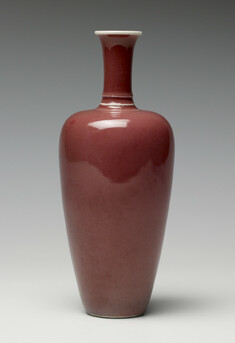
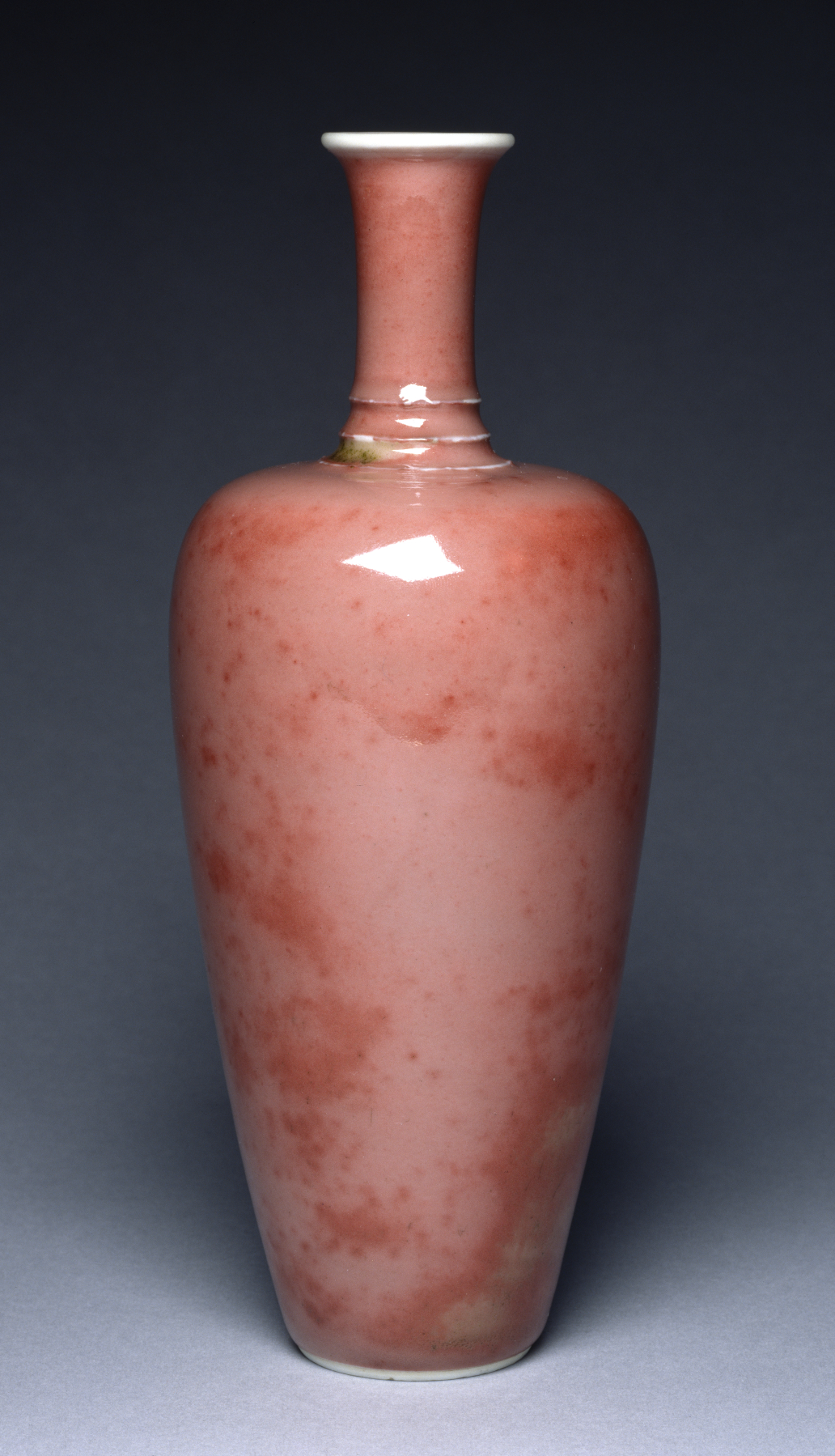
This porcelain vase displays a pinkish red glaze mottled with russet spots and tinged with green. The Chinese have various names for this glaze such as apple red (pingguo hong), and the most common, bean red (jiangdou hong). In English, this glaze is known as “peach bloom.” The mottled effect of the glaze occurs organically in the kiln through the unpredictable alchemy of oxidation during firing. The appeal of the bean red glaze lies in its infinite variations of colorful effects.
Inscription
Provenance
Provenance (from the French provenir, 'to come from/forth') is the chronology of the ownership, custody, or location of a historical object. Learn more about provenance at the Walters.
Cai Yuan [Tsai Yuan], Prince Yi [I] (d. 1861), Peking; Mrs. Mary Morgan, New York; Mrs. Mary J. Morgan Sale, American Art Association, March 8, 1886, lot 341; purchased by William T. Walters, Baltimore, 1886; inherited by Henry Walters, Baltimore, 1894; by bequest to Walters Art Museum, 1931.
Exhibitions
| 2014-2016 | From Rye to Raphael: The Walters Story. The Walters Art Museum, Baltimore. |
| 1984 | The Taste of Maryland: Art Collecting in Maryland 1800-1934. The Walters Art Gallery, Baltimore. |
| 1980-1981 | Masterpieces of Chinese Porcelain. The Walters Art Gallery, Baltimore. |
| 2026 | Imperial Chinese Treasures from the Walters Collection. 1991-0. |
Geographies
China (Place of Origin)
Measurements
H: 7 15/16 x Diam: 3 3/16 in. (20.2 x 8.1 cm)
Credit Line
Acquired by William T. Walters, 1886
Accession Number
In libraries, galleries, museums, and archives, an accession number is a unique identifier assigned to each object in the collection.
In libraries, galleries, museums, and archives, an accession number is a unique identifier assigned to each object in the collection.
49.155