
 Creative Commons License
 Creative Commons License


Incense Burner Lid
(Ancient Americas )
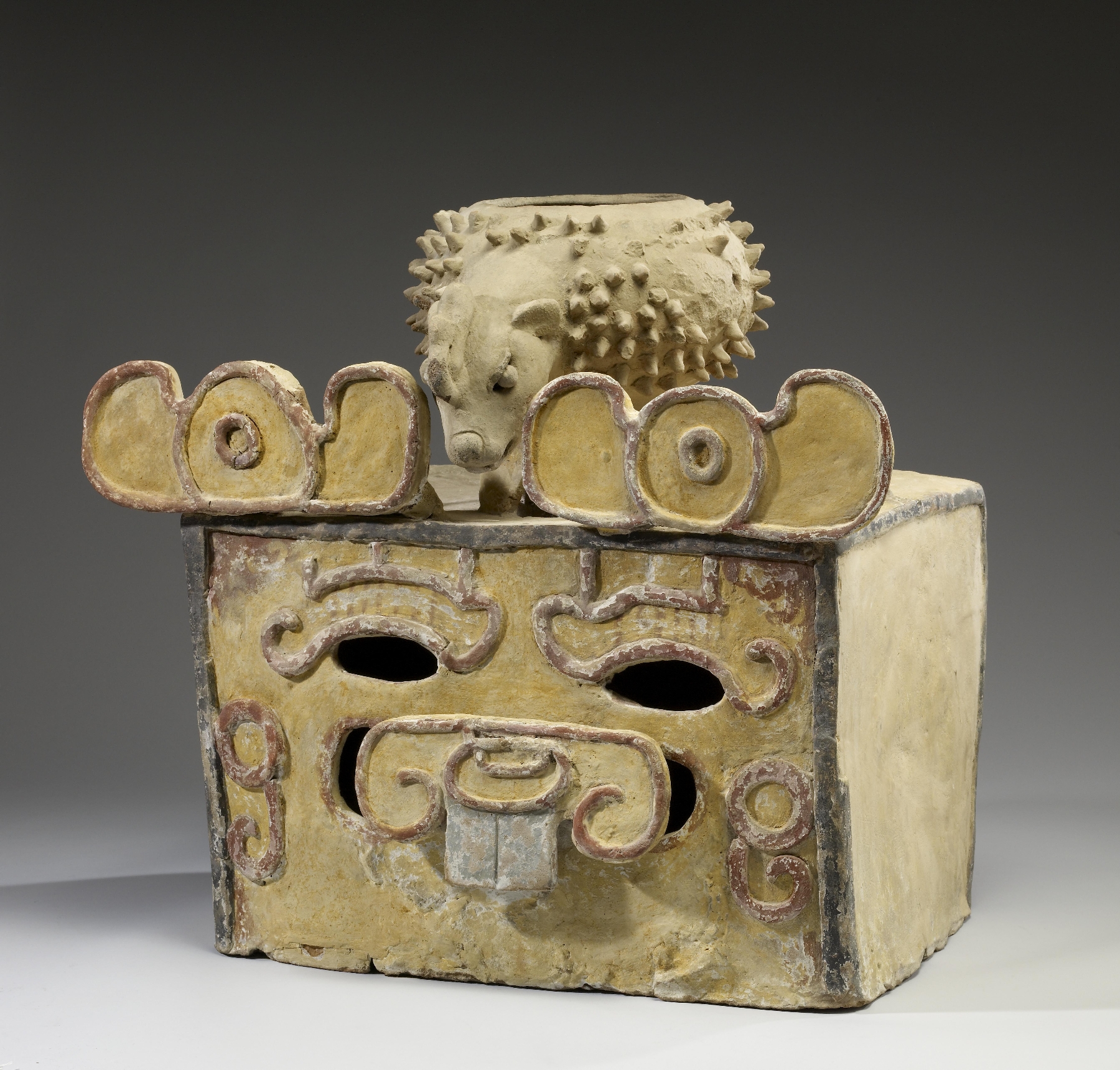
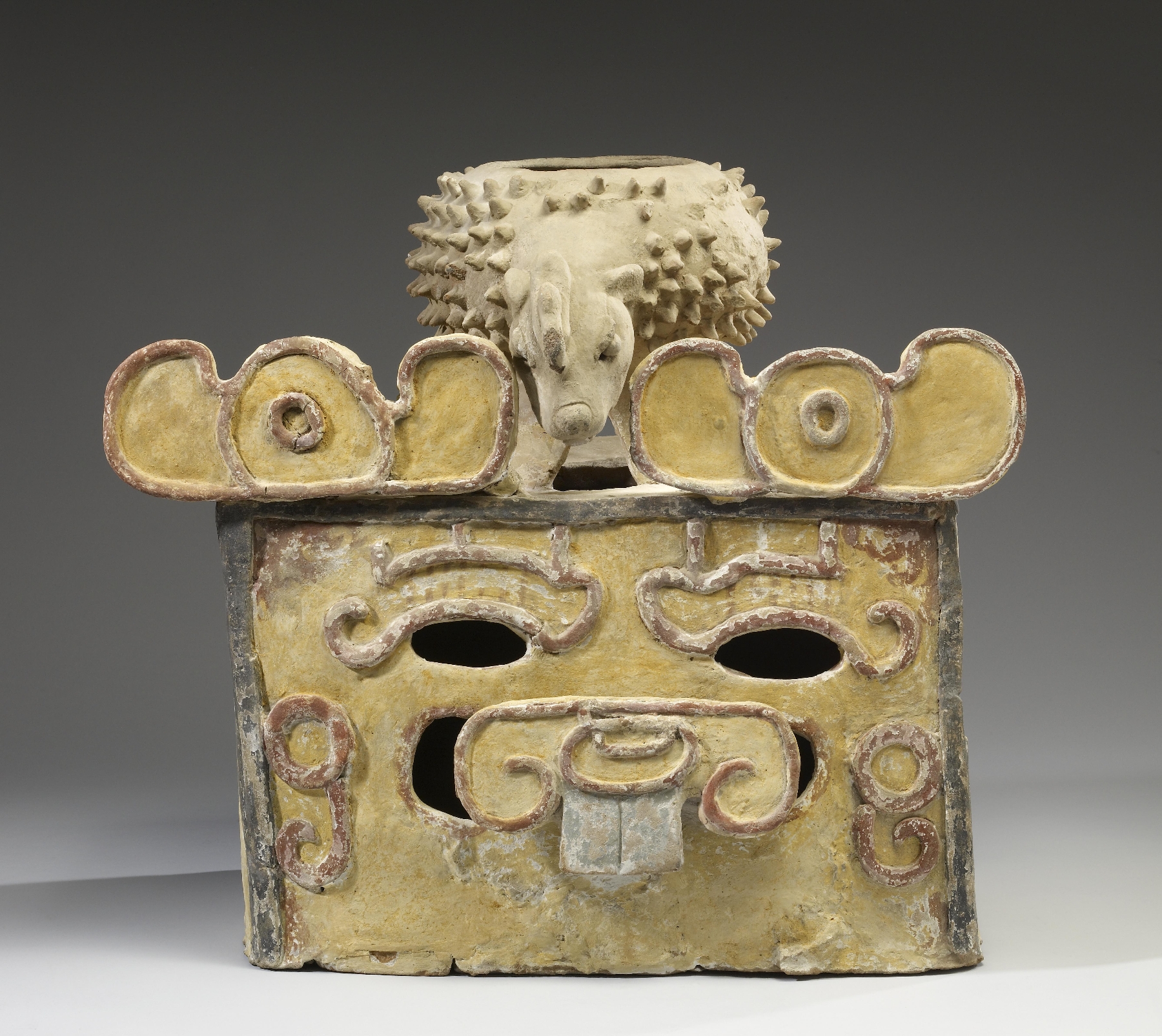
Five slabs of clay, painted yellow, form a box; holes are cut into one side to form eyes and a mouth. Coils of clay indicate decorations around the eyes and cheeks, while other clay pieces form eyebrows atop the box and a nose with what appear to be two buck teeth protruding below. On the top of the box is a round spiky vessel with a head at the front, depicting an animal, perhaps a hedgehog, who looks distinctly angry.
Each part of this object seems to come from a different time and place. The round vessel on top is typical of incense burners made in Colima, in the west of today’s Mexico, which may date to as early as the 3rd century BCE. The spikes may represent the thorns of the sacred ceiba tree. However, these incense burners never feature animal heads, and hedgehogs are not native to the Americas. The yellow box is similar to incense burners made by the Mixtecs and other peoples of south-central Mexico around 1200–1500 CE. The eyebrow elements atop the box are similar to how Maya peoples, in other parts of Mexico and Central America, depicted the brows and forehead ornaments of their rain god, Chaac.
Scientific analysis done in 2024 using thermoluminescence (TL) testing confirmed that multiple parts of this object were made about 700–1100 years ago (900–1300 CE.) Other objects that seem similar were made by the Zoque people of southern Mexico. They were culturally linked to, although distinct from, the better-known Maya people. Many Zoque ceramics have very thick walls like this one. And many also have spikes that seem to reference the thorny trunks of ceiba trees sacred in this area.
Provenance
Provenance (from the French provenir, 'to come from/forth') is the chronology of the ownership, custody, or location of a historical object. Learn more about provenance at the Walters.
Ron Messick Fine Arts, Santa Fe, New Mexico [date and mode of acquisition unknown]; John G. Bourne, 1990s, by purchase; Walters Art Museum, 2009, by gift.
Exhibitions
| 1998-2008 | Art of Ancient America, 1500 B.C.-1400 A.D.. Museum of New Mexico, Santa Fe. |
Geographies
Mexico, Puebla
(Place of Origin)
Mexico, Oaxaca (Place of Origin)
Measurements
H: 20 5/8 x W: 25 9/16 x D: 16 1/8 in. (52.4 x 65 x 41 cm)
Credit Line
Gift of John Bourne, 2009
Location in Museum
Not on view
Accession Number
In libraries, galleries, museums, and archives, an accession number is a unique identifier assigned to each object in the collection.
In libraries, galleries, museums, and archives, an accession number is a unique identifier assigned to each object in the collection.
2009.20.19