
 Creative Commons License
 Creative Commons License


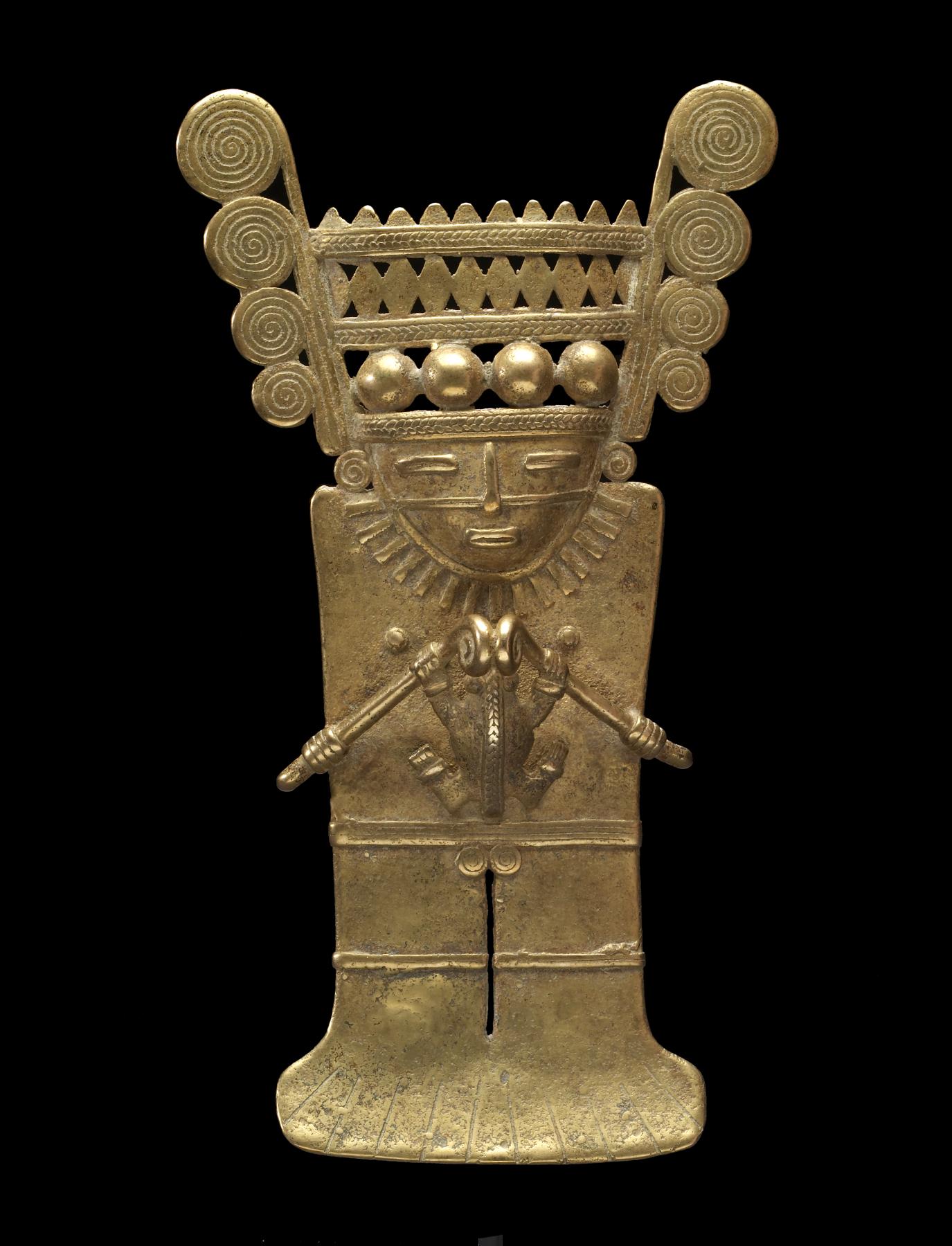
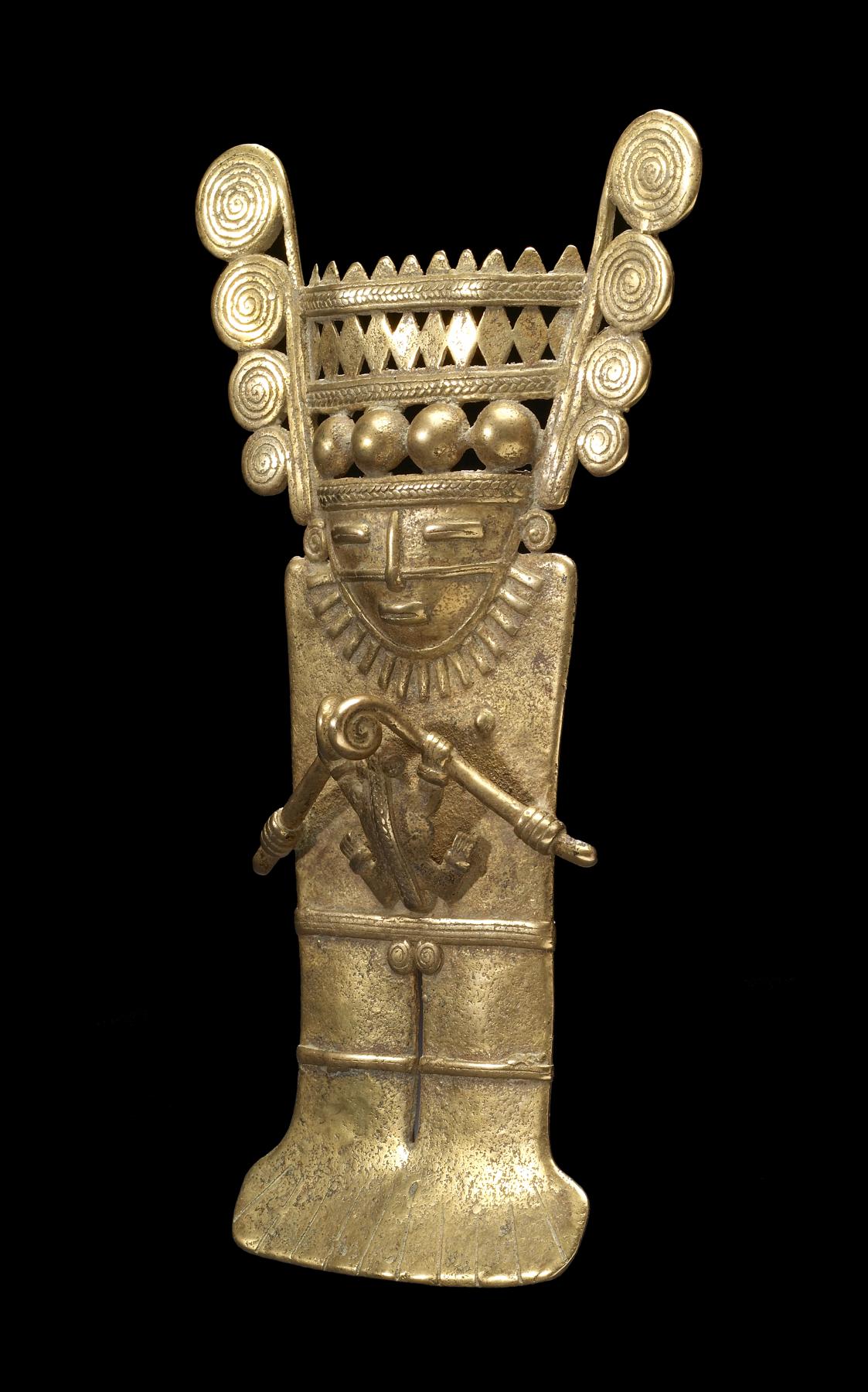
Human Effigy Pendant
(Ancient Americas )
The figure wears an elaborate headdress from which four spiral forms emerge on each side. These spirals decorate the ends of multiple bands of braided wire and geometric openwork that extend upward from the top of the head. The head has a semi-circular shape and flat, rectangular features. A bar-shaped nose ornament spans the width of the head and a small spirals appears in place of the ear on either side of the face. The chin and jawline are accented by a series of rectangular rays, perhaps a necklace. The remainder of the body is rectangular, with the shoulders falling right below the ears. Small hands emerge from the torso, each holding a staff with a spiral head, in front of the body. An amphibious creature, likely a frog, on the figure’s chest also grasps the shafts of the two staffs. A fine, braided band extends down the creature’s spine, and jewelry appears to adorn the animal’s legs and arms. Below this, a horizontal band indicates the beginning of the legs. A similar band traverses the legs at the knees. There is a small gap between the legs of the figure, though it reconnects at the feet. The connected feet form a sloping rectangle, with small carvings to accentuate eleven toes. Two flat loops with linear banding are located on the back of the object, allowing it to be suspended. The authenticity of this piece has been questioned.
Provenance
Provenance (from the French provenir, 'to come from/forth') is the chronology of the ownership, custody, or location of a historical object. Learn more about provenance at the Walters.
Ron Messick Fine Arts, Santa Fe, New Mexico [date and mode of acquisition unknown]; John G. Bourne, 1990s, by purchase; Walters Art Museum, 2009, by gift.
Exhibitions
| 1998-2008 | Art of Ancient America, 1500 B.C.-1400 A.D.. Museum of New Mexico, Santa Fe. |
Conservation
| Date | Description | Narrative |
|---|---|---|
| 10/30/2015 | Examination | examined for acquisition; examined for condition |
Geographies
Colombia (Place of Origin)
Measurements
H: 5 13/16 x W: 3 1/4 x D: 1 in. (14.7 x 8.2 x 2.6 cm)
Credit Line
Gift of John Bourne, 2009
Location in Museum
Not on view
Accession Number
In libraries, galleries, museums, and archives, an accession number is a unique identifier assigned to each object in the collection.
In libraries, galleries, museums, and archives, an accession number is a unique identifier assigned to each object in the collection.
2009.20.68