
 Creative Commons License

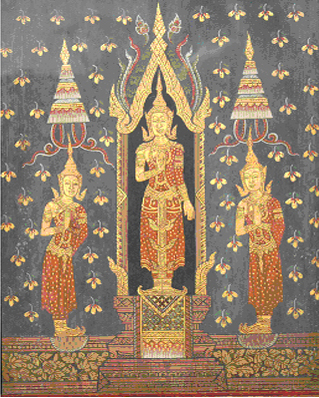
The Buddha with his disciples Sariputta and Moggalana
(Southeast Asia )
A scene showing Buddha and his two most famous disciples, Moggalana on his left and Sarriputta on his right. Buddha stands on a golden podium, in a position of abhaya-mudra, a gesture of fearlessness, (or, in Thailand, of pacifying the relatives).
The painting is believed to be from late in the reign of Rama III (1824-1851). Paintings in this period were characterized by the use of dark colors, heightened with gold leaf- emphasizing draftsmanship and minutiae of detail. The Lord Buddha is shown with his feet in a splayed position. All the figures are adorned with the princely-kingly robes, which became typical of the Rattankosin period of Thai art. The robes are heavily encrusted with gold embroidery; bracelets and armbands adorn the figures. The disciples enjoy princely three tier umbrellas, while the Buddha's halo is composed of the Naga and the coral tree of paradise. The figures have elaborate golden crowns.
This painting is housed under glass in the original frame.
Provenance
Provenance (from the French provenir, 'to come from/forth') is the chronology of the ownership, custody, or location of a historical object. Learn more about provenance at the Walters.
Collection of James E. Bogle, Philadelphia, Pennsylvania, 1958, by purchase [in Bangkok, Thailand, from a shop in the Nakorn Kasem Market]; Walters Art Museum, 2010, by gift.
Exhibitions
| 1971 | Art of Thailand. Ithaca College Museum of Art, Ithaca. |
| 1981-2002 | Exhibition of Thai Paintings from James Bogle's Collection. Lycoming College Gallery, Williamsport. |
Geographies
Thailand (Place of Origin)
Measurements
H: 20 1/16 x W: 16 in. (51 x 40.6 cm)
Credit Line
Gift of Mr. James E. Bogle, 2010
Location in Museum
Not on view
Accession Number
In libraries, galleries, museums, and archives, an accession number is a unique identifier assigned to each object in the collection.
In libraries, galleries, museums, and archives, an accession number is a unique identifier assigned to each object in the collection.
2010.12.4