 Creative Commons License
 Creative Commons License
 Creative Commons License
 Creative Commons License
 Creative Commons License
 Creative Commons License
 Creative Commons License


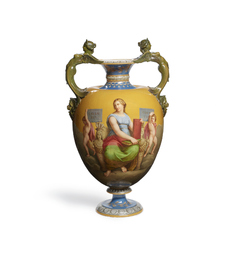
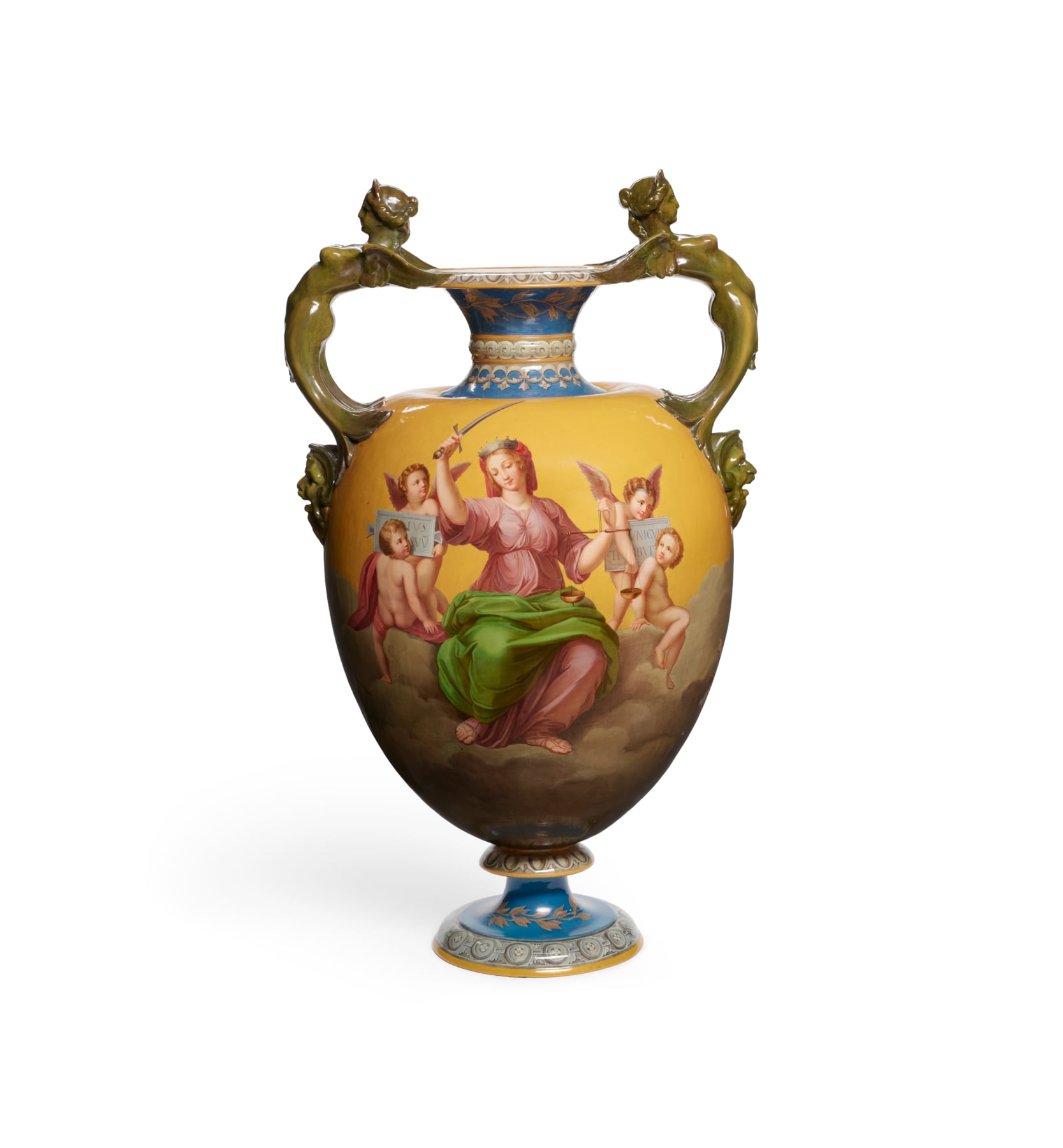
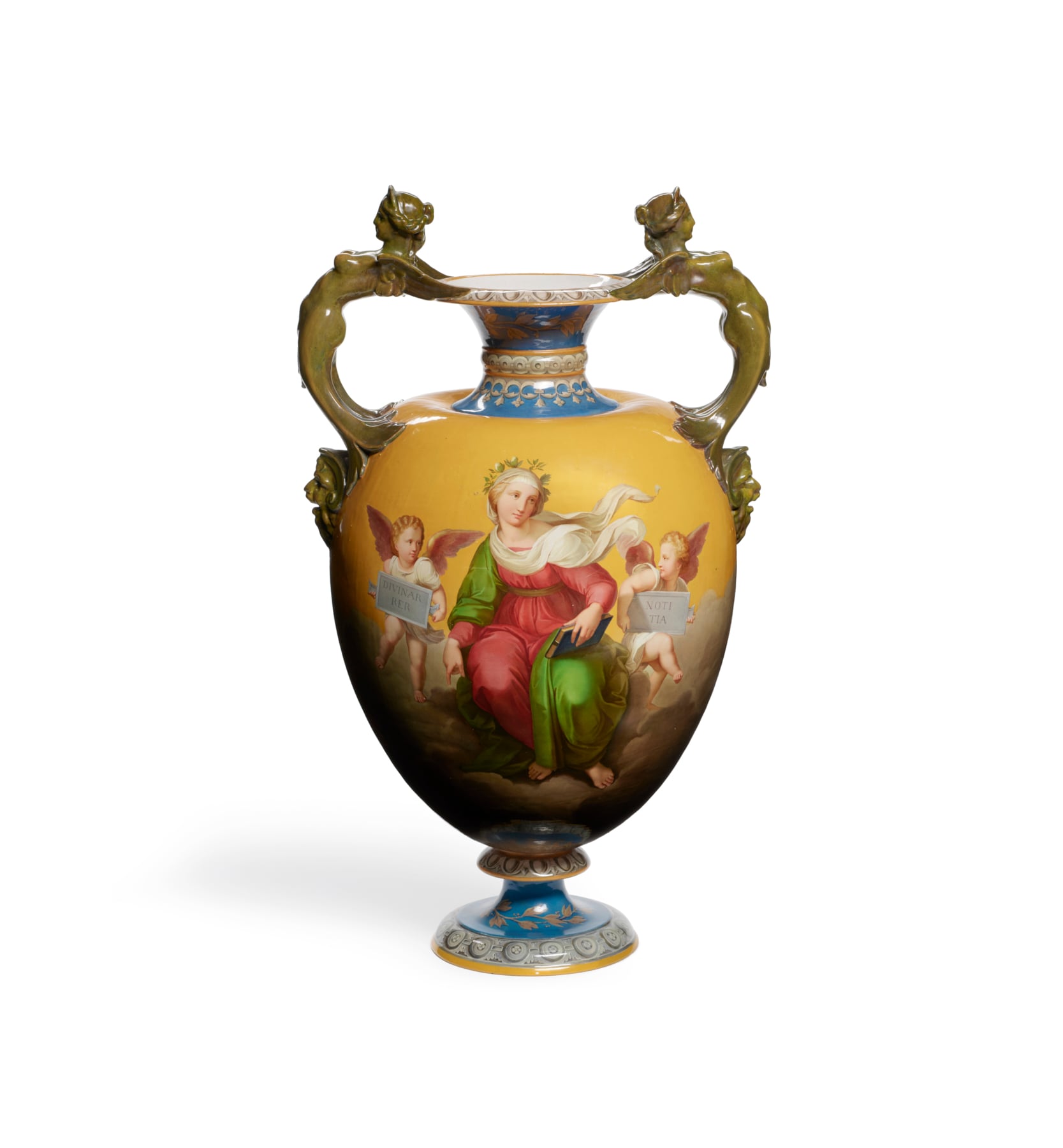
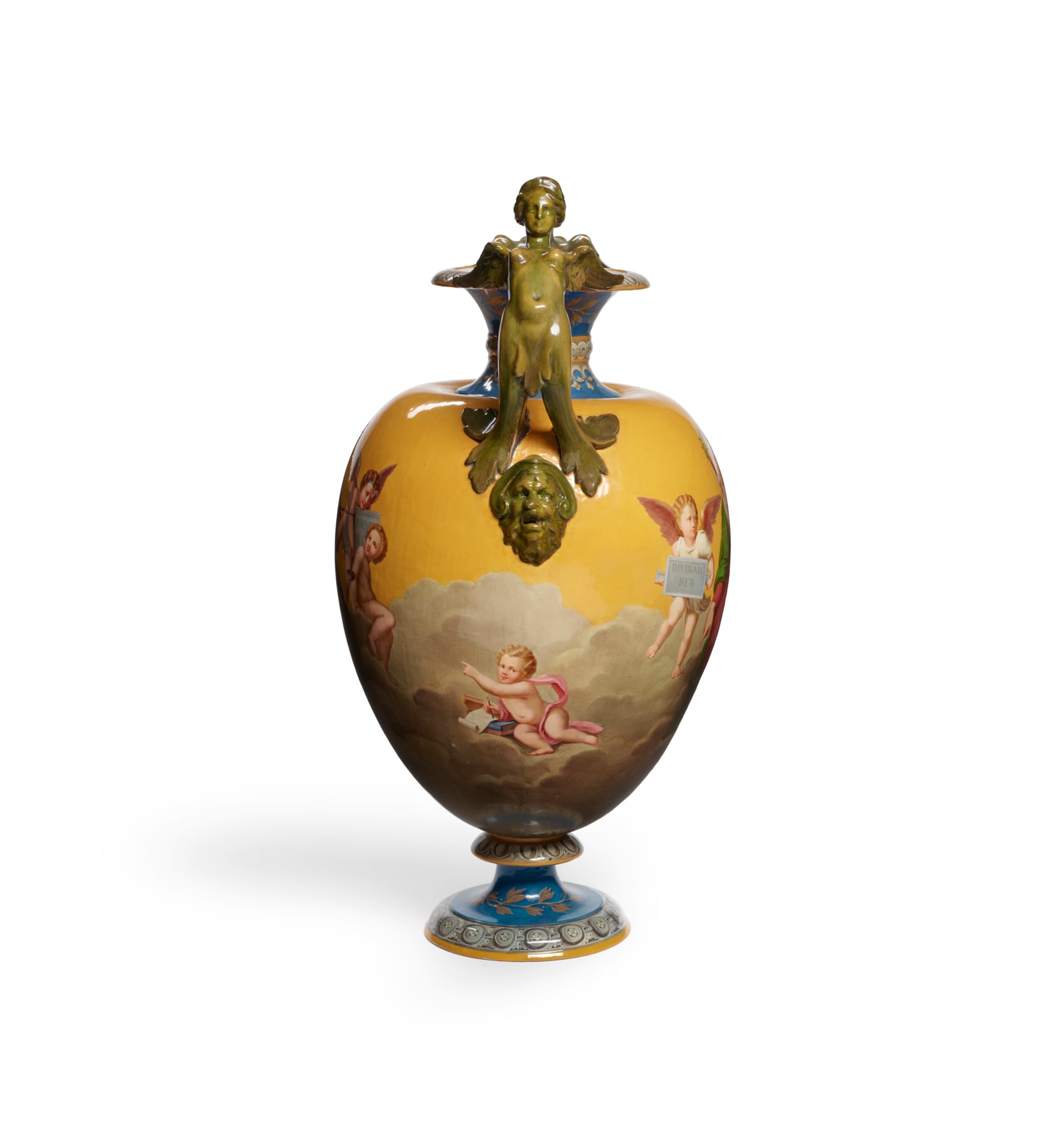
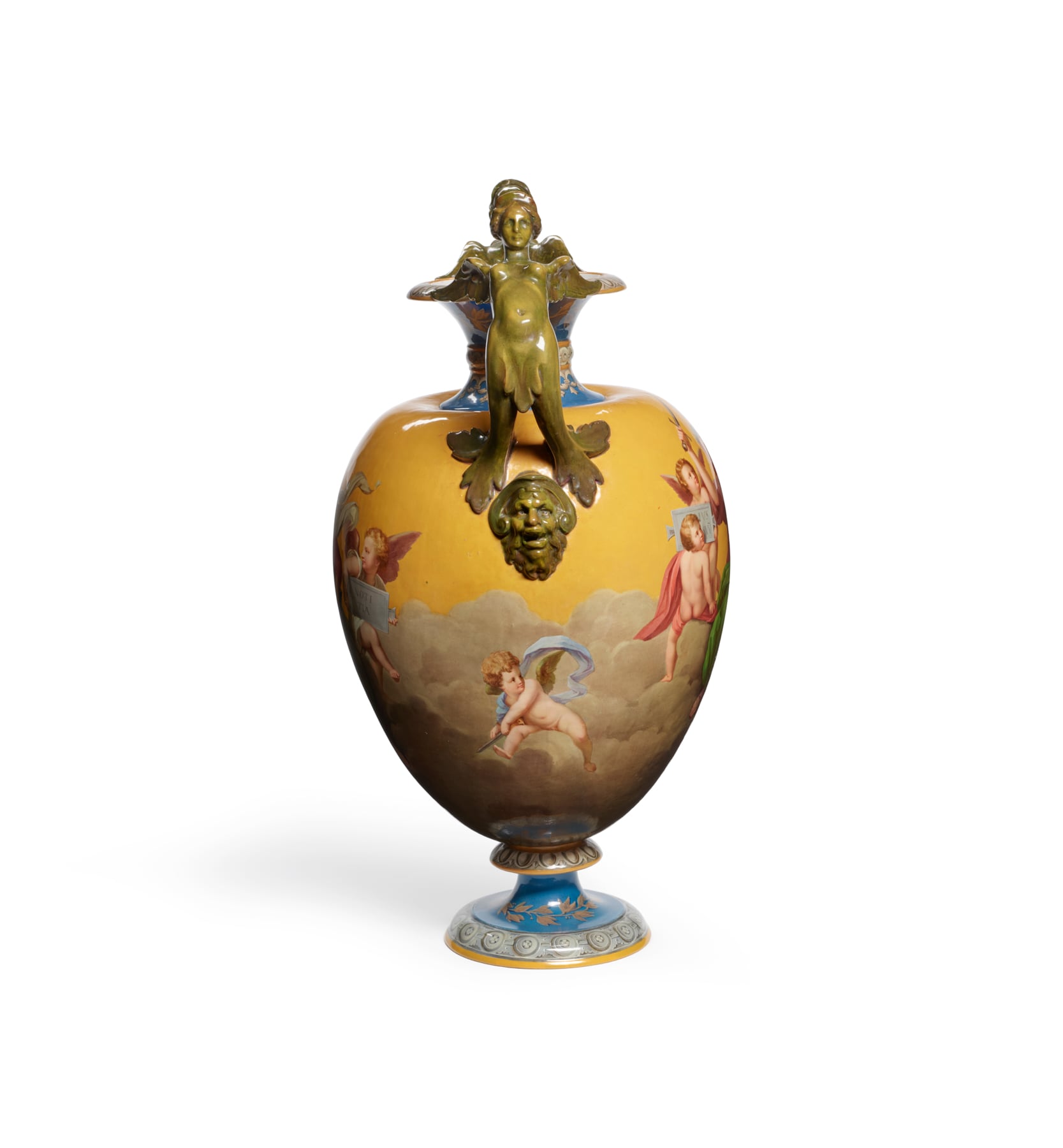
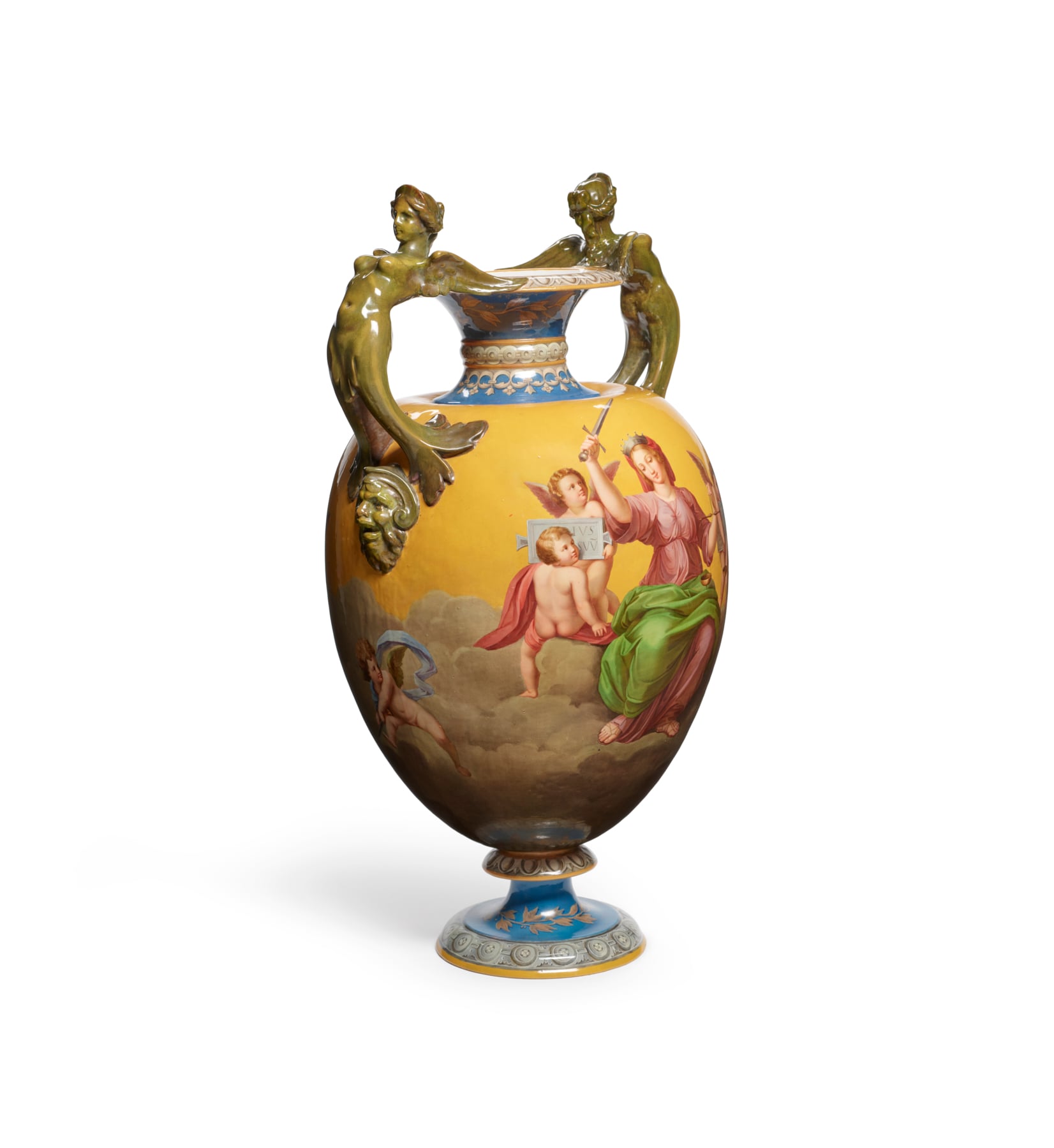
Vase Depicting Justice and Theology
This vase and its pair (accession no. 48.2925) are examples of the most refined artwares produced by Minton & Co. one of the most innovative and important manufacturers in the world in the mid-19th century. These vases embody how from the late 1840s through the 1870s Minton brought together a group of leading artists and designers from across Europe to create extraordinary works. They also are prime examples of the celebration of and reverence for the arts of the Italian Renaissance during this period, in particular the painter Raphel.
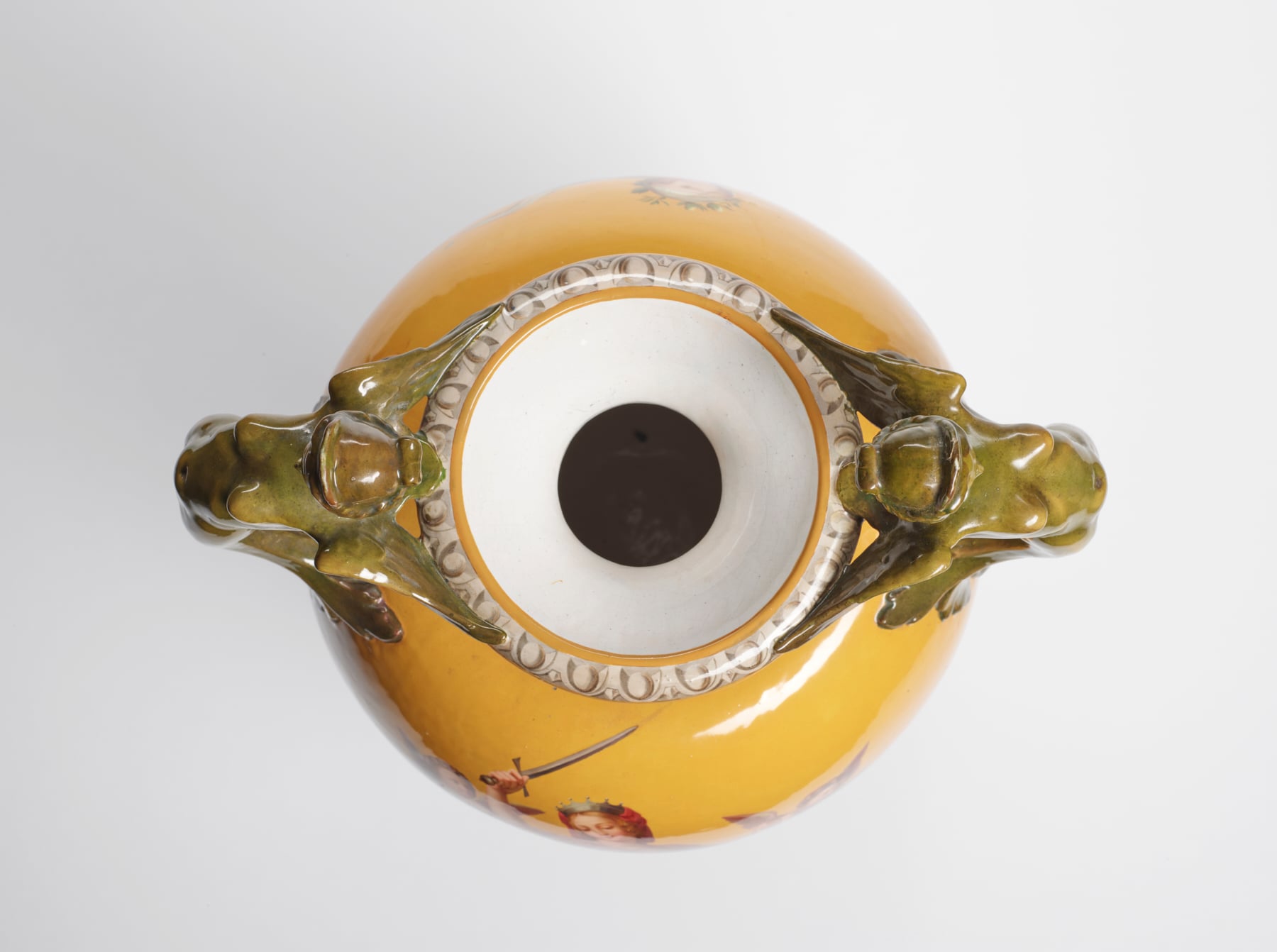
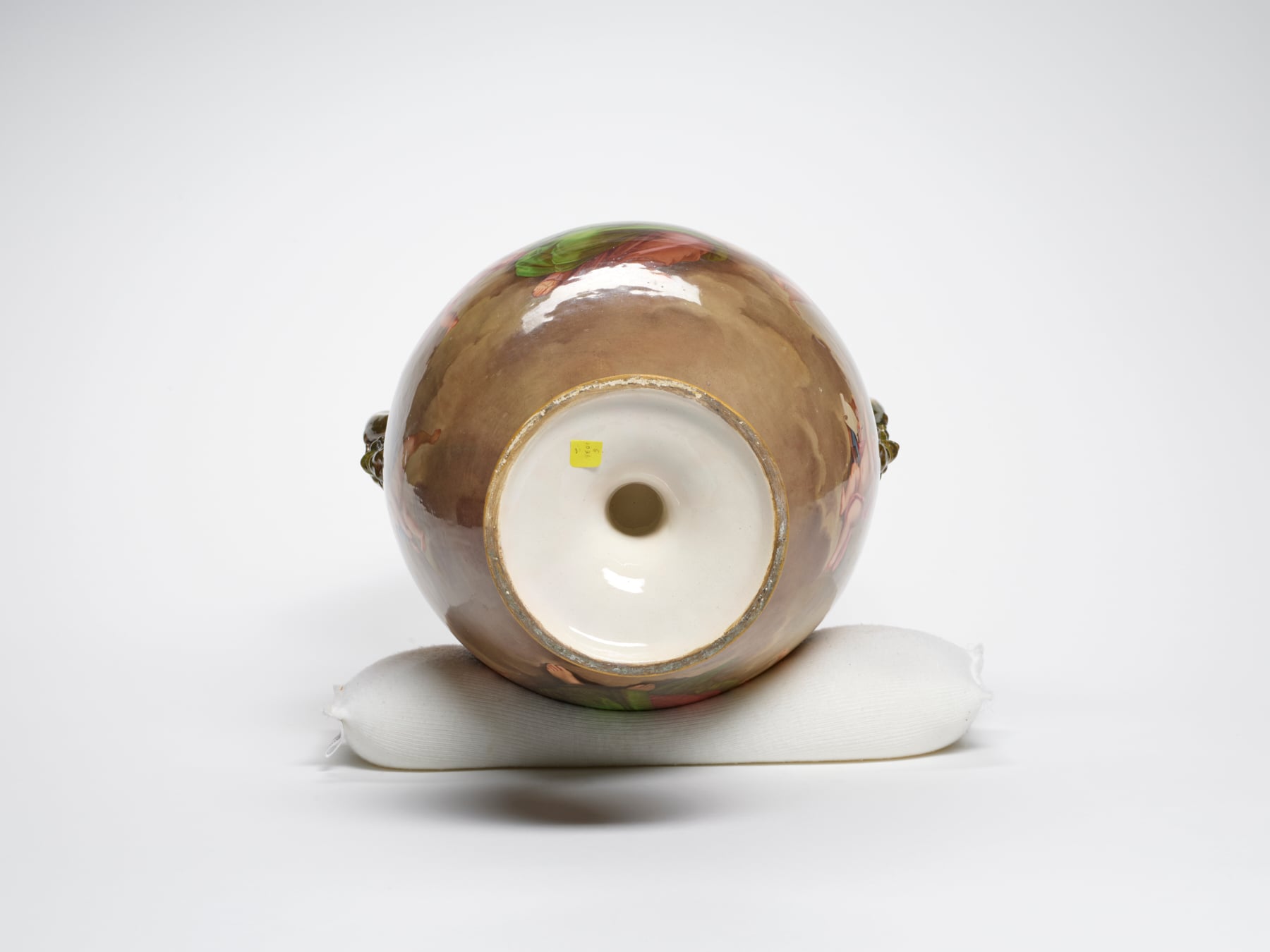
Minton & Co. featured this vase and its pair in its extensive display at the London International Exhibition of 1862. In preparation for its 1862 display Minton & Co. recorded the details of each piece prepared as well as the costs of making it in an “Estimate Book”. The vases’ entry in the Estimate Book contains the following details: “Vase / No. 804 / Orange ground / painted subject on each side by Jahn / Blue ground on neck & foot / White shaded cable & [illegible] on neck / & foot / Handles bronzed.” One of the vases retains on its underside a paper retailer’s label for Thomas Goode & Co. of London. Tellingly, the 1862 Estimate Book entry for the vases was later annotated “Goode – 150 G[uinea]s the pair” – providing further confirmation that these vases are the same pair shown in 1862. This annotation also provides an idea of the high cost of such artwares at the time. By one inflation calculator the cost of 150 Guineas or £157.50 translated to approximately £24,000.00 in 2024.
The “Jahn” listed as the painter in the Estimate Book refers to Louis Jahn, an extremely skilled ceramic artist. He was born Ludwig Hartmann Adalbert Jahn in 1839 in Thuringia, a region which since the 18th century had been a center for German porcelain production. Jahn presumably received training as a decorator there and perhaps also in Vienna. After a short time in the Austrian capital, he migrated to England to work in the Staffordshire Potteries, where he would remain for the rest of his life. Jahn seems to have come to work for Minton in the early 1860s, at the same time this leading British manufacturer was recruiting a number of Continental European artists and designers to join the company. Jahn is known to have decorated several impressive pieces for the 1862 Exhibition display. Jahn worked for Minton through the 1860s before he was named the first artistic director of another leading Staffordshire firm, William Brownfield & Sons, in 1872. At Brownfields he was instrumental in expanding their range of production, including introducing majolica in the mid-1870s. Jahn would return to Minton as its artistic director in 1893 before going into semi-retirement in 1903. From that year until his death in 1911, Jahn was the curator of the Hanley Museum, one of the predecessors of today’s Potteries Museum & Art Gallery.
Minton drew inspiration from Italian Renaissance forms to realize the shape of this vase and its pair and their artfully painted decoration created by Jahn also draws on this important period in European art. The catalogue Minton published for its 1862 display confirms this to be the case, listing the set as “Pair of Vases, No. 804, orange ground, decorated with the figures representing Justice, Theology, Philosophy, and Poetry, painted by Raphael in the Stauza Della Signatura [sic], in the Vatican.” By the middle of the 19th century, the painter Raphael was increasingly celebrated as the leading artist of the High Renaissance. His work was sought out and widely reproduced. In creating the decoration of these vases Jahn almost certainly used such reproductions to adapt details of Raphael’s earliest work at the Vatican, the frescoes he painted in the room known as the Stanza della Segnatura between 1508 and 1511. The figures on the vases correspond to Raphael’s representation of Renaissance humanism’s ideal ordering of culture into theology, philosophy, poetry, and jurisprudence. Female personifications of Justice, Poetry, Philosophy, and Theology feature in the decorative program of the vaulted ceiling of the room. While Jahn remained quite faithful to the Raphael prototypes, certain details like the elimination of the mosaic-like background and adjustments to colors have been made for the application on the Minton vases.
These vases are representative of a subset of majolica created at Minton from the 1850s through the early 1870s. This group utilizes shapes often inspired by Renaissance forms that are then glazed with majolica grounds and subsequently are further embellished with elaborate decoration painted in enamels. The motifs found on these pieces often copy known Renaissance artworks, as we see here, or echo Italian ceramic decoration of that period. The great time and expense taken in creating these works made them only accessible to the most elite clientele. While never made in quantity, some examples of this sort of ware were made in small numbers. In fact, another of these vases with similar painted decoration exists. It was created for the firm's display at the 1867 Exposition Universelle in Paris, but was painted by another talented Minton artist, Thomas Kirkby. While the Raphael’s personifications are again central, the other decorative details diverge widely from the two vases in the Walters collection. This other vase was retained in the Minton company’s collection until it was sold in 2002 and is now in the collection of the Potteries Museum & Art Gallery.
Inscription
Provenance
Provenance (from the French provenir, 'to come from/forth') is the chronology of the ownership, custody, or location of a historical object. Learn more about provenance at the Walters.
Edward Flower, Bay Shore, New York, by 2016; sale, Strawser Auction Group, Kulpsville, Pennsylvania, 23 August 2023, lot 1070; purchased by Deborah and Philip English, Baltimore, 2023; given to the Walters Art Museum, 2024.
Measurements
H: 21 5/8 x W: 13 x D: 11 1/2 in. (55 x 33 x 29 cm)
Credit Line
Gift of Deborah and Philip English, 2024
Location in Museum
Accession Number
In libraries, galleries, museums, and archives, an accession number is a unique identifier assigned to each object in the collection.
In libraries, galleries, museums, and archives, an accession number is a unique identifier assigned to each object in the collection.
48.2926