
 Creative Commons License
 Creative Commons License


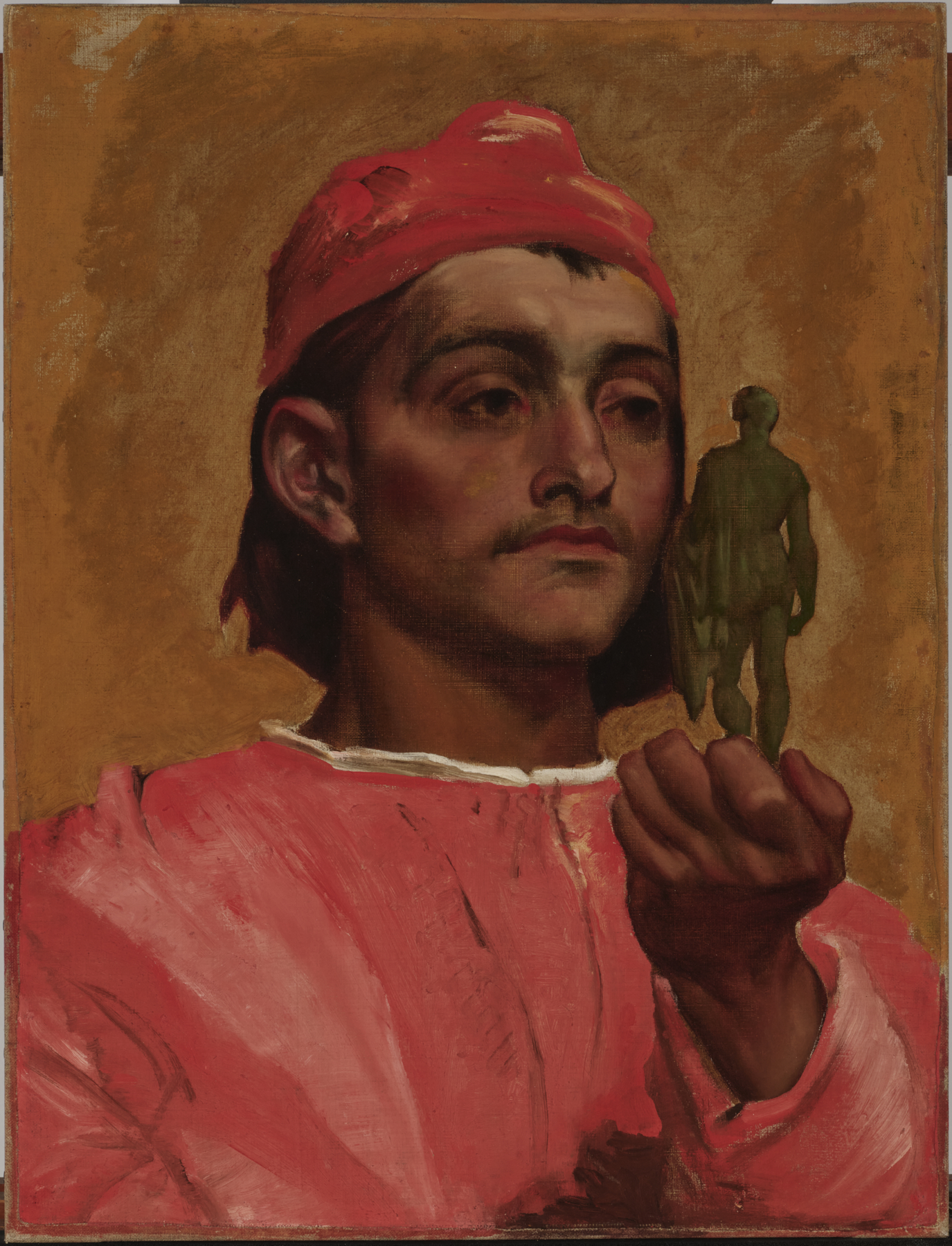
Oil Sketch of Nicola Pisano for the South Kensington Museum
This oil sketch depicts the thirteenth-century Italian sculptor Nicola Pisano and was made in preparation for the decorations Leighton undertook for the South Kensington Museum (now the Victoria and Albert Museum) in London, which ultimately comprised his largest and most prominent public artworks. In nineteenth-century Europe the decoration of public buildings was seen as the highest calling of the painter or sculpture, an idea that looked back to the public buildings of the Renaissance. In line with its mission to educate and inspire the public, the South Kensington Museum’s decorative program depicted canonical artists and artisans from European history. The South Court of the museum, given the nickname “the Kensington Valhalla” after the hall of heroes in Norse mythology, included arched spaces high up on the wall, which ultimately contained thirty-five full-length portraits of artists of both the past and more recent times in oil and mosaic. Leighton’s oil sketch of Pisano is a study for one of these panels. In the mid-nineteenth century Pisano was widely regarded as the father of Renaissance sculpture, and therefore worthy of inclusion. Appropriately, Leighton shows Pisano contemplating a bronze statuette of Mercury from the Roman period, likely drawn from the British Museum’s collection (id. no. 1824,0460.4), and therefore emphasizing that the Renaissance depended on the study of ancient sources. Although no longer in situ, Leighton’s full design for Pisano in oil as well as the completed mosaic are still in the collection of the Victoria and Albert Museum.
Leighton’s oil sketch foregrounds the idea of artistic achievement being passed from male artist to male artist through close visual study. However, Leighton’s oil-sketch also brings to light other alternative stories of male relations. Like other Victorian artists who were trained in the academic system, Leighton’s paintings of the human figure relied on meticulous studies made in front of live models who he employed to pose for him. The status of artists’ models was tenuous, and the job physically demanding, and under paid. In London, models were often part of the Italian immigrant community, and the same is true of the man who posed for Pisano. His name is not known, and the names of models more generally have only begun to be recovered by art historians. It is striking that the likeness of a man from this marginal community was anonymously immortalized at South Kensington.
Provenance
Provenance (from the French provenir, 'to come from/forth') is the chronology of the ownership, custody, or location of a historical object. Learn more about provenance at the Walters.
Acquired (gift?) from the artist by Herbert Arnould Olivier; by descent to James Larsson; Lowell Libson and Jonny Yarker, Ltd., 2024, by purchase; Walters Art Museum, Baltimore, by purchase, 2025.
Measurements
Framed: H: 29 15/16 × W: 24 3/16 × D: 1 15/16 in. (76 × 61.5 × 5 cm); Unframed: H: 20 7/8 × W: 16 1/8 × D: 13/16 in. (53 × 41 × 2 cm)
Credit Line
Museum purchase, 2025
Location in Museum
Not on view
Accession Number
In libraries, galleries, museums, and archives, an accession number is a unique identifier assigned to each object in the collection.
In libraries, galleries, museums, and archives, an accession number is a unique identifier assigned to each object in the collection.
37.2955