
 Creative Commons License
 Creative Commons License


Lampada
(18th and 19th Centuries )
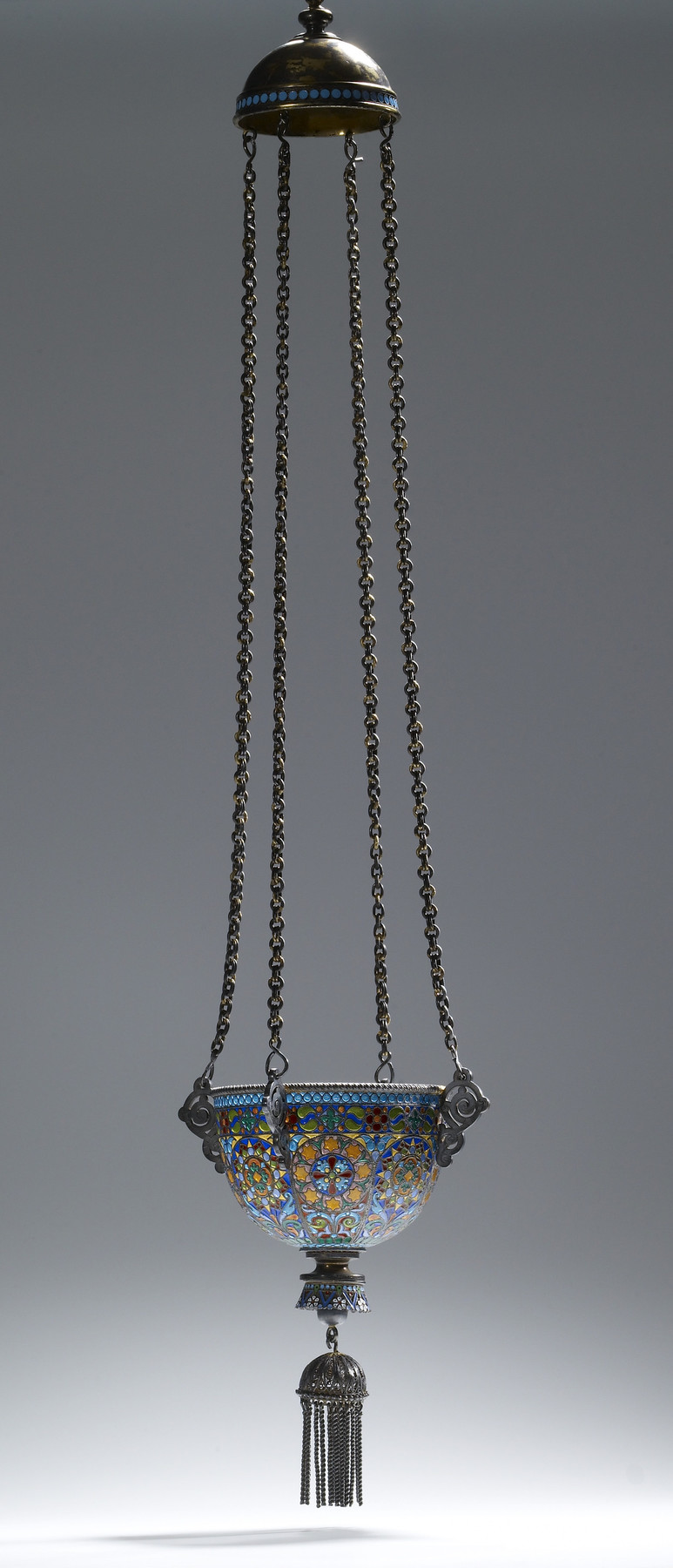
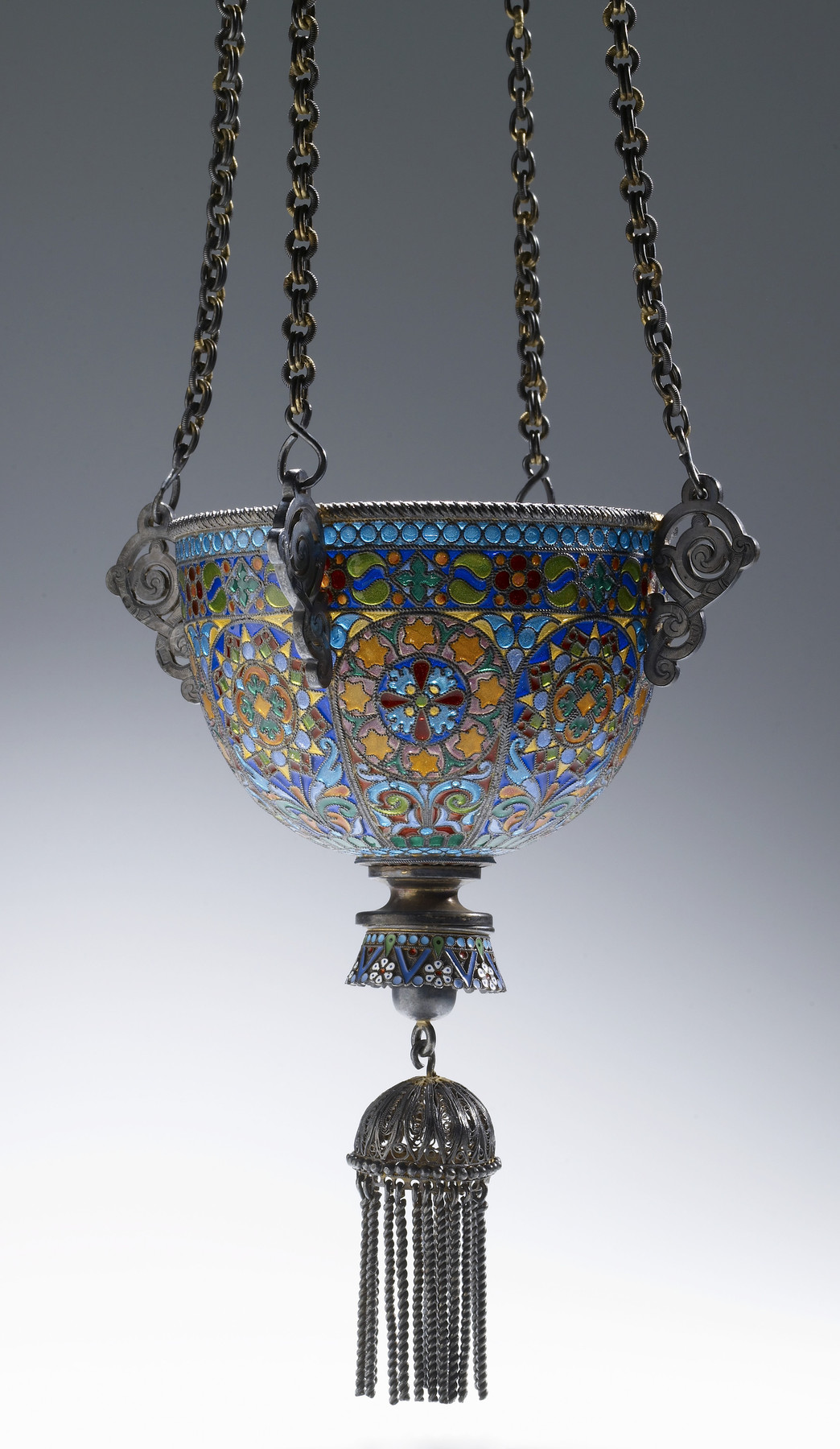
The bowl of the lampada, or icon lamp, is composed of eight arched segments, each containing a large, stylized blossom borne on a short stem with leaves executed in orange, pink, red, blue, turquoise and light green plique-à-jour enamel. The top edge is bordered by a row of light blue circles and a band of abstract floral motifs. Around the bottom there is a row of green lozenges and one of light blue circles. The base, in contrast, is in silver gilt decorated with a row of light blue circles, a zigzag pattern, and blue and white blossoms all in raised filigree enamel. A filigree wire tassel with twisted wire pendants is suspended from the foot. The enameling on the lampada's cap is limited to a row of light blue circles in opaque filigree enamel. Four chains, suspended from the cap, reach to the four scrolled handles on the bowl.
Inscription
Provenance
Provenance (from the French provenir, 'to come from/forth') is the chronology of the ownership, custody, or location of a historical object. Learn more about provenance at the Walters.
Leo Kaplan, Ltd., New York; Jean M. Riddell, Washington, D.C., December 15, 1972, by purchase; Walters Art Museum, 2010, by bequest.
Geographies
Russia, Moscow (Place of Origin)
Measurements
Bottom with tassle: H: 3 9/16 x Diam: 4 1/8 in. (9.1 x 10.5 cm)
Chain a: L: 16 5/8 in. (42.3 cm)
Chain b: L: 16 3/4 in. (42.5 cm)
Chain b: L: 16 13/16 in. (42.7 cm)
Lid: H: 3 7/16 x Diam: 2 15/16 in. (8.7 x 7.5 cm)
Lid chain: L: 16 5/8 in. (42.3 cm)
Credit Line
Bequest of Mrs. Jean M. Riddell, 2010
Location in Museum
Not on view
Accession Number
In libraries, galleries, museums, and archives, an accession number is a unique identifier assigned to each object in the collection.
In libraries, galleries, museums, and archives, an accession number is a unique identifier assigned to each object in the collection.
44.757