
 Creative Commons License

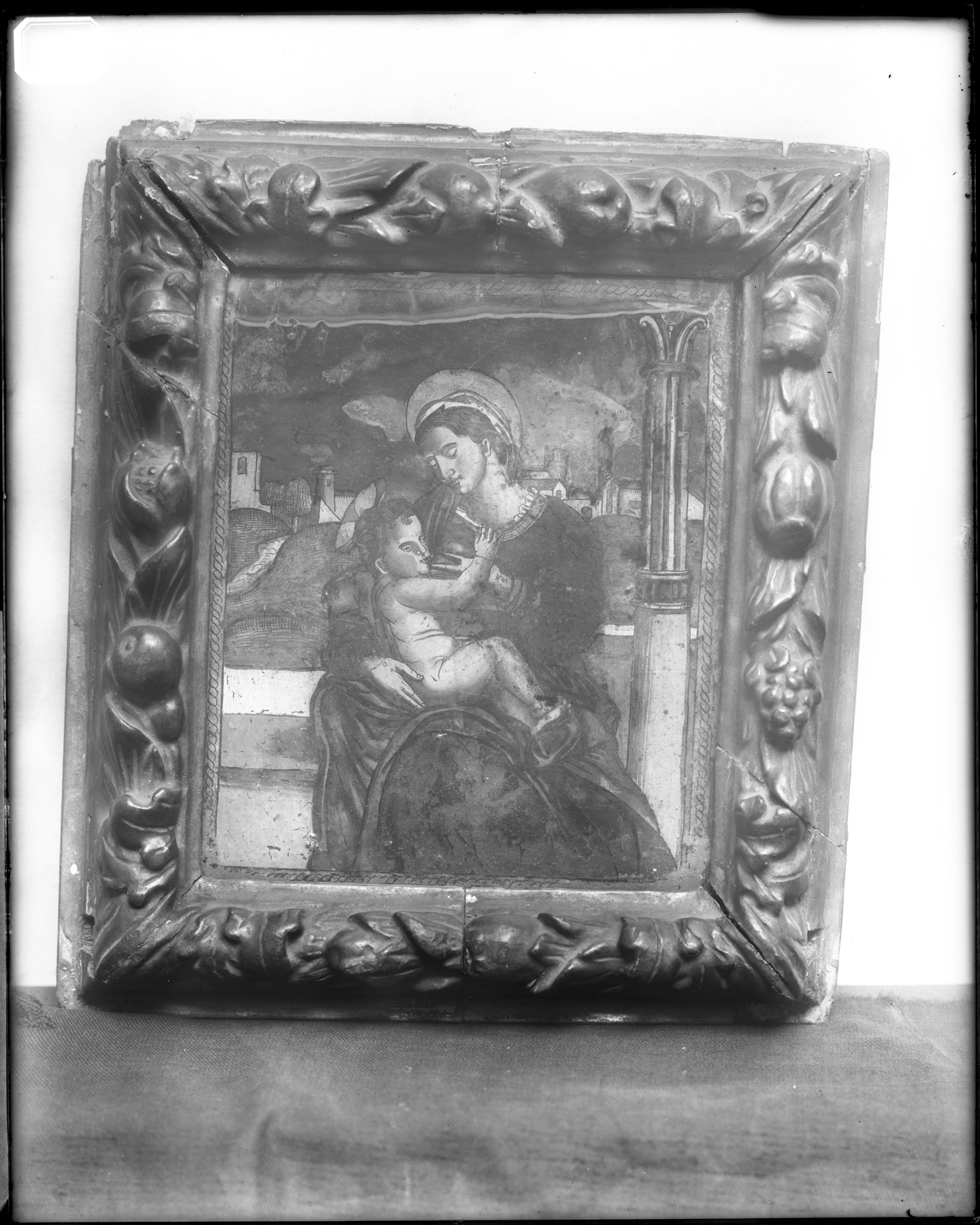
Plaque with the Virgin Nursing the Christ Child
In this reverse gilded and painted glass (verre églomisé) plaque, the Virgin Mary nurses the Christ child on her lap, and Jesus tenderly reaches toward the neck of his mother’s garment. They sit in a covered portico, indicated by the column that appears next to them.
The use of hatching in the background suggests that this image was based on an unidentified print. In the verre églomisé technique, the artist would begin by sketching the foreground, outlined in black, on the back of the pane of glass, adding depth and texture through shading and polychromy. After this, the Virgin and Child’s halos were rendered in gold leaf. The verre églomisé technique thus required the reversal of a painter’s usual practice, as highlights in the foreground needed to be added before figures and the background, requiring the artist to keep the finished image in their mind while applying each layer.
Provenance
Provenance (from the French provenir, 'to come from/forth') is the chronology of the ownership, custody, or location of a historical object. Learn more about provenance at the Walters.
F. Ongania, Venice, [date and mode of acquisition unknown]; Henry Walters, Baltimore, 1911, by purchase; Walters Art Museum, 1931, by bequest.
Geographies
Italy, Venice (Place of Origin)
Measurements
Overall (with frame): H: 11 3/8 × W: 10 1/4 in. (28.9 × 26 cm)
Image (without frame): H: 7 7/8 × W: 6 9/16 in. (20 × 16.7 cm)
Location in Museum
Not on view
Accession Number
In libraries, galleries, museums, and archives, an accession number is a unique identifier assigned to each object in the collection.
In libraries, galleries, museums, and archives, an accession number is a unique identifier assigned to each object in the collection.
46.18