
 Creative Commons License
 Creative Commons License
 Creative Commons License
 Creative Commons License
 Creative Commons License


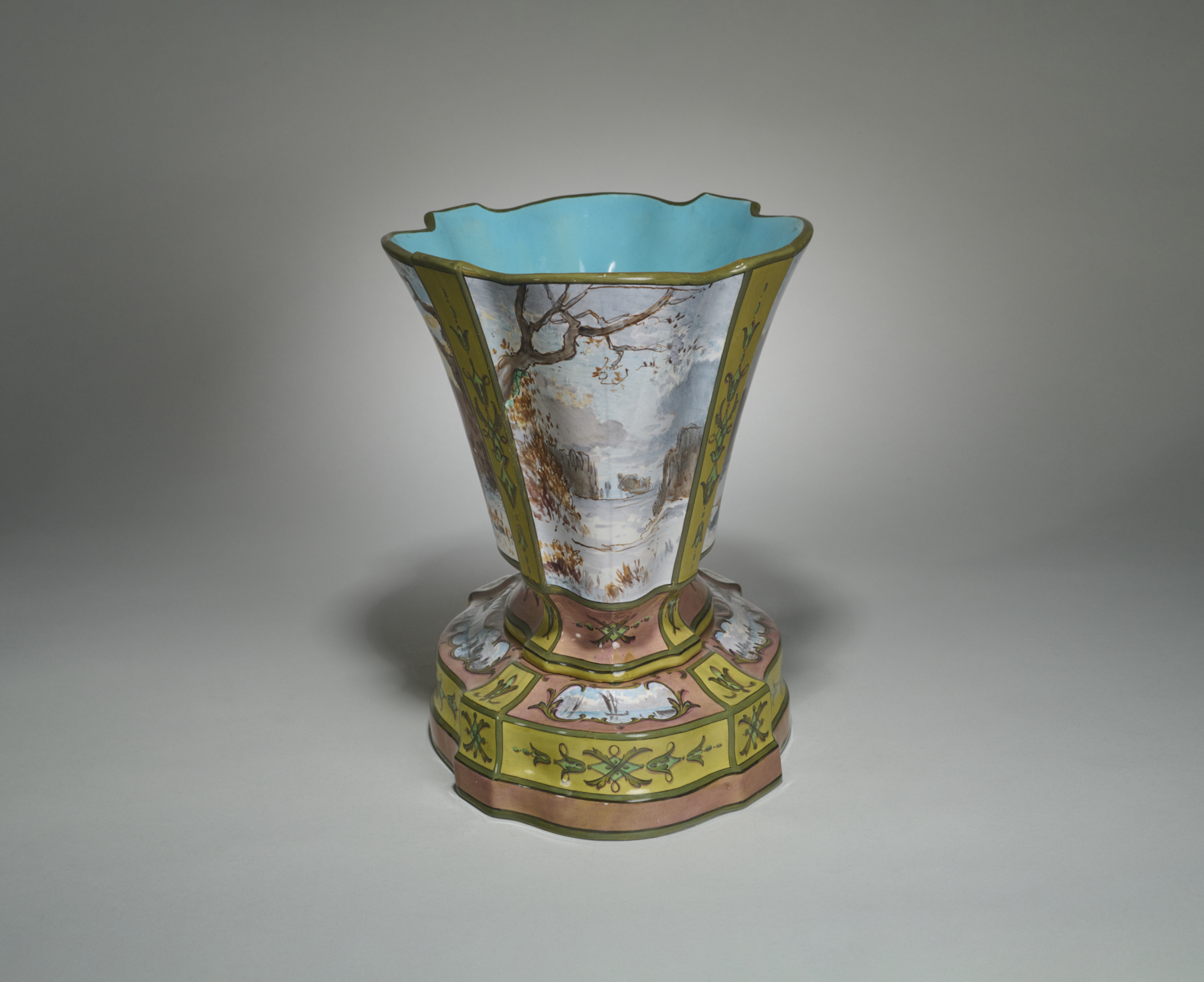
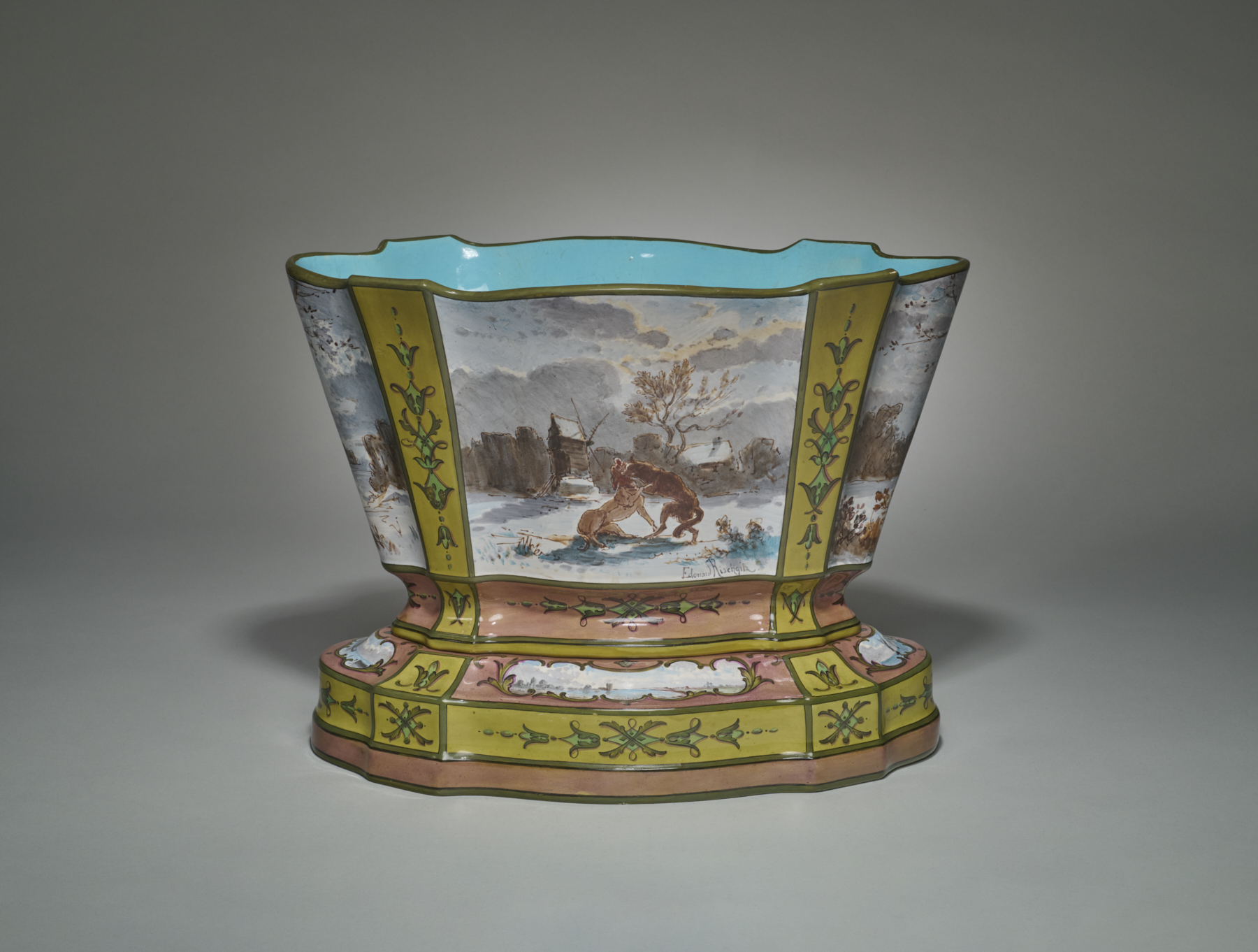
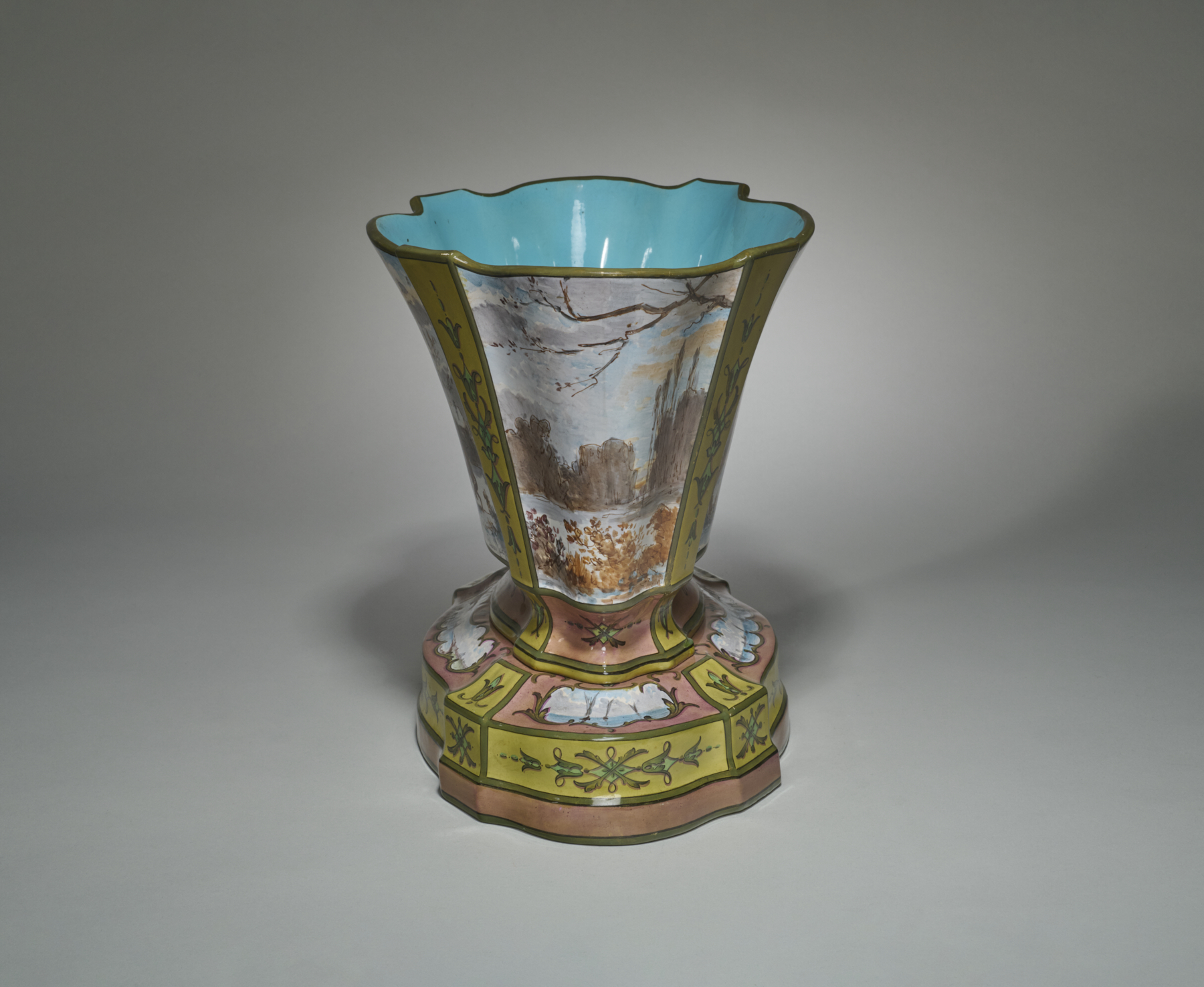
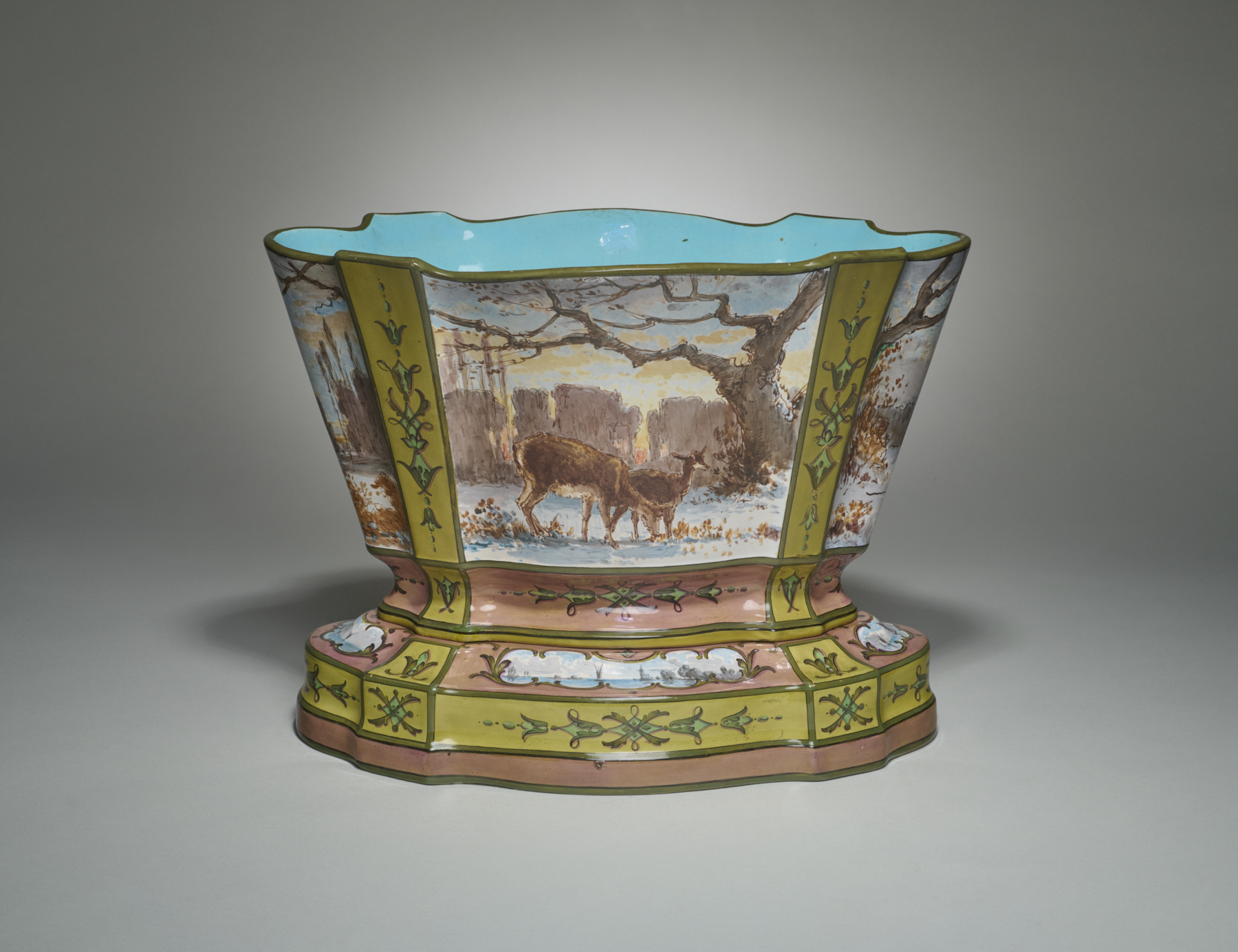
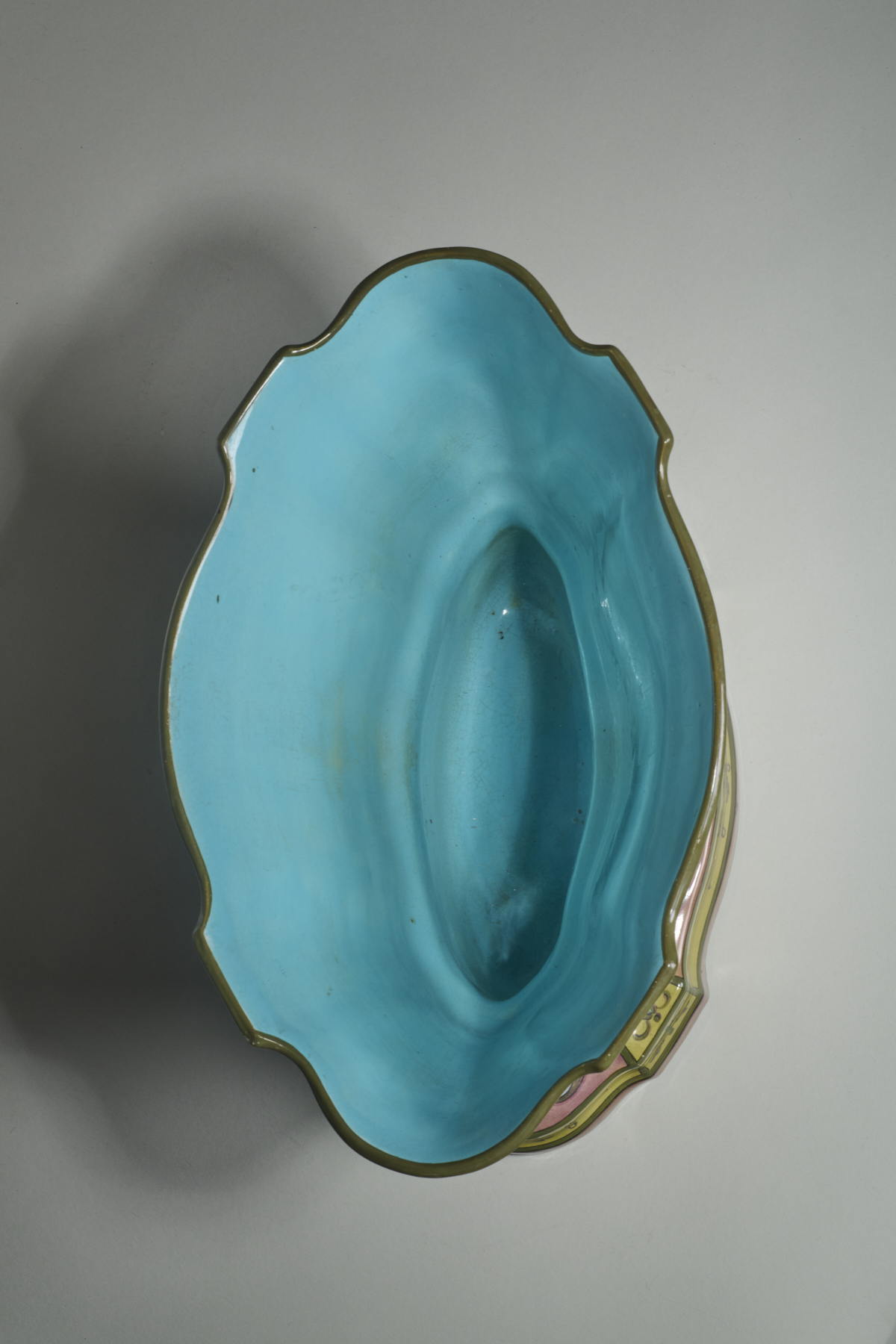
Vase with Scenes of Wolves and Deer
This vase is an exceptional example of a subset of the majolica production of Minton, the leading British manufacturer, in which the lead-glazed earthenware has been further enhanced by additional decoration painted in enamels. While the painted decoration on this vase shares some parallels with the Renaissance maiolica that may have inspired this category of Minton’s production, the painted scene in its light and sketch-like rendering of animals in landscape settings was quite contemporary for art ceramics of its time and is characteristic of the work of the Anglo-Swiss artist Edouard Rischgitz, its creator. Rischgitz, born in Geneva to a family with Hungarian and French roots, had a long and varied career, working across three countries and in a variety of media from the early 1850s until his death in 1909. Research has revealed relatively little about his background other than his father, Pierre Paul Rischgitz (1798/1799–1866) operated a jewelry manufacturing and retailing business in Geneva, a firm that exhibited as part of the Swiss delegation at the 1855 Exposition Universelle in Paris. The family firm created a variety of jewelry and luxury goods and enamelwork was amongst its offerings, possibly allowing Rischgitz access in his youth to explore the decorative possibilities of enamels, a medium he would return to throughout his life. Rischgitz also trained as a painter during his youth. While his obituaries or profiles written late in his life characterized him as a student of Corot, no further evidence of this claim has come to light. In fact, he was often identified as a student of the Swiss landscape painter François Diday (1802–1877), during the early 1850s and through the mid 1860s when Rischgitz had some success as a painter of landscapes. He regularly exhibited his work, mostly of the Swiss countryside and mountains, in the burgeoning number of annual exhibitions taking place in Switzerland and neighboring France during this period. Indeed, by the early 1860s he had relocated to the French capital, the artistic center of Europe at the time. Rischgitz was amongst the many Continental European artists which Minton & Co. recruited to design and decorate ceramics from the late 1840s through the 1870s. Rischgitz relocated to Stoke-on-Trent, Staffordshire, where Minton was based, in 1863 or early 1864 and would remain in England until about 1867 before returning to Paris. By about 1870 he was back in the UK, this time to London, where he would work and live until his death almost 40 years later.
It is unclear how much experience in decorating ceramics Rischgitz brought with him to Minton, but shortly after joining the firm his work was being prominently featured. In 1865, through the auspices of Thomas Goode and Co., its London-based retailer, Minton exhibited a range of works at the International Exhibition of Arts and Manufactures, a world's fair held in Dublin, Ireland. Among these the reviewer for London’s Morning Post remarked “but what strikes the observer most is the collection of vases painted by Rischgitz, a Hungarian, whose style is remarkable for great boldness and good colouring.” The same year Minton donated two examples of Rischgitz work in “modern majolica” (accession numbers 5-1865 and 6-1865) to the South Kensington Museum (today the Victoria and Albert Museum), which had been actively assembling examples of the best of modern manufactures to serve as examples for students, artists, and designers since the early 1850s. Minton once again featured Rischgitz’s work in its display at the 1867 Exposition Universelle in Paris. It seems that Rischgitz stopped working full-time for Minton about 1867, although he may have continued to produce works for the firm on a freelance basis. In the next few years he would decorate and exhibit ceramics under his own name in Paris and would also decorate works for the leading Parisian retailer Eugène Rousseau (1827–1890), who had recently received acclaim for Japanesque ceramic services designed by Félix Bracquemond (1833–1914). Rousseau exhibited Rischgitz work at the London International Exhibition of 1871 as did the British ceramics manufacturer W. T. Copeland & Sons. In addition to works for Copeland and Minton, Rischgitz-decorated pieces for another leading English firm, Josiah Wedgwood and Sons, also regularly appear in the art market and likely date to the period 1864–1875. His varied career in the next few decades included publishing and teaching about ceramic decoration and painting on textiles, working in enamels, acting as a founding member of Society of Painter-Etchers (today the Royal Society of Painter-Printmakers), and reaching some acclaim for his drawings, etchings, and paintings. He also had success teaching painting and appears to have been immersed in the art world from his youth forward. Tellingly, several of his children were involved in the arts, including two daughters who were painters and also taught art, Alice (1857–1936) and Mary (or Maria, 1864–1939), as well as a son Augustin Rischgitz (1863–1925), an arts journalist, print dealer, and founder of an early stock image company.
In addition to its decoration, this vase is interesting for its form, which in large part copies a model developed by Sèvres, the then royal porcelain manufactory of France. Sèvres first introduced the vase hollandois in 1754 and produced this model and redesigned versions of it in significant quantities for several decades. Minton first began making copies of various vase hollandois models as early as the 1830s, likely responding to a growing interest in 18th-century Sèvres amongst British consumers. Indeed, Minton’s copies of 18th-century Sèvres shapes continued to be a mainstay for the firm–like many other British manufacturers of the period–until the early 20th century. The Rischgitz-decorated example differs from the prototype in key ways–it is missing the holes that perforated the bottom of the original vase section so that water in the base could be drawn up and the open sections in the original base’s upper part are missing–these are only gestured to in the painted decoration of the Minton vase. Perhaps this was an effort to somewhat modernize the historic shape in this case. Indeed, we know that Minton was making almost exact copies of 18th-century Sèvres during this period. One example is a vase hollandois made in 1760 and now in the collection of the Philadelphia Museum of Art (accession no. 1939-41-46Aa--Ac), and a Minton copy which was acquired by William T. or Henry Walters and is now in the WAM collection (accession no. 48.735).
Inscription
Provenance
Provenance (from the French provenir, 'to come from/forth') is the chronology of the ownership, custody, or location of a historical object. Learn more about provenance at the Walters.
Majolica Auctions by Michael G. Strawser, Hatfield, Pennsylvania, “Two Day Majolica Auction, The Estate of Mrs. Ellis (Anna) E. Stern, 1500 Pieces,” 23-24 October 1998, lot 707; purchased by Deborah and Philip English, Baltimore, 1998; given to the Walters Art Museum, 2025.
Measurements
H. 9 5/16 x W. 12 5/16 x D. 7 5/8 in. (23.3 x 31.2 x 19.3 cm)
Credit Line
Gift of Deborah and Philip English, 2025
Location in Museum
Not on view
Accession Number
In libraries, galleries, museums, and archives, an accession number is a unique identifier assigned to each object in the collection.
In libraries, galleries, museums, and archives, an accession number is a unique identifier assigned to each object in the collection.
48.2947