
 Creative Commons License
 Creative Commons License


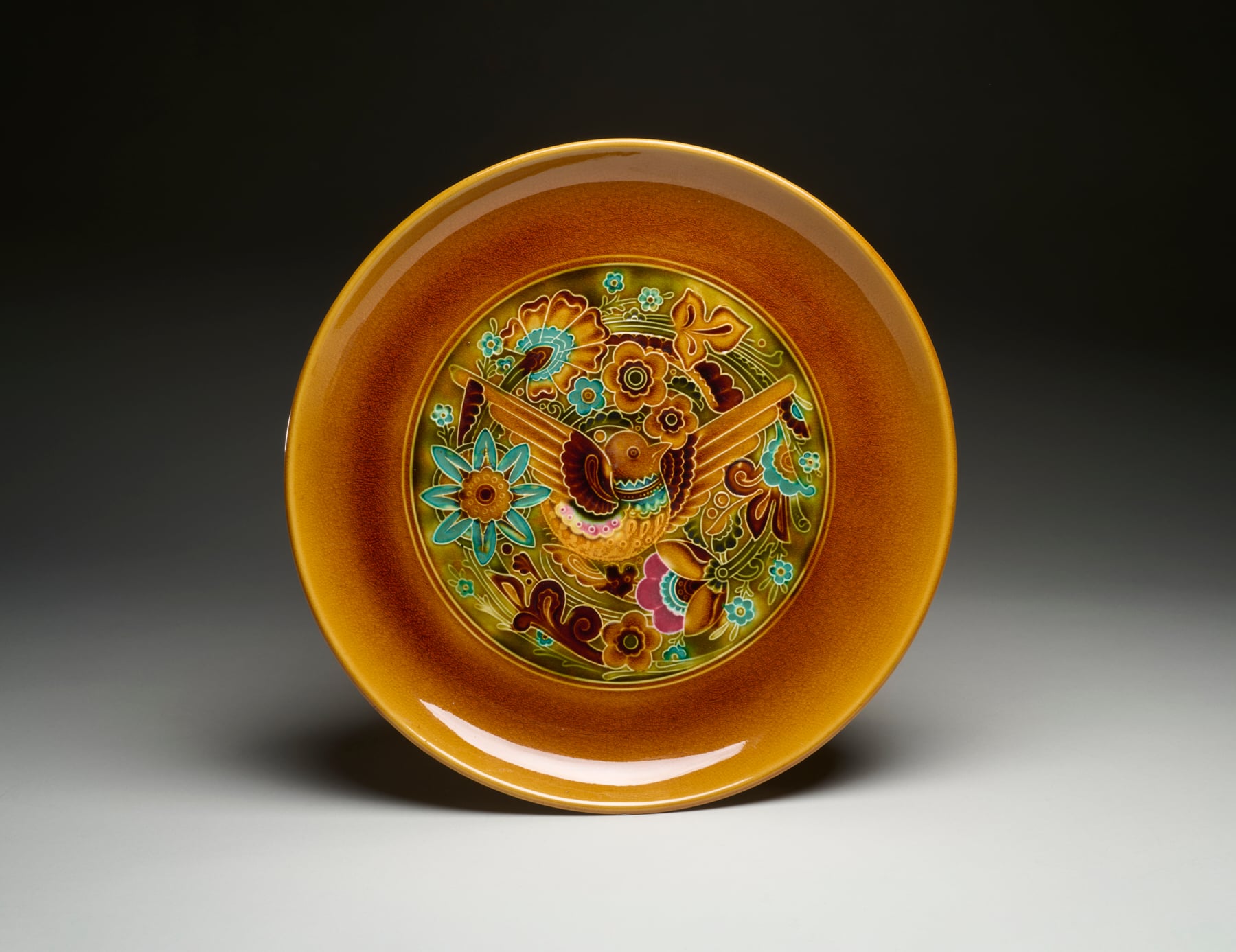
Plate
The designer and scholar Christopher Dresser (1834–1904) is often hailed as Britain’s first modern industrial designer. In 1862, influenced by the ideas of leading architects and design reformers Owen Jones and A. W. N. Pugin, Dresser published a treatise titled "The Art of Decorative Design." Dresser went on to distinguish himself as one of the most innovative designers of the era, creating ceramics and decorative housewares in molded glass and metalwork, as well as carpets, fabrics, wall treatments, stained glass, and furniture. Guided by the ideals he characterized as “Truth, Beauty, and Power” to create morally uplifting art, Dresser was also a keen businessman who capitalized on Britain’s industrialization to create affordable and satisfying designs for the burgeoning middle classes.
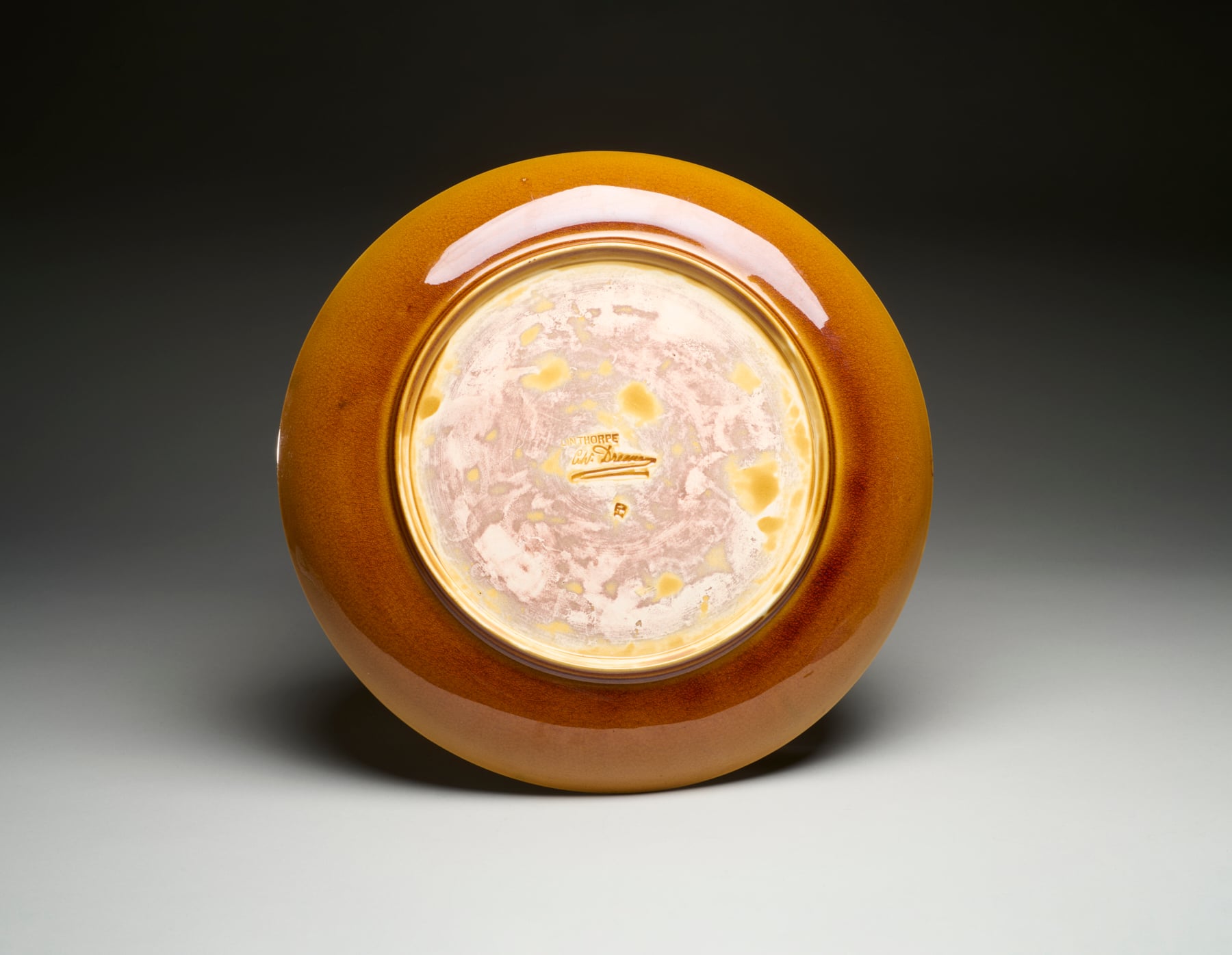
In 1879, Christopher Dresser partnered with John Harrison, the owner of a defunct brick works in Middlesbrough, North Yorkshire, to found the Linthorpe Art Pottery. Dresser took on the role of art director, appointing Henry Tooth, an aspiring artist who had worked in the local brickworks in his youth, to the role of manager. The pieces made during Tooth’s 1879 to 1882 tenure, like this plate, are marked with the monogram “HT.” During this period, the company employed around 100 workers. Linthorpe products were available to purchase from both Dresser & Holme, the designer’s retail venture that specialized in imported goods from Asia, and his ambitious collective design showroom, the Art Furnishers’ Alliance. They were also sold by the luxury department store Liberty & Co. of London.
As a designer, Dresser drew inspiration from the artistic traditions of South America, the ancient Mediterranean and Western Asia, prehistoric Britain, Fiji, and especially Japan. While Dresser never traveled to Central America, the decoration of this plate may have been inspired by the intricate swirling designs of flowers and animals featured in the Tonalá and Talavera pottery traditions of Mexico to design the decoration for this plate. During the 19th century, works of ancient Mesoamerican architecture, stone carving, and wall painting reached a British audience through the travel accounts of figures like British diplomat and student of Maya archaeology Alfred Maudsley, who left a Talavera vessel from his collection to the Victoria and Albert Museum.
A design in the Minton Archive, signed by Dresser, matches the decoration of this plate, and is accompanied by two related designs for plates decorated with a butterfly and a sitting bird motif. While it is unclear exactly when Dresser began designing for Minton, the relationship was certainly established by the early 1860s. This series was never realized by Minton, but Dresser returned to them in the 1880s when all three of these designs were applied to earthenware plates made at Linthorpe. Unlike most of Dresser’s work for Linthorpe, the plate designs emphasize surface decoration over sculptural form.
Inscription
Provenance
Provenance (from the French provenir, 'to come from/forth') is the chronology of the ownership, custody, or location of a historical object. Learn more about provenance at the Walters.
Collection of Peter Rose and Albert Gallichan, Brighton, England, by 2004 [mode of acquisition unknown]; sale, Christie’s, London, “An Aesthetic Odyssey: The Peter Rose and Albert Gallichan Collection,” 30 September 2021, lot 84; purchased by Deborah and Philip English, Baltimore, 2021; given to the Walters Art Museum, 2025.
Measurements
H: 1 3/8 × Diam: 11 1/2 in. (3.4 × 29.3 cm)
Credit Line
Gift of Deborah and Philip English, 2025
Location in Museum
Not on view
Accession Number
In libraries, galleries, museums, and archives, an accession number is a unique identifier assigned to each object in the collection.
In libraries, galleries, museums, and archives, an accession number is a unique identifier assigned to each object in the collection.
48.2960