
 Creative Commons License
 Creative Commons License


Oyster Plate
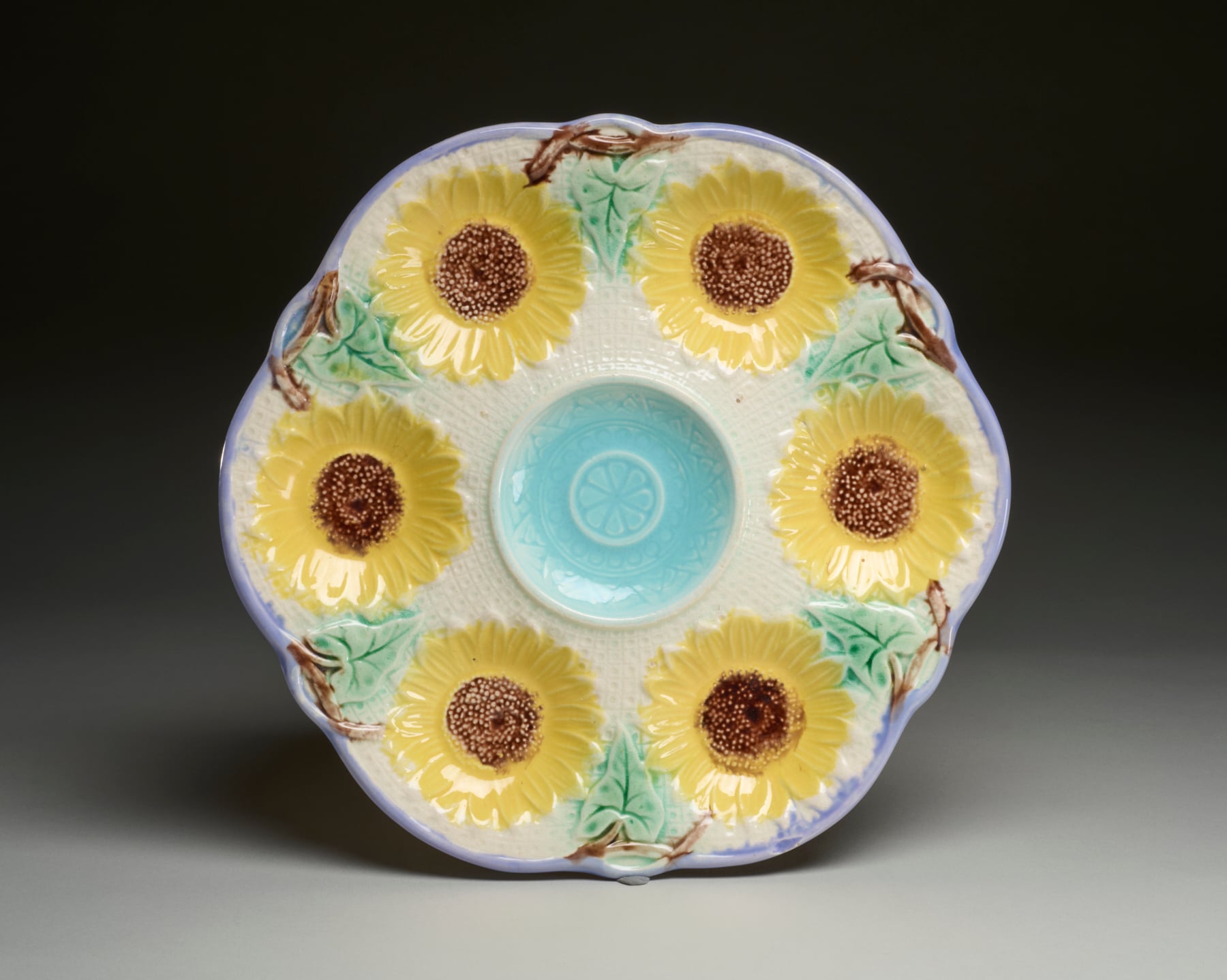
Based in Hanley, Staffordshire, Samuel Lear (ca. 1853–1888) founded his eponymous company in about 1874, developing it from a warehousing business into a successful ceramic factory, which made inexpensive majolica, often tablewares, from 1881 to 1886. Lear aggressively pursued foreign markets for his wares and frequently ran advertisements in the trade press, including one that illustrated the model considered here among a range of the company’s offerings and instructed “Buyer’s Attention Is Particularly Called to the Superior Quality of Majolica”. By December 1886, the pottery’s financial difficulties prompted Lear to sell the entire business to Thomas Forester, a leading entrepreneur and majolica manufacturer. Upon receipt of the funds from the sale, Lear secretly fled Staffordshire and defaulted on all of his debts. Less than two years later, his body was found in a shipwreck off the coast of New Zealand.
In May 1882, Lear copyrighted the design featured on this oyster plate by registering it with the British Designs Registry. This government entity was created by the United Kingdom’s 1839 Designs Registration Act, which protected manufacturers from unauthorized copying of “ornamental” designs that were registered. As part of submitting a design for registration, a manufacturer had to include a “representation” of the design, often a drawing or, as time went on, a photograph. In the case of this design the photograph features a teapot on which the pattern has been applied. This pattern–which features sunflowers in classical-style urns next to fans combined with bands and circles of geometric ornament–was used on a range of shapes including salad bowls, tea sets, dessert plates, trays, butter dishes, and oyster plates like this one. These items feature pastel-colored glazes on a white or ivory ground, a combination inspired by the popularity of the white-ground decoration style first introduced by Wedgwood in the late 1870s, which that firm dubbed “Argenta.”
With this pattern Lear catered to the fashion in the 1880s for sunflower motifs. The flower was an emblem of the fashionable Aesthetic movement, which held it up as an archetypal symbol of beauty. Sunflowers were often depicted in other contexts, including in popular music and theater, as well as on a range of household goods and more ephemeral objects like packaging and in advertisements. Several other majolica manufacturers produced sunflower wares at this time including the British firms Wardle & Co.; Josiah Wedgwood & Sons; and S. Fielding & Co.; as well as the American pottery Griffen, Smith & Company.
Inscription
Provenance
Provenance (from the French provenir, 'to come from/forth') is the chronology of the ownership, custody, or location of a historical object. Learn more about provenance at the Walters.
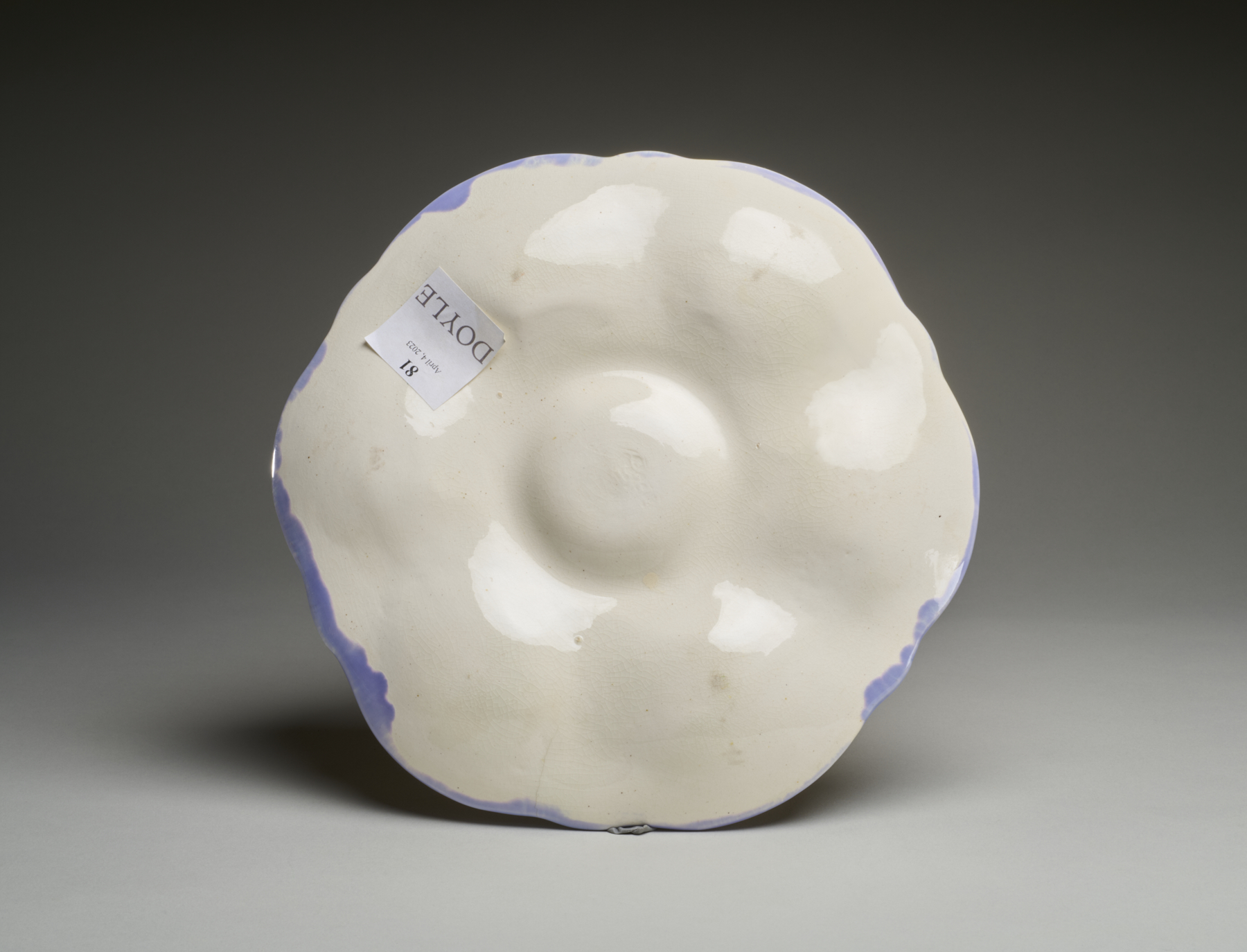
Collection of Joan Stacke Graham, New York, by 2016 [date and mode of acquisition unknown]; sale, Doyle Auctioneers & Appraisers, New York, “The Joan Stacke Graham Majolica Collection: Part II,” 4 April 2023, lot 81; purchased by Deborah and Philip English, Baltimore, 2023; given to the Walters Art Museum, 2025.
Exhibitions
| 2021-2022 | Majolica Mania. The Bard Graduate Center, New York; The Walters Art Museum, Baltimore. |
Measurements
H: 7/8 x Diam: 10 in. (2.2 x 25.3 cm)
Credit Line
Gift of Deborah and Philip English, 2025
Location in Museum
Not on view
Accession Number
In libraries, galleries, museums, and archives, an accession number is a unique identifier assigned to each object in the collection.
In libraries, galleries, museums, and archives, an accession number is a unique identifier assigned to each object in the collection.
48.2985