
 Creative Commons License
 Creative Commons License


Pugin Dessert Plate
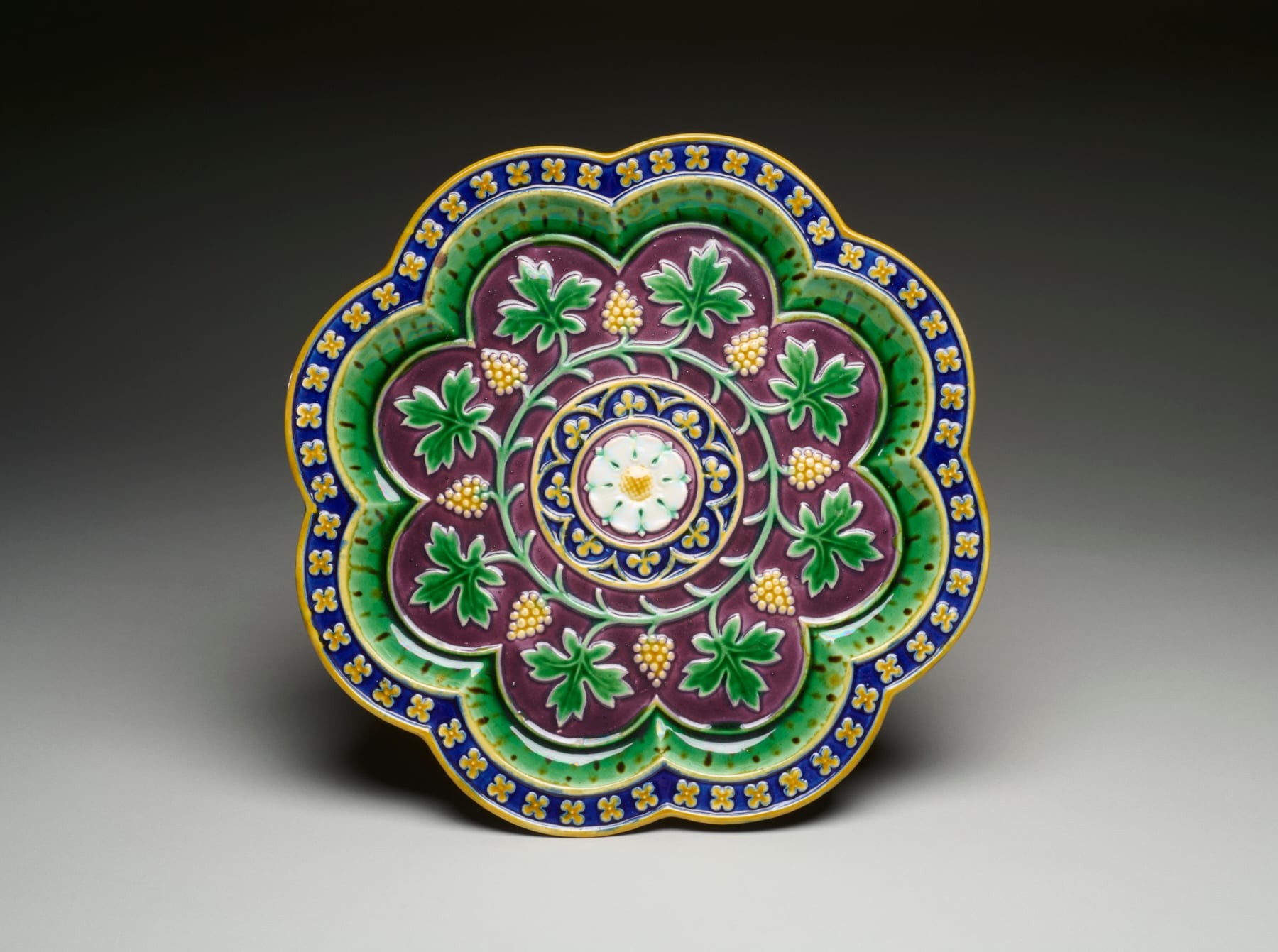
The revival of the Gothic or medieval style during the mid-19th century was tied to its evocation of an era characterized by chivalry and strong Christian faith. Many in Britain laid claim to the Gothic as an indigenous style, one reinforcing a sense of national identity. The prominent architect and designer Augustus Welby Northmore Pugin was a champion of the style’s revival and applied Gothic ornament to a wide range of buildings and interiors, including the Palace of Westminster, home to Britain’s Houses of Parliament, as well as to all manner of objects, including furniture, metalwork, and ceramics. Pugin formed an important relationship with Herbert Minton, the head of Minton & Co. at the time, and created a range of designs for the firm. Pugin’s designs for Minton chiefly consisted of a range of tiles that would be used to furnish many 19th-century structures, but the designs also included a garden seat as well as a range of tableware items, the most well-known being a bread plate model with the motto "Waste Not Want Not.” While most of Pugin’s designs were not made in majolica, this plate is an interesting exception. Its flat, stylized leaf and flower motifs and its vibrant colors are typical of his decorative vocabulary. Pugin converted to Catholicism in 1834 and may also have incorporated some subtle religious symbolism into his design: the white rose could represent the Virgin Mary; the three-leaf clover, the Trinity; and the grapes, the communion wine. A porcelain example of this model in the Victoria and Albert Museum, London, carries a Minton year cipher mark for 1848, giving us an approximate date for the design.
Inscription
Provenance
Provenance (from the French provenir, 'to come from/forth') is the chronology of the ownership, custody, or location of a historical object. Learn more about provenance at the Walters.
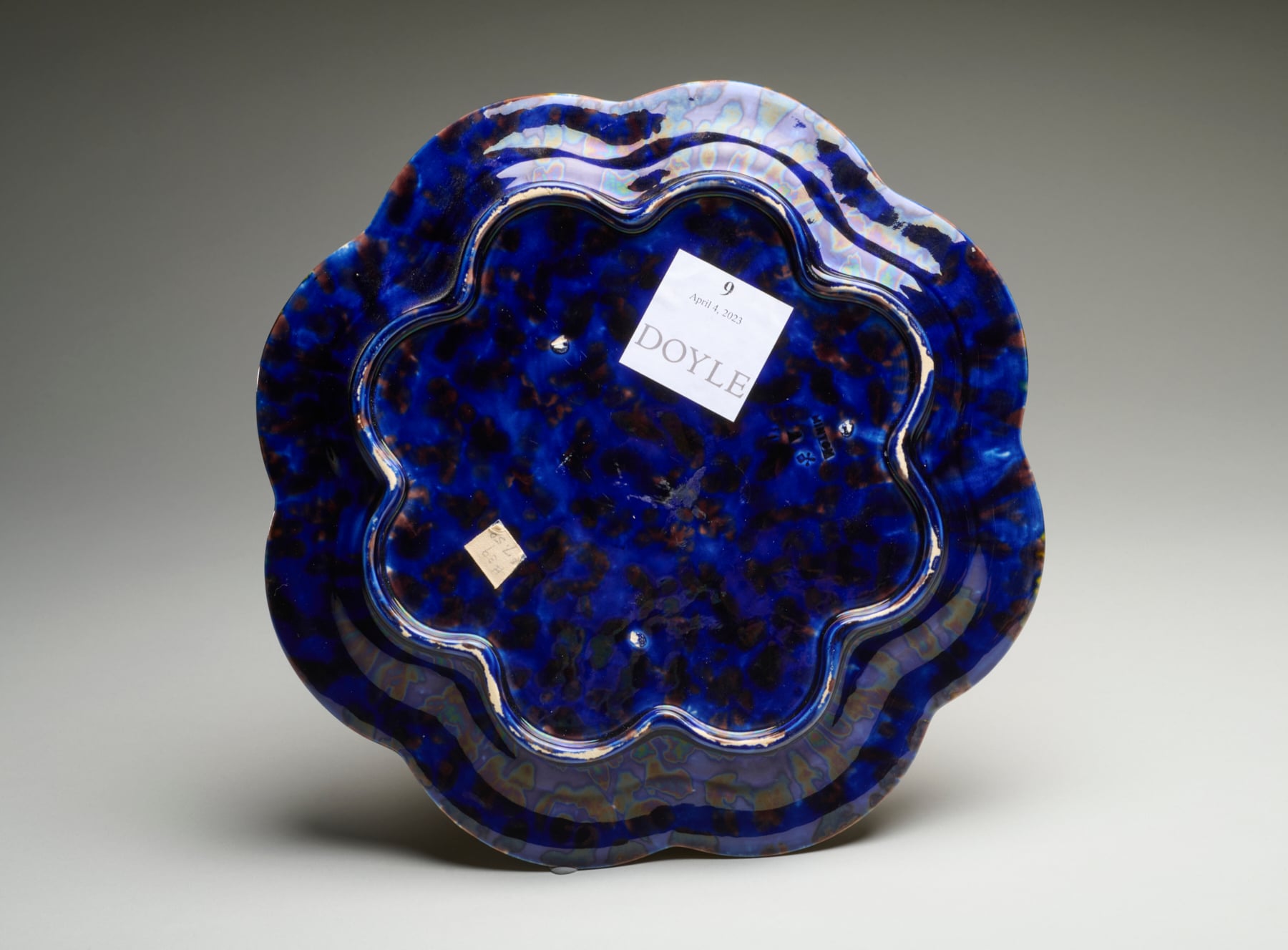
Sale, Strawser Auction Group, Hatfield, Pennsylvania, “Fine Majolica For The Connoisseur 2016,” 29 October 2016, lot 13; purchased by Joan Stacke Graham, New York, 2016; sale, Doyle Auctioneers & Appraisers, New York, “The Joan Stacke Graham Majolica Collection: Part II,” 4 April 2023, lot 9; purchased by Deborah and Philip English, Baltimore, 2023; given to the Walters Art Museum, 2025.
Exhibitions
| 2021-2022 | Majolica Mania. The Bard Graduate Center, New York; The Walters Art Museum, Baltimore. |
Measurements
H: 7/8 x Diam: 9 1/2 in. (2.2 x 24.2 cm)
Credit Line
Gift of Deborah and Philip English, 2025
Location in Museum
Not on view
Accession Number
In libraries, galleries, museums, and archives, an accession number is a unique identifier assigned to each object in the collection.
In libraries, galleries, museums, and archives, an accession number is a unique identifier assigned to each object in the collection.
48.2986