
 Creative Commons License
 Creative Commons License


Frog Pendant
(Ancient Americas )
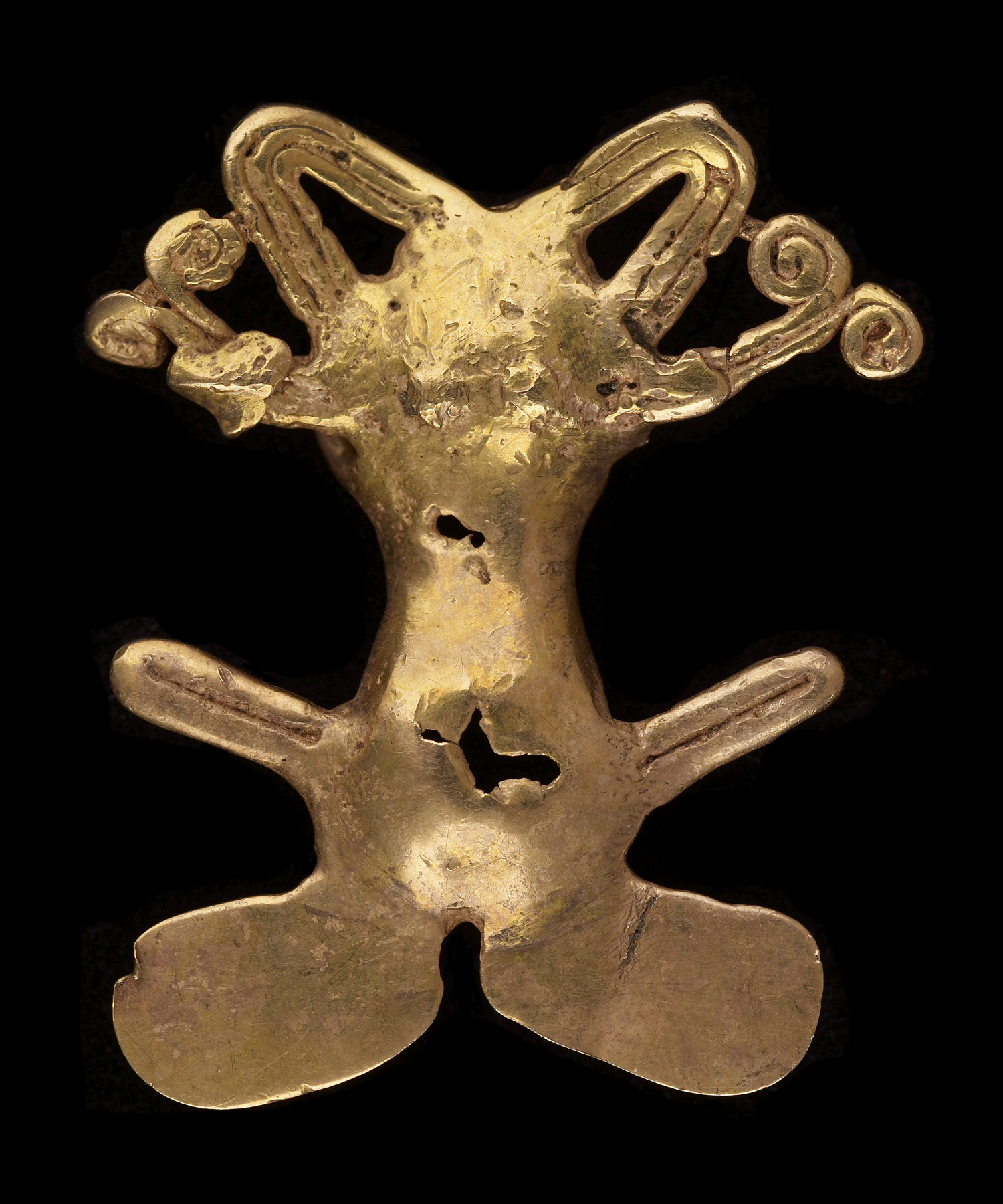
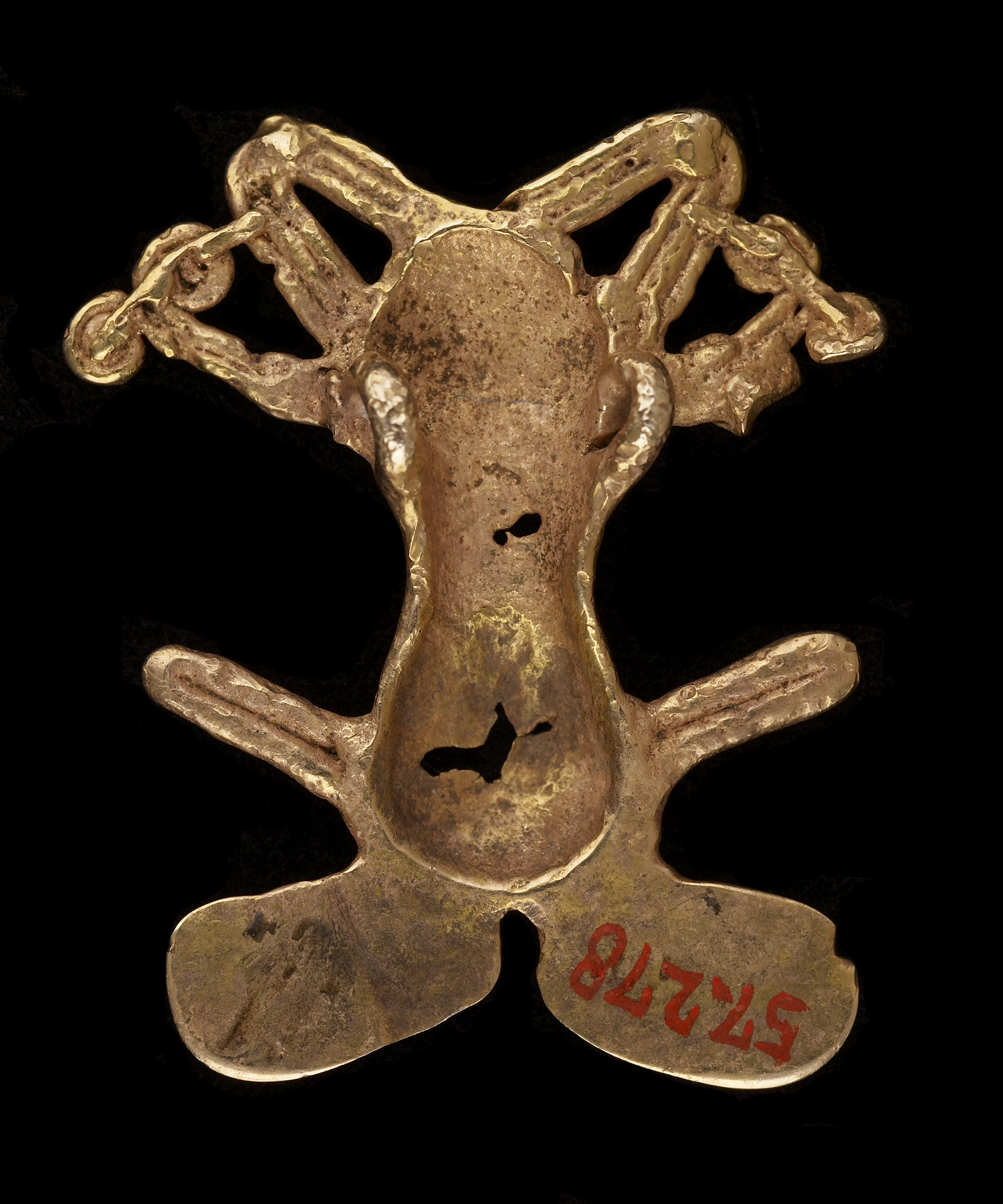
This frog pendant may be a totem, symbolic of transformational abilities or special connections to the supernatural. Here, the body of the frog tapers in the center, with most of the design focused on the front and back end of the pendant. Two tongues emerge from the mouth, obscuring the forelimbs of the frog. The tongues are fluted and end in scrollwork, following the artistic convention at the time. Similarly, the back feet are comprised of two smooth, paddle-like protrusions. The thin back legs which protrude from the amphibian’s lower half may indicate this pendant is a tree frog. Pendants of this type rarely delineate toes on the hindlegs, and many further exaggerate this rectangular foot shape. Two loops are affixed to the back of the piece underneath the arms, allowing the work to be suspended. The surface bears signs of chips and losses.
Indigenous craftsmen carefully shaped and polished works of gold, shell, jade and other materials, enhancing the powerful forces that animated them. When leaders wore these ornaments, it was for more than beauty: they were able to harness powers inherent to the materials themselves, their origins in faraway places, or adhered to them through ancestral use. In Central America gold was and is an embodiment of the sun’s energy and emblematic of male fertility. Gold artifacts from “Veraguas-Gran Chiriqui” (in present-day Panama) are primarily objects of personal adornment, made of gold alloyed with other metals, chiefly copper. Such jewelry was a marker of rank; only chiefs, the elite nobility, and courageous warriors wore these objects, especially in ceremonies.
Provenance
Provenance (from the French provenir, 'to come from/forth') is the chronology of the ownership, custody, or location of a historical object. Learn more about provenance at the Walters.
[Found at a graveyard between Divalá (a village on the outskirts of settled Panama, thirty miles west of David in the province of Chiriqui) and Costa Rica, Spring 1909]; purchased [1] by Tiffany & Co. New York, 1910; purchased by Henry Walters, Baltimore, 1911; by bequest to Walters Art Museum, 1931.
[1] from "Indians," see December 29, 1910 correspondance from Tiffany & Co. to Henry Walters
Exhibitions
| 2015 | Gold of the Ancient Americas. The Walters Art Museum, Baltimore. |
Geographies
Panama, Veraguas (Place of Origin)
Measurements
Overall: 1 9/16 in. (3.9 cm)
Credit Line
Acquired by Henry Walters, 1911
Location in Museum
Not on view
Accession Number
In libraries, galleries, museums, and archives, an accession number is a unique identifier assigned to each object in the collection.
In libraries, galleries, museums, and archives, an accession number is a unique identifier assigned to each object in the collection.
57.278