
 Creative Commons License

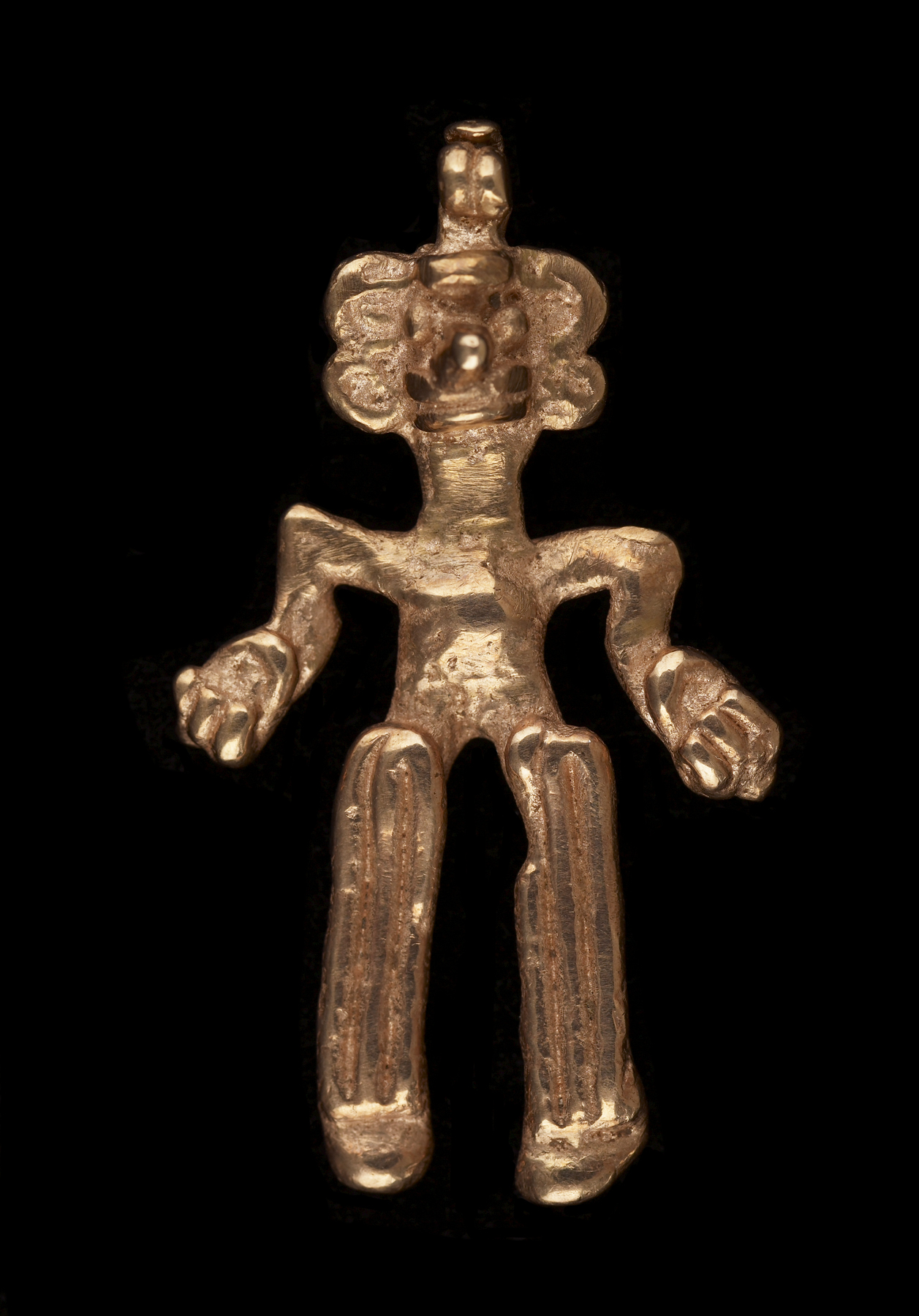
Man with Feather Headdress Pendant
(Ancient Americas )
This small pendant figure illustrates the increasing knowledge of metallurgy in the Americas. This pendant was likely produced by casting molten metal into a mold and later refining the details through a process of filing and carving. The figure portrayed stands with legs apart, arms at the sides, and palms up. The position of the arms and shoulders is unusual. The details of the face and fingers have been rendered by the artist. The eyes, nose, and mouth of the face are visible as well as three curled fingers on each hand. The ears on each side of the face have been enlarged by the presence of earspools. A feather headdress emerges from the top of the head, spiraling forward over the forehead. The legs are simpler, with fluting down the front of each leg and rounded feet. A loop has been affixed behind the neck to allow for suspension.
Indigenous craftsmen carefully shaped and polished works of gold, shell, jade and other materials, enhancing the powerful forces that animated them. When leaders wore these ornaments, it was for more than beauty: they were able to harness powers inherent to the materials themselves, their origins in faraway places, or adhered to them through ancestral use. In Central America gold was and is an embodiment of the sun’s energy and emblematic of male fertility. Gold artifacts from “Veraguas-Gran Chiriqui” (in present-day Panama) are primarily objects of personal adornment, made of gold alloyed with other metals, chiefly copper. Such jewelry was a marker of rank; only chiefs, the elite nobility, and courageous warriors wore these objects, especially in ceremonies.
Provenance
Provenance (from the French provenir, 'to come from/forth') is the chronology of the ownership, custody, or location of a historical object. Learn more about provenance at the Walters.
[Found at a graveyard between Divalá (a village on the outskirts of settled Panama, thirty miles west of David in the province of Chiriqui) and Costa Rica, Spring 1909]; purchased [1] by Tiffany & Co. New York, 1910; purchased by Henry Walters, Baltimore, 1911; by bequest to Walters Art Museum, 1931.
[1] from "Indians," see December 29, 1910 correspondance from Tiffany & Co. to Henry Walters
Exhibitions
| 2015 | Gold of the Ancient Americas. The Walters Art Museum, Baltimore. |
Geographies
Panama (Place of Origin)
Measurements
H: 1 1/2 in. (3.8 cm)
Credit Line
Acquired by Henry Walters, 1911
Location in Museum
Not on view
Accession Number
In libraries, galleries, museums, and archives, an accession number is a unique identifier assigned to each object in the collection.
In libraries, galleries, museums, and archives, an accession number is a unique identifier assigned to each object in the collection.
57.283