
 Creative Commons License

Alexander the Great
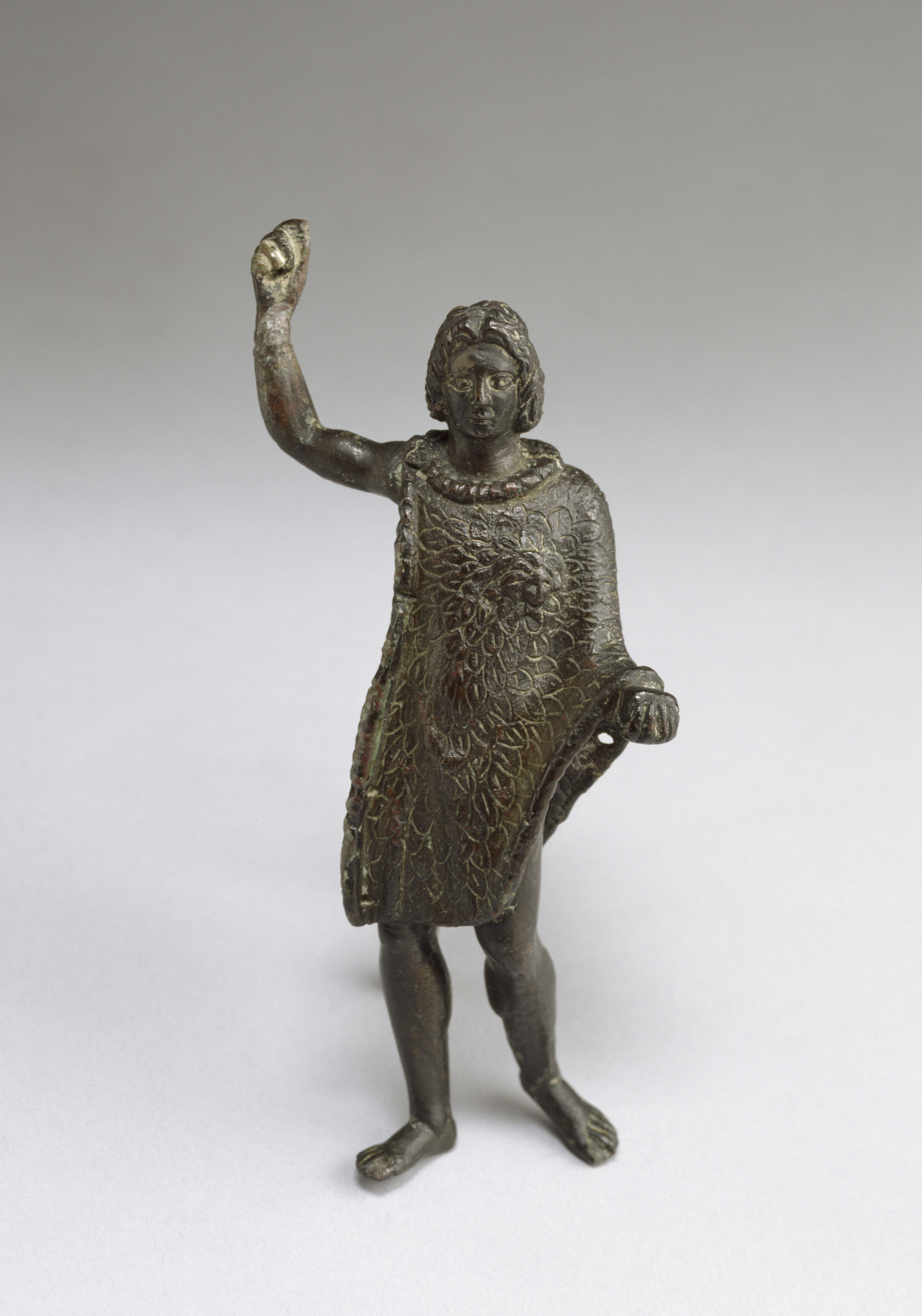
Said to be from Alexandria, the city in Egypt founded by Alexander in 331 BCE, this small bronze statuette depicts the youthful Alexander with long, full hair. His hair, with the characteristic "anastole," and the shape of his face have led scholars to posit that this portrait derives from a Lysippan original, created during Alexander's lifetime. Alexander stands in "contrapposto" with the weight on his right leg. His right arm is raised, and he probably held a spear or lance in this hand. This statuette is of particular interest for the garment worn by Alexander. He wears an aegis shaped as a loosely draped "chlamys," a type of cloak often worn by Macedonian soldiers. The aegis is embellished with incised scales and a Gorgoneion at Alexander's left breast, which is typical for this statue type. Alongside the edge of the aegis are a number of holes, where small snakes might have been attached.
This statue type has been linked with the Alexander "Aigiochos" ("Alexander wearing the aegis") mentioned in literary sources (see Steward 1993, 243-52; Parlasca 2004; Reinsberg 2005, 226-29). Parallels indicate that Alexander might have held the Palladion, an archaistic statue type of Athena seized by Diomedes and Odysseus from Troy in his outstretched right hand. The aegis links Alexander to Zeus and Athena, but also to the city of Alexandria, which ancient authors said was laid out in the shape of a chlamys. Like Athena for Athens, he is represented as patron and founder of Alexandria and the aegis associates him with divine power.
Provenance
Provenance (from the French provenir, 'to come from/forth') is the chronology of the ownership, custody, or location of a historical object. Learn more about provenance at the Walters.
Dikran Kelekian, New York and Paris [date and mode of acquisition unknown]; Henry Walters, Baltimore, 1922, by purchase; Walters Art Museum, 1931, by bequest.
Exhibitions
| 2025-2026 | Soulful Creatures: Animal Mummies in Ancient Egypt. The Walters Art Museum, Baltimore. |
| 2009-2011 | Heroes: Mortals and Myths in Ancient Greece. The Walters Art Museum, Baltimore; Frist Center for the Visual Arts, Nashville; San Diego Museum Of Art, San Diego; Alexander S. Onassis Public Benefit Foundation (USA), New York. |
| 2005-2006 | Ägypten Griechenland Rom: Abwehr und Berührung. Staedtische Galerie Liebieghaus, Frankfurt am Main. |
| 2002 | Serapis: The Creation of a God. The Walters Art Museum, Baltimore. |
| 1995-1996 | Hellenistic Bronze Exchange with Staatliche Museen zu Berlin Preussischer Kulturbesitz. Staatliche Museen zu Berlin Preussischer Kulturbesitz, Berlin. |
| 1988-1989 | From Alexander to Cleopatra: Greek Art of the Hellenistic Age. The Walters Art Gallery, Baltimore. |
| 1980-1983 | The Search for Alexander. National Gallery of Art, Washington; The Art Institute of Chicago, Chicago; Museum of Fine Arts, Boston, Boston; Fine Arts Museums of San Francisco, San Francisco; New Orleans Museum of Art, New Orleans; Royal Ontario Museum, Toronto. |
Conservation
| Date | Description | Narrative |
|---|---|---|
| 10/1/1948 | Treatment | repaired |
| 6/7/1957 | Treatment | cleaned |
| 9/15/1959 | Treatment | cleaned |
| 9/18/1974 | Treatment | repaired |
| 8/3/1981 | Loan Consideration | examined for loan |
| 2/17/1982 | Treatment | repaired |
| 10/20/1982 | Loan Consideration | examined for loan |
| 5/26/1988 | Treatment | cleaned; loss compensation |
| 10/31/1988 | Treatment | loss compensation |
| 3/1/2002 | Treatment | cleaned; coated |
| 4/1/2004 | Loan Consideration | examined for loan |
| 1/31/2011 | Treatment | cleaned |
Measurements
H: 4 3/4 × W: 2 9/16 × D: 1 1/4 in., 0.48 lb. (12 × 6.5 × 3.2 cm, 0.2178 kg)
Credit Line
Acquired by Henry Walters, 1922
Location in Museum
Not on view
Accession Number
In libraries, galleries, museums, and archives, an accession number is a unique identifier assigned to each object in the collection.
In libraries, galleries, museums, and archives, an accession number is a unique identifier assigned to each object in the collection.
54.1075