
 Creative Commons License
 Creative Commons License


A Florentine Lady
(18th and 19th Centuries )
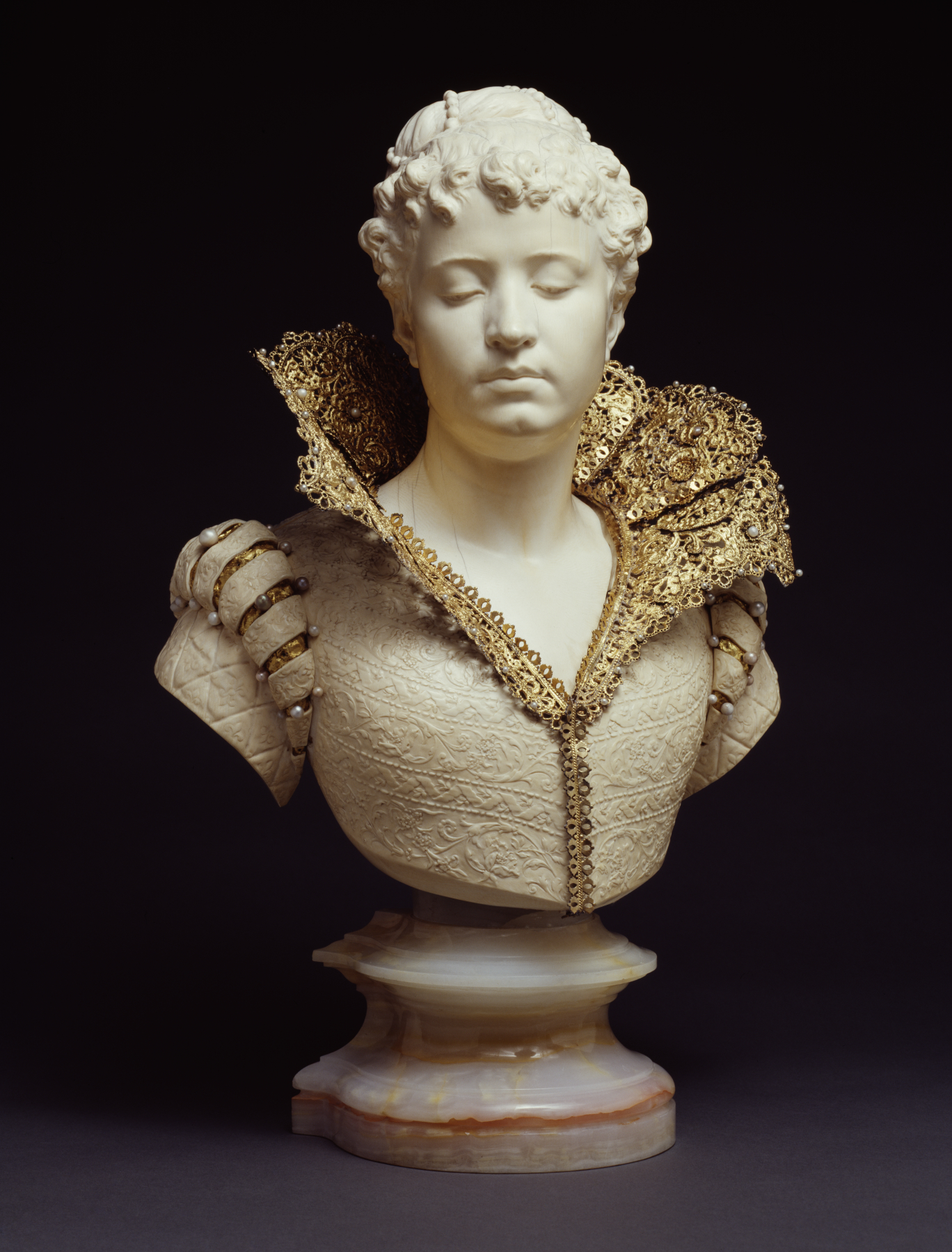
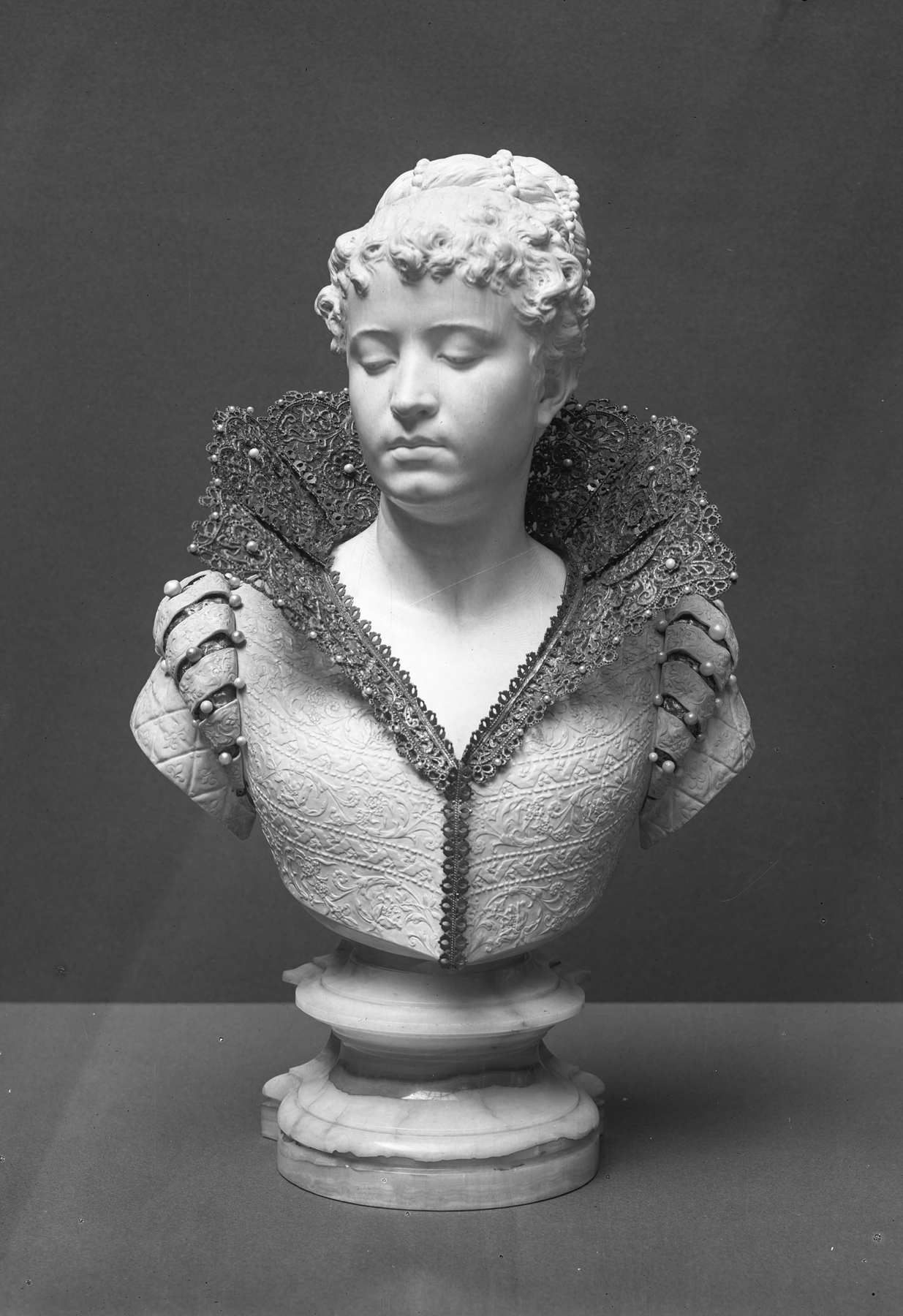
This work depicts a woman carved from ivory wearing an intricate gown, also carved ivory and partly gilded, with an elaborate lace collar made of gilded silver set with pearls. She recalls images of Marie de' Medici (1573-1642), the queen of France, as painted by the Flemish 17th-century masters Peter Paul Rubens and Frans Pourbus the Younger. Moreau-Vauthier who sculpted in bronze, marble, and terracotta, is especially known for his work in ivory and "chryselephantine," a combination of ivory and silver or gold. An eclectic sculptor, he was equally adept in a range of historical revival styles including Gothic, Renaissance, and Rococo.
Inscription
Provenance
Provenance (from the French provenir, 'to come from/forth') is the chronology of the ownership, custody, or location of a historical object. Learn more about provenance at the Walters.
With Tiffany & Co., New York, by 1898 [date and mode of acquisition unknown]; purchased by Henry Walters, Baltimore, 1898; by bequest to the Walters Art Museum, 1931.
Conservation
| Date | Description | Narrative |
|---|---|---|
| 6/10/1982 | Treatment | cleaned |
Geographies
France (Place of Origin)
Measurements
Overall H: 18 1/8 × W: 10 5/8 × D: 6 3/4 in. (46 × 27 × 17.2 cm)
Credit Line
Acquired by Henry Walters, 1898
Location in Museum
Not on view
Accession Number
In libraries, galleries, museums, and archives, an accession number is a unique identifier assigned to each object in the collection.
In libraries, galleries, museums, and archives, an accession number is a unique identifier assigned to each object in the collection.
71.446