
 Creative Commons License

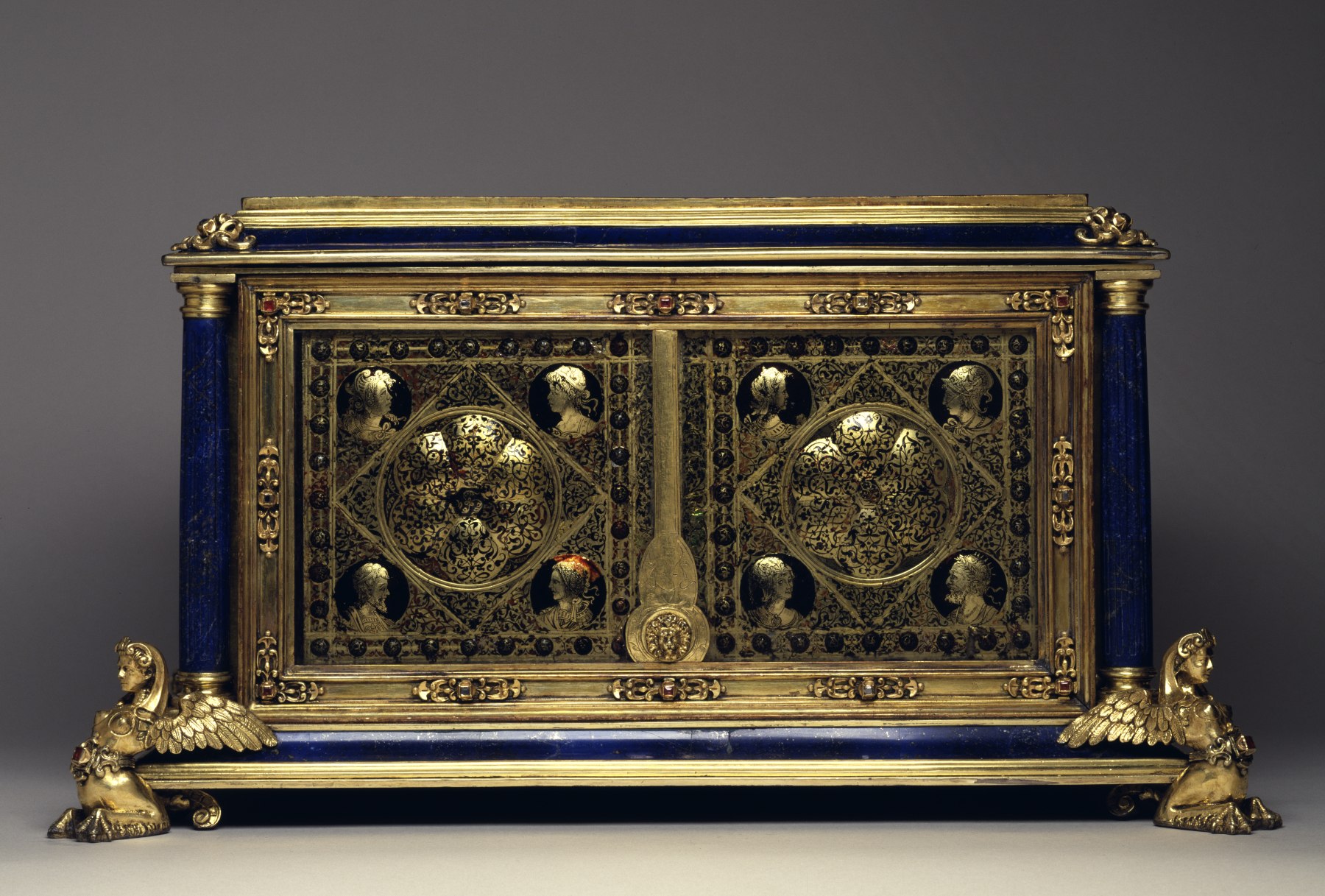
Jewel Casket with Busts of Emperors
(Renaissance Europe , 18th and 19th Centuries )
Splendid caskets were a specialty of Nuremberg goldsmiths in the late 1500s, particularly of Wenzel Jamnitzer (1507-1585) and his family. They were typically commissioned as presents for noblewomen for the safekeeping of small precious objects, but they were display pieces in and of themselves.
The decoration of the casket consists of glass plaques, gilded and painted on their reverse in the amalierung technique, which depict portrait busts of unidentified emperors from classical antiquity within an ornamental interlace scheme. The metal framing elements were largely replaced or newly constructed in the 1800s by the French goldsmith Alfred André. The feet in the shape of harpies are similar to the feet of other caskets by Jamnitzer; but drawings of caskets by André suggest that this was part of his intervention.
The first step of the amalierung technique, used to decorate the top and sides of this casket, involved the application of a layer of gold leaf onto the rock crystal. Next, the negative space of the composition would be scratched away with a stylus to create the outlines of the classical portrait busts and the filigree decoration. Then, the artist would paint the image with translucent, colored resins. This technique required the reversal of a painter’s usual practice, as highlights in the foreground needed to be added before figures and the background, requiring the artist to keep the finished image in their mind while applying each layer. Finally, a sheet of reflective silver foil was added to the back of the composition. Light is refracted through the rock crystal, passes through the translucent resins, and reflects off the backing, giving the image a luminous quality.
Provenance
Provenance (from the French provenir, 'to come from/forth') is the chronology of the ownership, custody, or location of a historical object. Learn more about provenance at the Walters.
Ferdinando Lorenzo Strozzi, Florence, [date and mode of acquisition unknown]; Piero Strozzi, Florence, 1878, by inheritance. Raoul Heilbronner, Paris, by 1909, by purchase; Henry Walters, Baltimore, 1909, by purchase; Walters Art Museum, 1931, by bequest..
Exhibitions
| 1982 | 3000 Years of Glass: Treasures from The Walters Art Gallery. The Walters Art Gallery, Baltimore. |
Geographies
France, Paris
(Place of Origin)
Germany, Nuremberg (Place of Origin)
Measurements
8 3/16 x 15 5/8 in. (20.8 x 39.7 cm)
Credit Line
Acquired by Henry Walters, 1909
Location in Museum
Accession Number
In libraries, galleries, museums, and archives, an accession number is a unique identifier assigned to each object in the collection.
In libraries, galleries, museums, and archives, an accession number is a unique identifier assigned to each object in the collection.
46.3