
 Creative Commons License

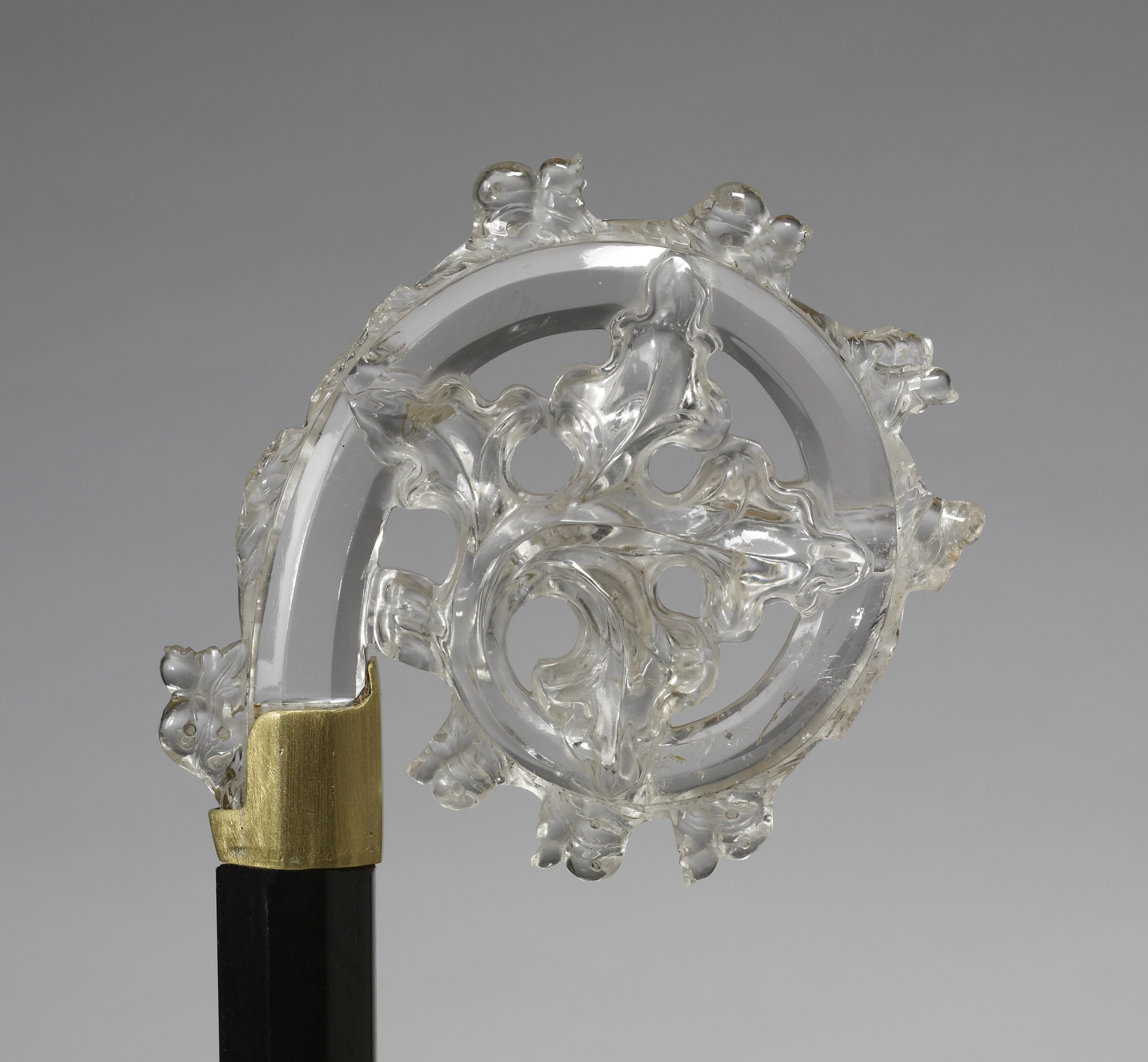
Head of a Crozier
(Medieval Europe )
This rare and beautiful crozier was carved from rock crystal, a hard stone that is very difficult to work. Due to the risk of breakage, croziers and ceremonial staves made of crystal were often fortified with metal mounts. This crozier is the only known example made entirely of rock crystal. The skill of the carver can be seen in the smooth swirl of acanthus tendrils and the series of small hooks, called crockets, lining the outer edge.
According to Pliny’s Natural History, which was read and copied throughout the Middle Ages, rock crystal was seen as a permanently solidified form of water. Medieval commentators associated this material with spiritual purification through the water of baptism. An abbess may have used this crystal crozier as a sign of her purity.
Medieval rock crystal carvers in Europe adapted methods of carving and faceting rock crystal developed in the Islamic world. In the centuries after Fatimid royal rock crystal objects were incorporated into European church treasuries after the dispersal of the Fatimid treasury in Cairo in 1068-1069, European rock crystal carvers began to reverse-engineer the delicate process of carving crystal. By the 13th century, Paris had become an important center for the craft of crystal carving, with the formation of a guild in the city by 1259.
Provenance
Provenance (from the French provenir, 'to come from/forth') is the chronology of the ownership, custody, or location of a historical object. Learn more about provenance at the Walters.
Dikran Kelekian, Paris and New York, [date and mode of acquisition unknown] [said to be from a collection in Reims]; Henry Walters, Baltimore, 1913 (?) or 1923 (?), by purchase; Walters Art Museum, 1931, by bequest.
Exhibitions
| 1999-2000 | Vive la France! French Treasures from the Middle Ages to Monet. The Walters Art Gallery, Baltimore. |
| 1966-1967 | Treasures from Medieval France. The Cleveland Museum of Art, Cleveland. |
| 1967 | An Exhibition of the Treasures of The Walters Art Gallery. The Walters Art Museum, Baltimore; Smith College Museum of Art, Northampton; Pace Wildenstein Gallery, New York. |
Geographies
France, Paris (Place of Origin)
Measurements
4 11/16 x 5 7/16 x 1 7/16 in. (12 x 13.8 x 3.6 cm)
Credit Line
Acquired by Henry Walters
Location in Museum
Accession Number
In libraries, galleries, museums, and archives, an accession number is a unique identifier assigned to each object in the collection.
In libraries, galleries, museums, and archives, an accession number is a unique identifier assigned to each object in the collection.
41.62